We read your photo as:

An X-ray tube operating at a P.D. of 50 kV has a tube current 20 mA. Calculate the electric input and the number of electrons hitting the target per second.

Physics

ScanSolve AI Answer

Answers

3 parts
b(i)

1000 W\text{1000 W}

b(ii)

1.25×10¹⁷ electrons/second1.25 \times 10^{17} \text{ electrons/second}

b(iii)

1.33×10⁸ m/s1.33 \times 10^8 \text{ m/s}

Step-by-step solution

4 steps

here are the solutions to the remaining parts of your question:

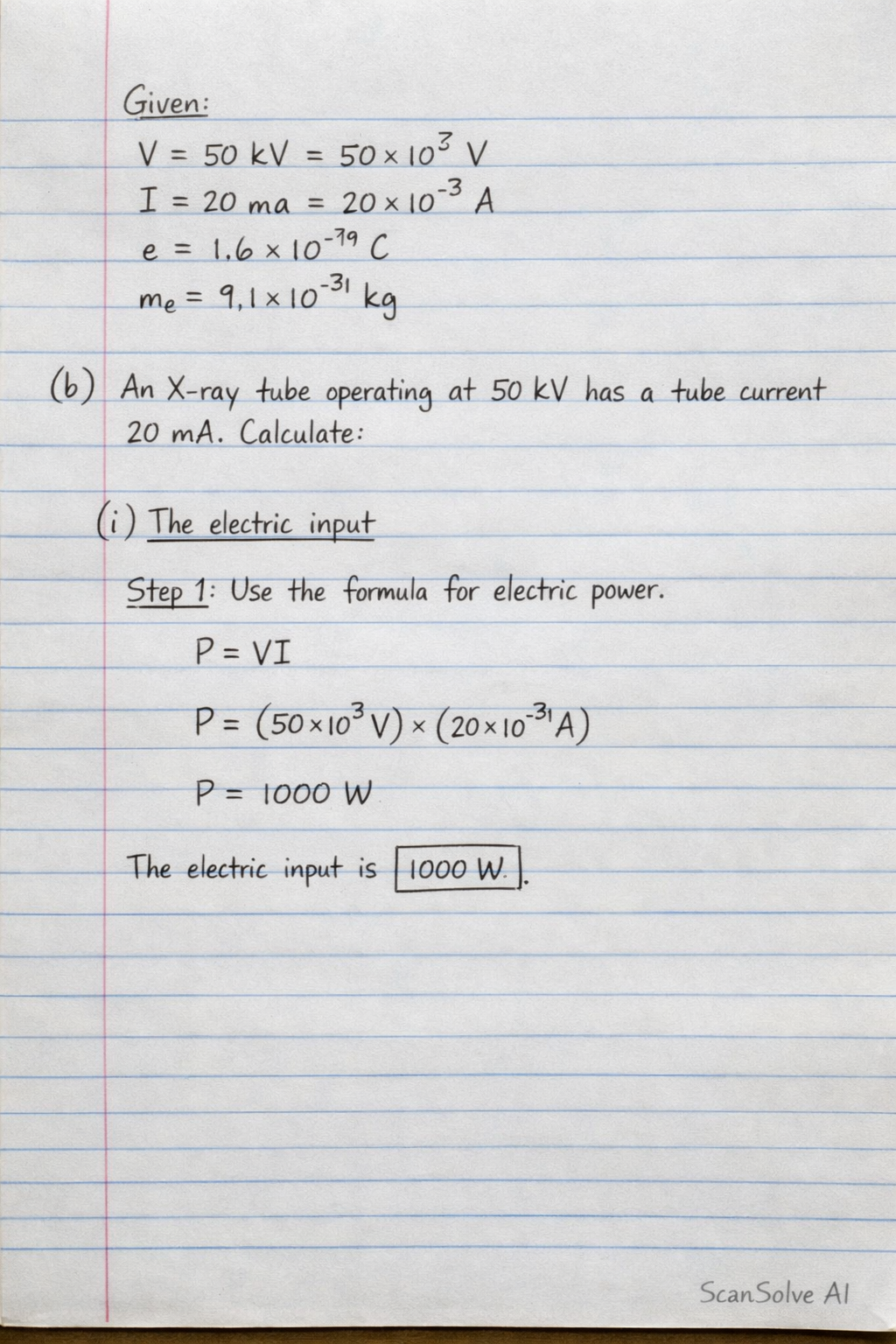
Given:
Potential difference, V=50 kV=50×103 VV = 50 \text{ kV} = 50 \times 10^3 \text{ V}
Current, I=20 mA=20×10−3 AI = 20 \text{ mA} = 20 \times 10^{-3} \text{ A}
Charge of an electron, e=1.6×10⁻¹⁹ Ce = 1.6 \times 10^{-19} \text{ C}
Mass of electron, me=9.1×10⁻³¹ kgm_e = 9.1 \times 10^{-31} \text{ kg}

Part b(i)· 1 step

The electric input

An X-ray tube operating at a P.D. of 50 kV50 \text{ kV} has a tube current 20 mA20 \text{ mA}. Calculate

  1. Use the formula for electric power.

    P=VIP = VI P=(50×103 V)×(20×10−3 A)P = (50 \times 10^3 \text{ V}) \times (20 \times 10^{-3} \text{ A}) P=1000 WP = 1000 \text{ W}

    The electric input is 1000 W\boxed{\text{1000 W}}.

Part b(ii)

1.25×10¹⁷ electrons/second1.25 \times 10^{17} \text{ electrons/second}

The number of electrons hitting the target per second given that e=1.6×10⁻¹⁹ Ce = 1.6 \times 10^{-19} \text{ C}

  1. Use the relationship between current, charge, and number of electrons.

    I=Qt=netI = \frac{Q}{t} = \frac{ne}{t}

    Where nn is the number of electrons and tt is time. We need to find nt\frac{n}{t}.

    nt=Ie\frac{n}{t} = \frac{I}{e} nt=20×10−3 A1.6×10−19 C\frac{n}{t} = \frac{20 \times 10^{-3} \text{ A}}{1.6 \times 10^{-19} \text{ C}} nt=1.25×10¹⁷ electrons/second\frac{n}{t} = 1.25 \times 10^{17} \text{ electrons/second}

    The number of electrons hitting the target per second is 1.25×10¹⁷ electrons/second\boxed{1.25 \times 10^{17} \text{ electrons/second}}.

Part b(iii)

1.33×10⁸ m/s1.33 \times 10^8 \text{ m/s}

The velocity of electrons when they hit the target.

  1. The kinetic energy gained by an electron accelerated through a potential difference VV is equal to the work done on it.

    KE=eVKE = eV KE=(1.6×10⁻¹⁹ C)×(50×103 V)KE = (1.6 \times 10^{-19} \text{ C}) \times (50 \times 10^3 \text{ V}) KE=8.0×10⁻¹⁵ JKE = 8.0 \times 10^{-15} \text{ J}
  2. Use the kinetic energy formula to find the velocity.

    KE=12mev2KE = \frac{1}{2} m_e v^2 v=2×KEmev = \sqrt{\frac{2 \times KE}{m_e}} v=2×(8.0×10−15 J)9.1×10⁻³¹ kgv = \sqrt{\frac{2 \times (8.0 \times 10^{-15} \text{ J})}{9.1 \times 10^{-31} \text{ kg}}} v=1.75824×10¹⁶v = \sqrt{1.75824 \times 10^{16}} v≈1.326×10⁸ m/sv \approx 1.326 \times 10^8 \text{ m/s}

    The velocity of electrons when they hit the target is 1.33×10⁸ m/s\boxed{1.33 \times 10^8 \text{ m/s}}.

Was this helpful?

Try one yourself

A new problem that tests the same skill.

Still stuck on this one?

Ask a follow-up, and the answer starts from this question.

Got a different question?Ask your own question
Handwritten step-by-step solution preview

Handwritten Step-by-Step Solution

Get this as a handwritten image on WhatsApp — like a tutor wrote it for you.

Try on WhatsApp