
We read your photo as:
Analyze the difference between uniform and non-uniform motion using real-life examples, and explain how you can identify each type of motion through observation or measurement.
ScanSolve AI Answer
Step-by-step solution
3 stepshere are the solutions to the questions:
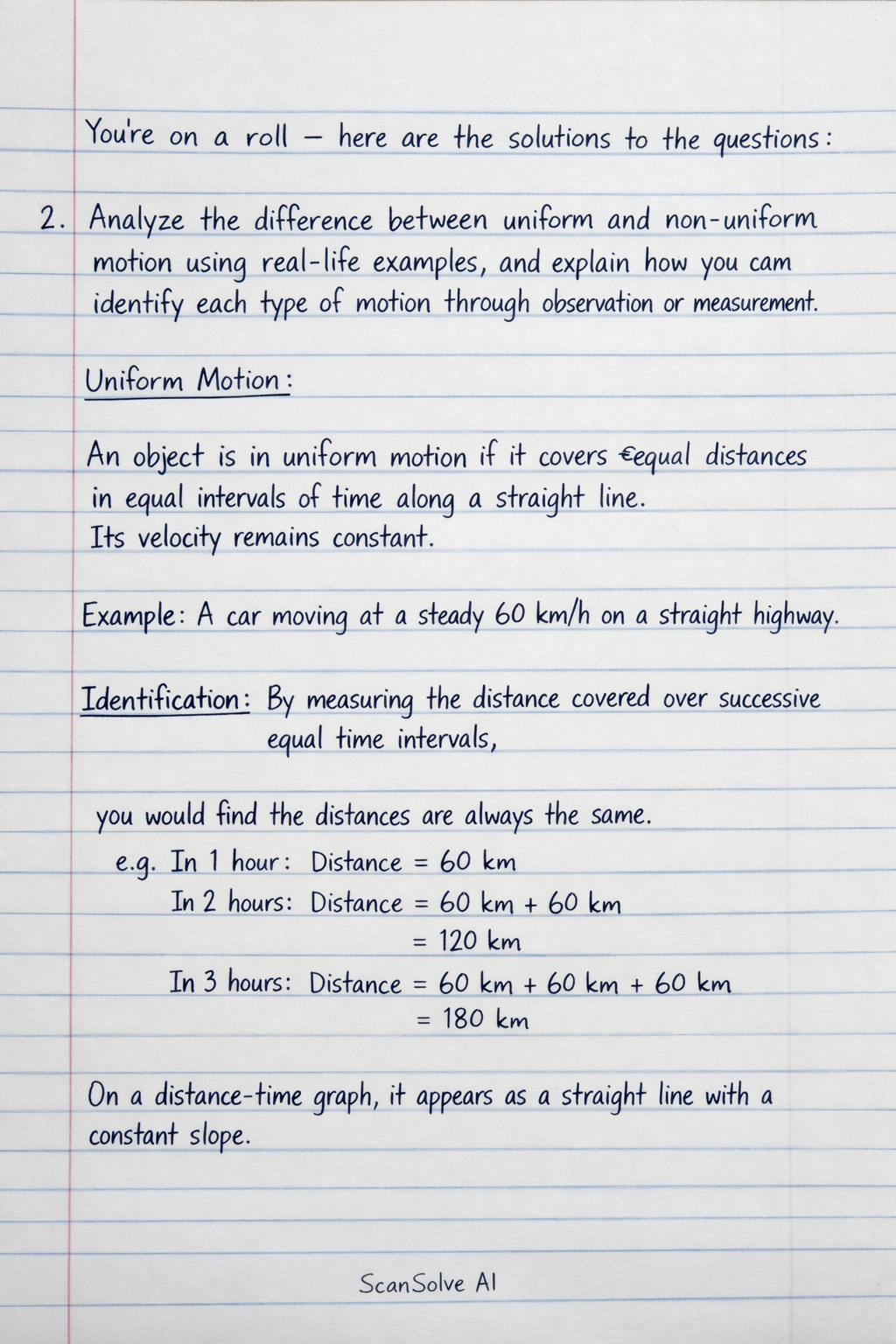
2. Analyze the difference between uniform and non-uniform motion using real-life examples, and explain how you can identify each type of motion through observation or measurement.
-
Uniform Motion: An object is in uniform motion if it covers equal distances in equal intervals of time along a straight line. Its velocity remains constant.
- Example: A car moving at a steady on a straight highway.
- Identification: By measuring the distance covered over successive equal time intervals, you would find the distances are always the same. On a distance-time graph, it appears as a straight line with a constant slope.
-
Non-uniform Motion: An object is in non-uniform motion if it covers unequal distances in equal intervals of time, or if its direction of motion changes. Its velocity is not constant.
- Example: A car accelerating from a stoplight, or a ball rolling down a hill.
- Identification: By measuring the distance covered over successive equal time intervals, you would find the distances are different. On a distance-time graph, it appears as a curved line.
3. A body is accelerating at a constant rate of . If the body starts from rest, how much distance will it cover in 2 seconds?
Identify the given values.
Initial velocity (starts from rest)
Acceleration
TimeUse the second equation of motion.
Substitute the values and calculate the distance ().
The distance covered is .
4. An ant moves along a circular path of radius with a constant speed. It takes to move from a point on the path to the diametrically opposite point, find:
Given:
Radius
Time
Movement is half a revolution (from A to B, diametrically opposite).a) the distance covered
The distance covered for half a revolution is half the circumference of the circle.Using :
The distance covered is .
b) the speed
Speed is the total distance covered divided by the total time taken.Using :
The speed is .
c) the displacement
Displacement is the shortest distance from the initial point to the final point. For diametrically opposite points, the displacement is equal to the diameter of the circle.The displacement is .
Long Answer Questions:
1. (a) Study the given graph and answer the following questions.
The graph is a velocity-time graph.(i) Which part of the graph shows accelerated motion?
Accelerated motion occurs when the velocity is increasing. This is represented by a positive slope on a velocity-time graph.
The part of the graph showing accelerated motion is .(ii) Which part of the graph shows retarded motion?
Retarded motion (deceleration) occurs when the velocity is decreasing. This is represented by a negative slope on a velocity-time graph.
The part of the graph showing retarded motion is .(iii) Calculate the distance travelled by the body in first 4 seconds of journey graphically.
The distance travelled is the area under the velocity-time graph. For the first 4 seconds, this is the area of the trapezoid formed by points A(0,0), B(2,4), C'(4,4) and the point (4,0) on the time axis.
Area = Area of triangle from to + Area of rectangle from to .
Area of triangle (0,0) to (2,4) to (2,0):Area of rectangle from (2,4) to (4,4) to (4,0) to (2,0):
Total distance travelled = .
The distance travelled in the first 4 seconds is .(b) Write any 2 point of difference between Speed and Velocity.
- Definition: Speed is the rate at which an object covers distance (distance per unit time), while velocity is the rate at which an object changes its position (displacement per unit time).
- Nature: Speed is a scalar quantity (only has magnitude), while velocity is a vector quantity (has both magnitude and direction).
- Value: Speed is always positive or zero, whereas velocity can be positive, negative, or zero depending on the direction of motion.
2. (a) Draw the distance-time graph for the following situations:
(I will describe the graphs as I cannot draw them directly.)(i) When a body is stationary.
The graph would be a horizontal straight line parallel to the time axis. This indicates that the distance from the origin does not change over time.(ii) When a body is moving with a uniform speed.
The graph would be a straight line with a positive constant slope. This indicates that the distance increases linearly with time.(iii) When a body is moving with non-uniform speed.
The graph would be a curved line. This indicates that the rate of change of distance (speed) is not constant. The curve could be bending upwards (increasing speed) or downwards (decreasing speed).(b) An auto is moving along a circular path of radius r. What will be the distance and displacement of the body when it completes half revolution?
-
Distance: When the auto completes half a revolution, it travels along half the circumference of the circular path.
The distance is .
-
Displacement: When the auto completes half a revolution, it moves from one point on the circle to the diametrically opposite point. The shortest distance between these two points is the diameter of the circle.
The displacement is .
Still stuck on this one?
Ask a follow-up, and the answer starts from this question.
More Physics Questions
Handwritten Step-by-Step Solution
Get this as a handwritten image on WhatsApp — like a tutor wrote it for you.
Try on WhatsApp