
We read your photo as:
And also calculate the total change in the 150 microfarad capacitor
ScanSolve AI Answer
Answer
Step-by-step solution
3 stepsThis problem involves two phases of a circuit with capacitors.
Analyze the circuit when Z is connected to X.
When the switch Z is closed at point X, the capacitor (let's call it ) is connected in series with the resistor and the battery. The capacitor () is not part of this circuit.
The problem states that is fully charged. When a capacitor is fully charged in a DC circuit, the voltage across it equals the source voltage, and no current flows through the resistor.
The initial charge on is .The capacitor () is initially uncharged, so its initial charge is .
Analyze the circuit when Z is moved to Y.
When Z is moved to Y, the capacitor () is now connected in parallel with the capacitor (). The battery and resistor are no longer part of this closed loop.
Since the capacitors are connected in parallel, they will share the total charge until they reach a common voltage. The total charge in this isolated system is conserved.
Total initial charge .The equivalent capacitance of and in parallel is .
The final common voltage across both capacitors, , can be found using .
Calculate the total change in the 150 microfarad capacitor.
The question asks for the total change in the capacitor, which refers to the change in its charge.
The final charge on () is .The change in charge on is .
The total change in the capacitor is .
Try one yourself
A new problem that tests the same skill.
Still stuck on this one?
Ask a follow-up, and the answer starts from this question.
More Physics Questions
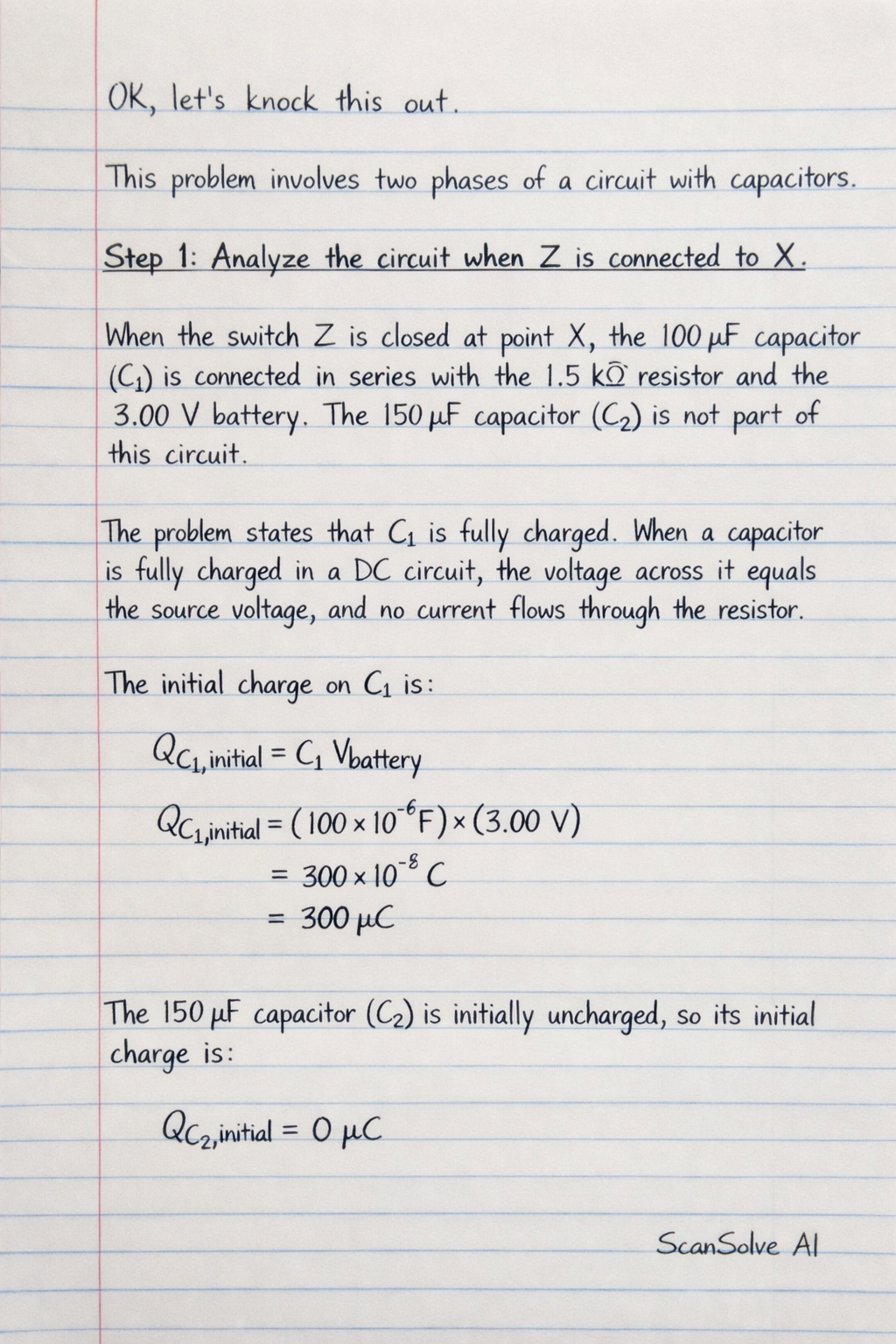
Handwritten Step-by-Step Solution
Get this as a handwritten image on WhatsApp — like a tutor wrote it for you.
Try on WhatsApp