
We read your photo as:
Archimedes' principle states that upthrust equals the weight of which of the following? Also, what happens to the viscosity of liquids as temperature increases?
ScanSolve AI Answer
Answer
Step-by-step solution
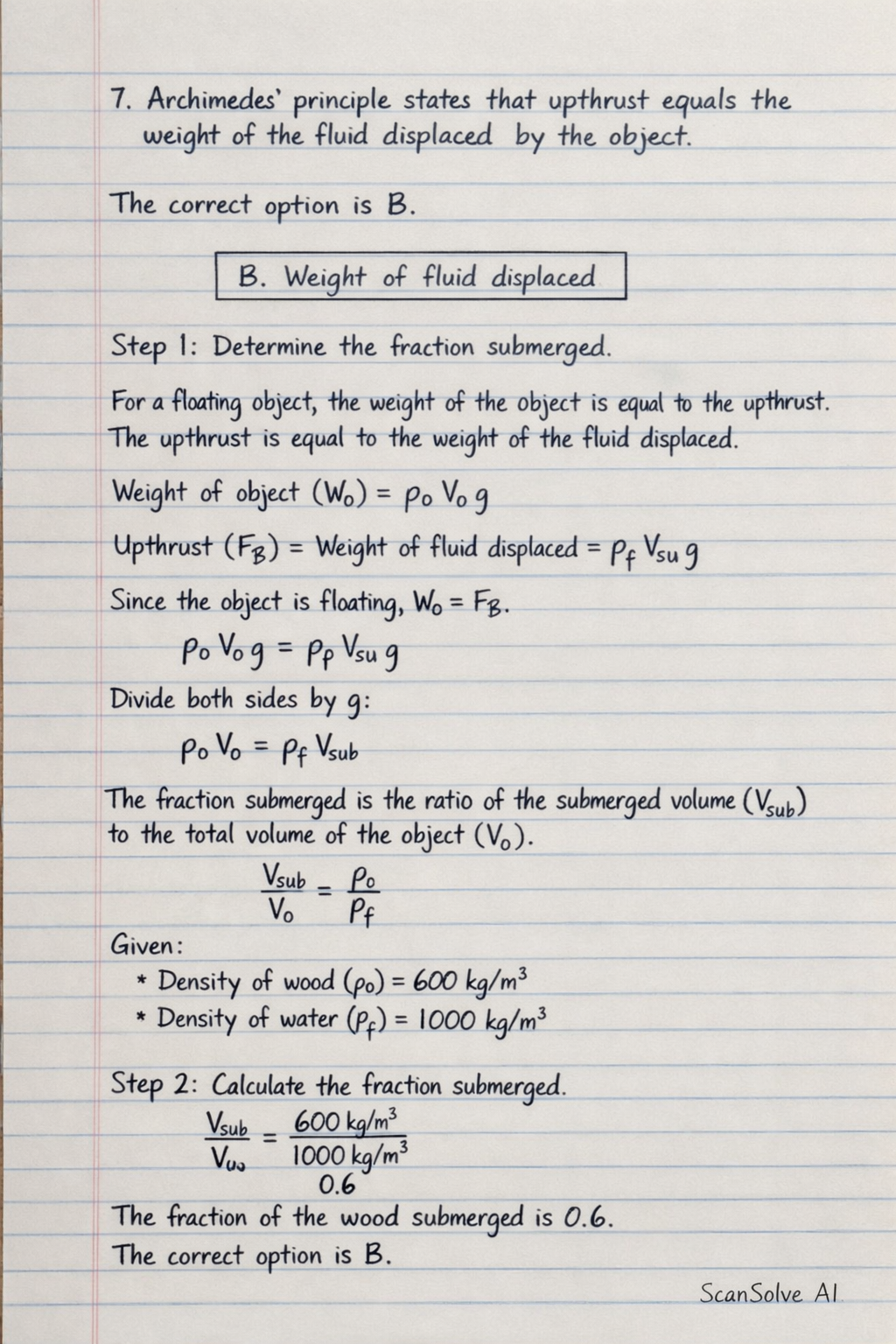
4 steps- Archimedes' principle states that upthrust equals the weight of the fluid displaced by the object.
The correct option is B.
Determine the fraction submerged.
For a floating object, the weight of the object is equal to the upthrust. The upthrust is equal to the weight of the fluid displaced.
Weight of object () =
Upthrust () = Weight of fluid displaced =
Since the object is floating, .Divide both sides by :
The fraction submerged is the ratio of the submerged volume () to the total volume of the object ().
Given:
- Density of wood () =
- Density of water () =
Calculate the fraction submerged.
The fraction of the wood submerged is 0.6.
The correct option is B.
As temperature increases, the viscosity of most liquids decreases. This is because the increased kinetic energy of the molecules allows them to overcome intermolecular forces more easily, reducing resistance to flow.
The correct option is B.
The stretched elastic skin behavior of liquids is called surface tension. This phenomenon arises from the cohesive forces between liquid molecules, which cause the surface to behave like a stretched elastic membrane.
The correct option is C.
Convert the pressure from mmHg to Pascals.
Standard atmospheric pressure is , which is equivalent to .
The conversion factor for to Pascals is approximately .Given:
- Pressure =
State the approximate pressure in Pascals.
Since is exactly , its approximate value in Pascals is .
The correct option is A.
Try one yourself
A new problem that tests the same skill.
Still stuck on this one?
Ask a follow-up, and the answer starts from this question.
More Physics Questions
Handwritten Step-by-Step Solution
Get this as a handwritten image on WhatsApp — like a tutor wrote it for you.
Try on WhatsApp