
We read your photo as:
Viscosity of a liquid does not depend on the A. Nature of liquid. B. Relative velocity between the liquid layers. C. Area of the surface in contact D. Temperature of the liquid. E. Normal reaction between the liquid layers.
ScanSolve AI Answer
Answer
The question asks what the viscosity of a liquid does not depend on. Viscosity is an intrinsic property of a fluid that measures its resistance to flow.
Let's analyze each option:
- A. Nature of liquid: The viscosity of a liquid fundamentally depends on its molecular structure and intermolecular forces. Different liquids (e.g., water, honey, oil) have different viscosities. So, viscosity does depend on the nature of the liquid.
- B. Relative velocity between the liquid layers: For Newtonian fluids (which are typically assumed in general physics unless stated otherwise), the coefficient of viscosity is independent of the shear rate (velocity gradient), which is related to the relative velocity between layers. The viscous force depends on the relative velocity, but the viscosity coefficient itself does not.
- C. Area of the surface in contact: The coefficient of viscosity is an intensive property of the liquid and does not depend on the area of contact between the layers. While the viscous force is proportional to the area of contact, the viscosity itself is independent of it.
- D. Temperature of the liquid: Viscosity is highly dependent on temperature. For most liquids, viscosity decreases as temperature increases. So, viscosity does depend on the temperature of the liquid.
- E. Normal reaction between the liquid layers: Normal reaction is a force perpendicular to the layers. Viscosity is related to shear forces (parallel to the layers). While pressure (normal force per unit area) can have a minor effect on viscosity, the normal reaction force itself is not a direct determinant of the intrinsic viscosity.
Both options B and C describe factors that the coefficient of viscosity does not depend on, while they do affect the viscous force. However, the area of the surface in contact (C) is a purely geometric factor, and intensive properties like viscosity are always independent of the extent or geometry of the system. For non-Newtonian fluids, viscosity can depend on the relative velocity (shear rate), making option B less universally true than C. Therefore, C is the most unequivocally correct answer.
The final answer is
Try one yourself
A new problem that tests the same skill.
Still stuck on this one?
Ask a follow-up, and the answer starts from this question.
More Physics Questions
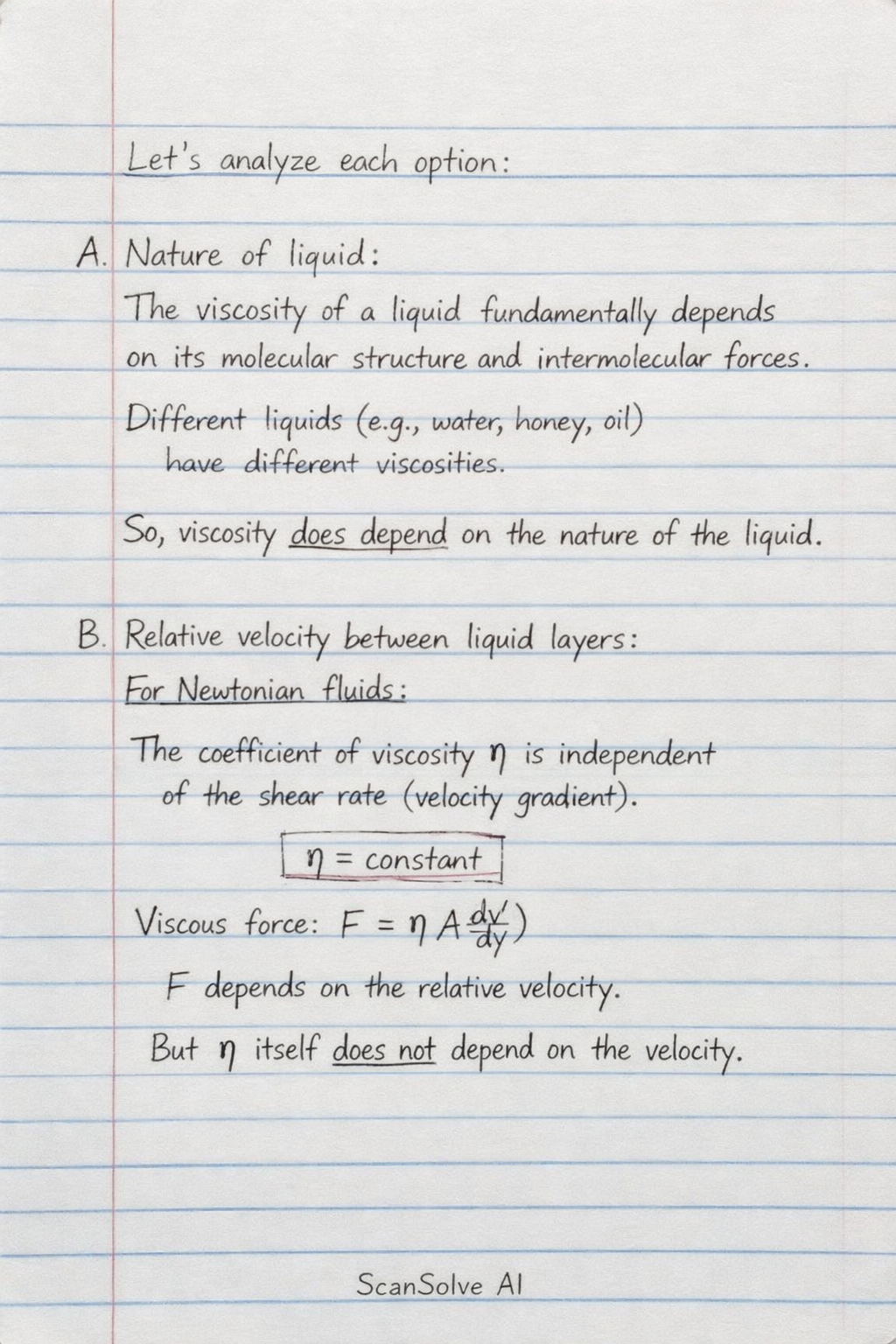
Handwritten Step-by-Step Solution
Get this as a handwritten image on WhatsApp — like a tutor wrote it for you.
Try on WhatsApp