
We read your photo as:
Calculate the bearing loads on A and B.
ScanSolve AI Answer
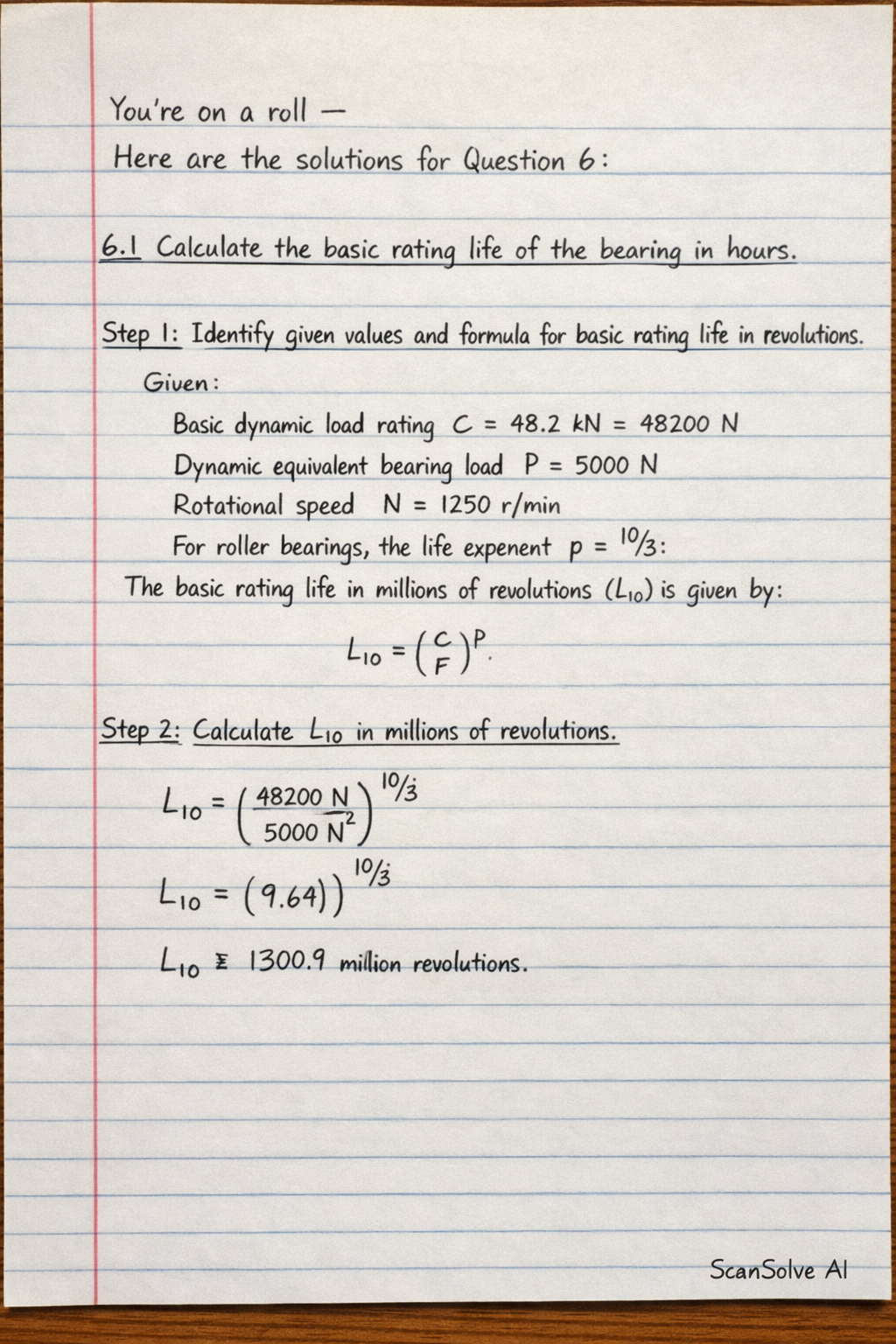
6.1 Calculate the basic rating life of the bearing in hours.
-
Step 1: Identify given values and formula for basic rating life in revolutions. Given: Basic dynamic load rating Dynamic equivalent bearing load Rotational speed For roller bearings, the life exponent . The basic rating life in millions of revolutions () is given by:
-
Step 2: Calculate in millions of revolutions.
-
Step 3: Convert to hours. The life in hours () is given by:
The basic rating life of the bearing is .
6.2.1 Neatly sketch and show all dimensions and forces.
A sketch of the shaft would show:
- A horizontal line representing the 600 mm long shaft.
- Two upward arrows at each end of the shaft, representing the reaction forces from the two identical bearings.
- A downward arrow at the midpoint of the shaft, representing the 20 kN radial load.
- Horizontal arrows at each bearing, representing the 5 kN axial load (e.g., pushing into the bearing).
6.2.2 Calculate the dynamic equivalent load.
-
Step 1: Determine the radial and axial loads on each bearing. The total radial load on the shaft is . Since it's in the middle and supported by two identical bearings, each bearing supports half of this radial load.
The axial load on each bearing is given as .
Given radial load factor and axial load factor .
-
Step 2: Calculate the dynamic equivalent load (). The dynamic equivalent load is given by the formula:
The dynamic equivalent load is .
6.3 Calculate the bearing loads on A and B.
Let the left bearing be A and the right bearing be B.
Given:
Shaft load (acting downwards at the sheave)
Dimension (distance between bearing A and bearing B)
Dimension (distance from bearing B to the shaft load)
-
Step 1: Calculate the reaction force at bearing B () by taking moments about bearing A. Assume upward reactions are positive.
-
Step 2: Calculate the reaction force at bearing A () by summing vertical forces. Assume upward forces are positive.
The negative sign indicates that the reaction force at A is actually downwards (meaning the shaft is pulling upwards on bearing A, or bearing A is pushing downwards on the shaft). The bearing load is the magnitude of this force.
-
Step 3: State the bearing loads. Load on bearing A = Load on bearing B = The bearing load on A is and on B is .
Still stuck on this one?
Ask a follow-up, and the answer starts from this question.
More Physics Questions
Handwritten Step-by-Step Solution
Get this as a handwritten image on WhatsApp — like a tutor wrote it for you.
Try on WhatsApp