
We read your photo as:
• Boyle's Law: For a fixed mass of gas at constant temperature, the pressure of the gas is inversely proportional to its volume. Mathematically, P (1)/(V) or PV = constant.
Physics
ScanSolve AI Answer
Step-by-step solution
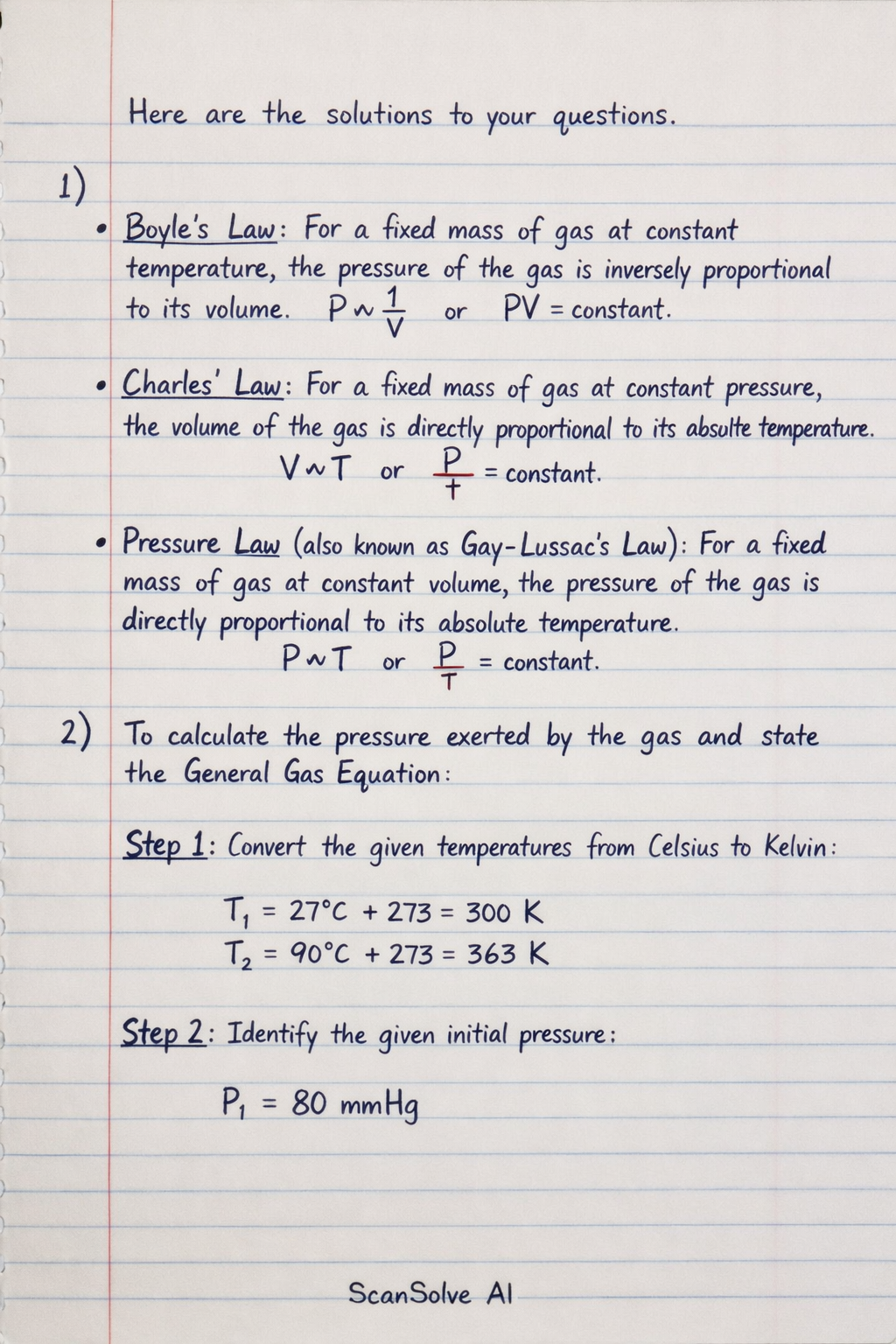
5 stepsHere are the solutions to your questions.
- Boyle's Law: For a fixed mass of gas at constant temperature, the pressure of the gas is inversely proportional to its volume. Mathematically, or .
- Charles' Law: For a fixed mass of gas at constant pressure, the volume of the gas is directly proportional to its absolute temperature. Mathematically, or .
- Pressure Law (also known as Gay-Lussac's Law): For a fixed mass of gas at constant volume, the pressure of the gas is directly proportional to its absolute temperature. Mathematically, or .
To calculate the pressure exerted by the gas and state the General Gas Equation:
Convert the given temperatures from Celsius to Kelvin.
Identify the given initial pressure.
Since the volume is maintained at constant, we use the Pressure Law (Gay-Lussac's Law), which states that .
Rearrange to solve for .
Substitute the values and calculate the final pressure.
The pressure exerted by the gas is .
State the General Gas Equation.
The General Gas Equation combines Boyle's Law, Charles' Law, and the Pressure Law. It is given by:
Was this helpful?
Still stuck on this one?
Ask a follow-up, and the answer starts from this question.
Got a different question?Ask your own question
More Physics Questions
QBoyle's Law states that for a fixed mass of gas at constant temperature, the pressure of the gas is…QState Boyle's law -- It states that at constant temperature of a fixed mass of a gas is inversely…QThis question relates to Boyle's Law, which describes the relationship between the pressure and…QThe Pressure Law (also known as Gay-Lussac's Law or Amontons's Law) states that for a fixed mass of…QDemonstrate Boyle's Law using the provided pressure and volume data for a gas.
Browse by topic:Thermodynamics
Handwritten Step-by-Step Solution
Get this as a handwritten image on WhatsApp — like a tutor wrote it for you.
Try on WhatsApp