

This physics problem tests your understanding of fundamental physical laws and their applications. The step-by-step solution below breaks down the problem using relevant equations and physical reasoning.
ScanSolve AI Answer
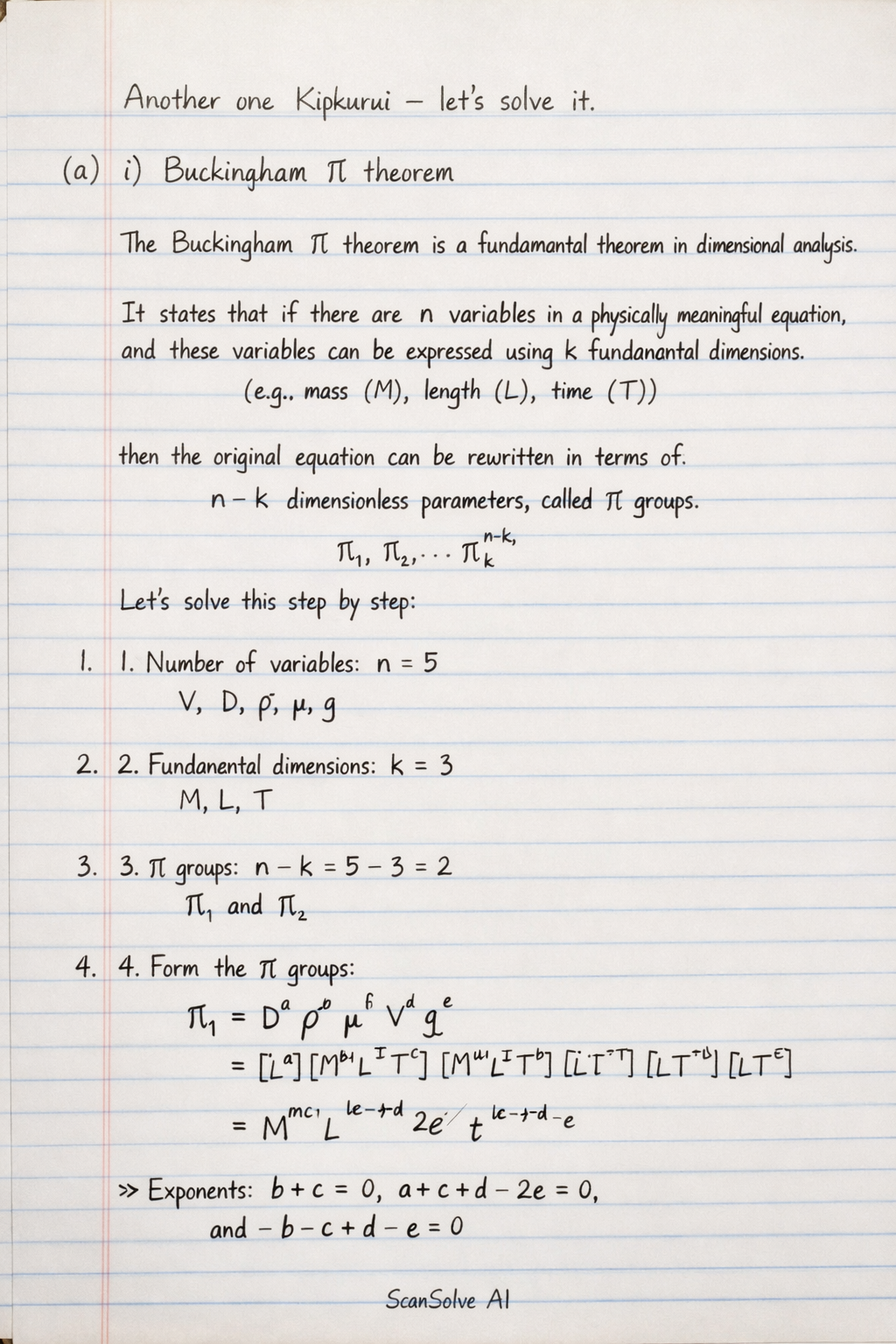
Another one Kipkurui — let's solve it. a) i) Buckingham theorem The Buckingham theorem is a fundamental theorem in dimensional analysis. It states that if there are n variables in a physically meaningful equation and these variables can be expressed using k fundamental dimensions (e.g., mass, length, time), then the original equation can be rewritten in terms of n-k dimensionless parameters, called groups. This theorem helps reduce the number of variables in complex problems and is crucial for designing experiments and scaling models. ii) Dynamic similarity Dynamic similarity is a condition in fluid mechanics where the ratios of all forces (inertial, viscous, gravitational, etc.) acting on corresponding fluid particles in two systems (a model and a prototype) are the same. This implies that the flow patterns in the model and prototype are geometrically and kinematically similar, and all relevant dimensionless numbers (like Reynolds number, Froude number, Mach number) are equal for both systems. Achieving dynamic similarity is essential for accurately predicting the behavior of a prototype based on model tests. Send me the next one 📸