
We read your photo as:
Calculate the capillary rise of water in a glass tube with a radius of 0.5 mm, given surface tension = 75 dyne/cm, density of water = 1000 kg/m³ and g = 9.8 m/s².
Physics
ScanSolve AI Answer
Answer
e
Step-by-step solution
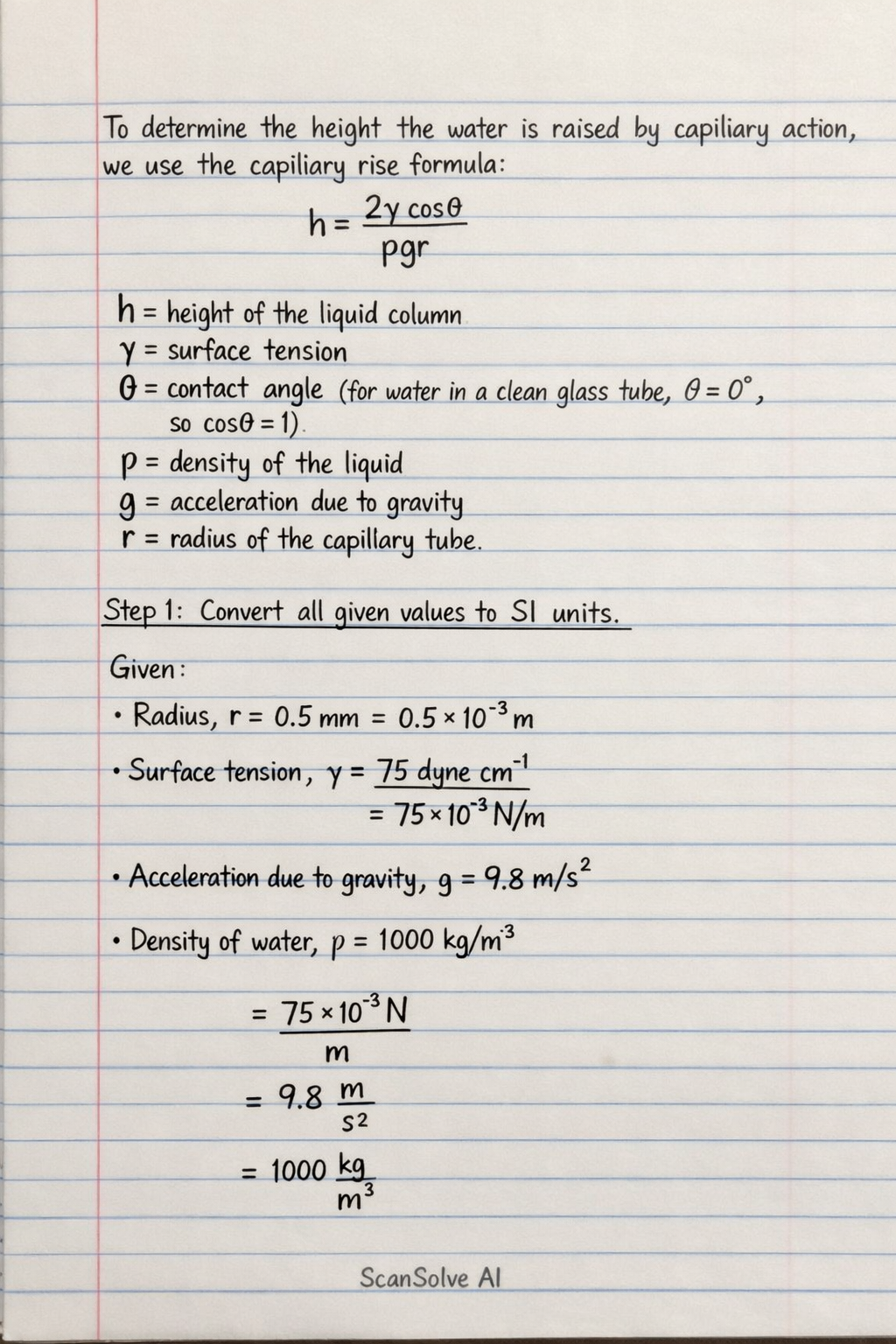
4 stepsTo determine the height the water is raised by capillary action, we use the capillary rise formula:
where:
- is the height of the liquid column
- is the surface tension
- is the contact angle (for water in a clean glass tube, , so )
- is the density of the liquid
- is the acceleration due to gravity
- is the radius of the capillary tube
Convert all given values to SI units.
Given:
- Radius,
- Surface tension,
- Acceleration due to gravity,
- Density of water,
Convert surface tension from dyne/cm to N/m:
We know that and .Substitute the values into the capillary rise formula.
Assuming the contact angle , so .
Calculate the height .
Convert the height to centimeters.
Comparing this result with the given options:
(a) 3.06 cm
(b) 6.12 cm
(c) 1.53 cm
(d) 9.42 cm
(e) None of the above
The calculated height matches option (a).
The final answer is .
Was this helpful?
Try one yourself
A new problem that tests the same skill.
Still stuck on this one?
Ask a follow-up, and the answer starts from this question.
Got a different question?Ask your own question
More Physics Questions
QCalculate the radius of a capillary tube, given the height of water rise and mercury depression, and…QCalculate the surface tension of a liquid using a capillary tube. Given radius, liquid density, and…QTo find the weight of the water raised in the capillary tube, we can use the formula for weight…QCalculate the upthrust force acting on a test tube if its weight in air is 0.4 N and its apparent…QA reservoir is filled with liquid of density 2000 kgm⁻¹. Calculate the depth at which the pressure…
Handwritten Step-by-Step Solution
Get this as a handwritten image on WhatsApp — like a tutor wrote it for you.
Try on WhatsApp