
We read your photo as:
Explain how car safety features like airbags and crumple zones reduce passenger injuries during a collision, referencing the impulse-momentum theorem and Newton's Third Law.
ScanSolve AI Answer
Answers
2 partsStep-by-step solution
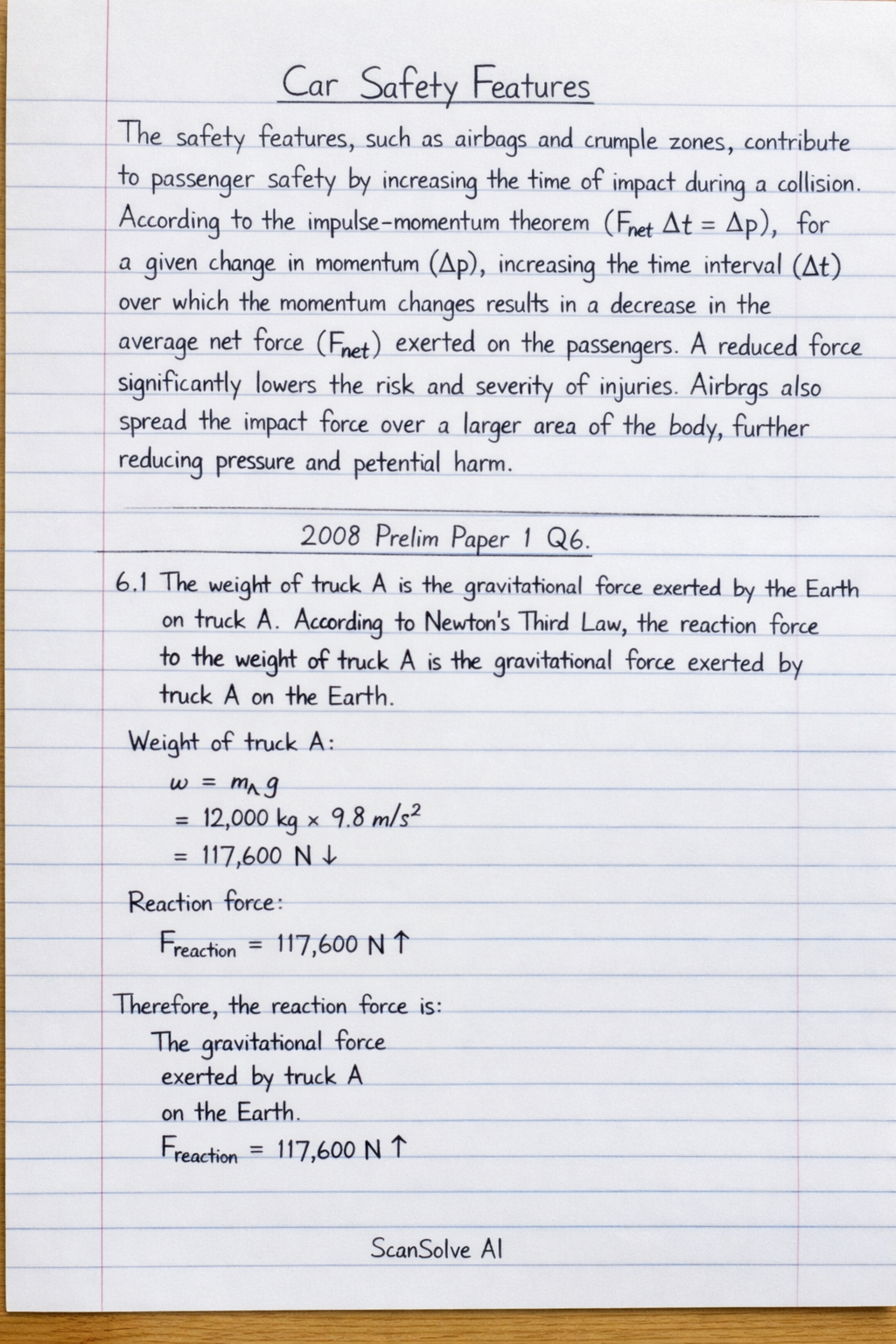
2 stepsCar Safety Features
The safety features, such as airbags and crumple zones, contribute to passenger safety by increasing the time of impact during a collision. According to the impulse-momentum theorem (), for a given change in momentum (), increasing the time interval () over which the momentum changes results in a decrease in the average net force () exerted on the passengers. A reduced force significantly lowers the risk and severity of injuries. Airbags also spread the impact force over a larger area of the body, further reducing pressure and potential harm.
2008 Prelim Paper 1 Q6
6.1 The weight of truck A is the gravitational force exerted by the Earth on truck A. According to Newton's Third Law, the reaction force to the weight of truck A is the gravitational force exerted by truck A on the Earth.
Step 1: Calculate the magnitude of the weight of truck A.
The magnitude of the reaction force is equal to the magnitude of the weight.
The direction of the reaction force (force of truck A on Earth) is opposite to the direction of the weight (force of Earth on truck A).
The magnitude and direction of the 'reaction force' to the weight of truck A is
Part 6.2· 1 step
Step 1: Identify the given values and define a positive direction.
Let west be the positive direction.
Mass of truck A
Initial velocity of truck A
Mass of truck B
Initial velocity of truck B
After the collision, the trucks combine and move with a common final velocity .
Apply the principle of conservation of linear momentum.
The velocity of truck B after the collision is
Part 6.3
Step 1: Identify the given values for truck B and the collision time.
Mass of truck B
Initial velocity of truck B
Final velocity of truck B (using the unrounded value )
Time of collision
Force exerted by truck A on truck B
Apply the impulse-momentum theorem to truck B.
The magnitude of the force that truck A exerts on truck B is
6.4 Bubble plastic is preferred because it increases the time of impact () during a collision. According to the impulse-momentum theorem (), for a given change in momentum (), a longer impact time () results in a smaller average force () exerted on the electronic equipment. This reduced force minimizes damage to the equipment.
Try one yourself
A new problem that tests the same skill.
Still stuck on this one?
Ask a follow-up, and the answer starts from this question.
More Physics Questions
Handwritten Step-by-Step Solution
Get this as a handwritten image on WhatsApp — like a tutor wrote it for you.
Try on WhatsApp