
We read your photo as:
Explain the difference between elastic and inelastic collisions. State Newton's second law of motion and apply it to calculate pressure in a hydraulic system.
ScanSolve AI Answer
Answer
Step-by-step solution
3 stepsPart ii
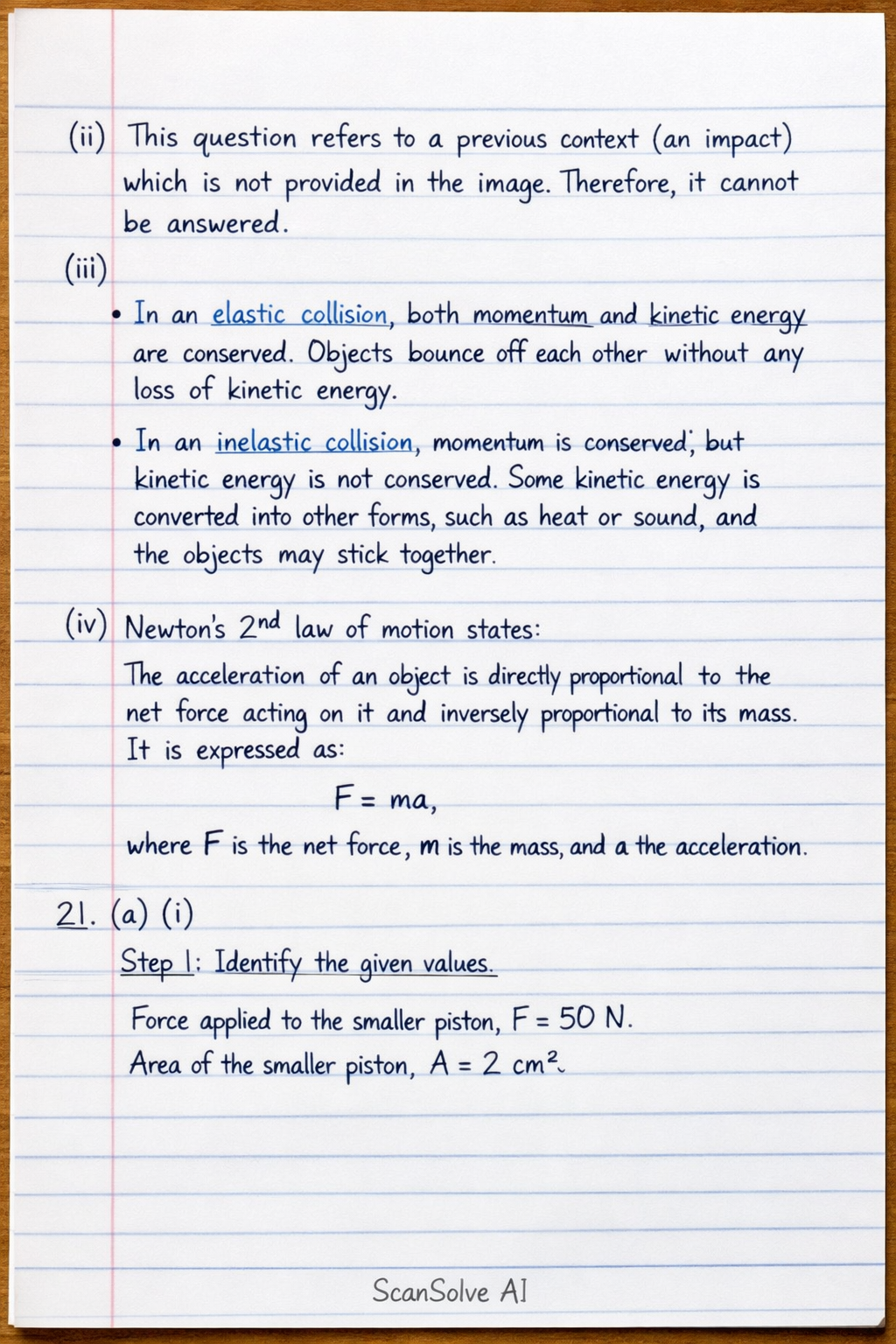
This question refers to a previous context (an impact) which is not provided in the image. Therefore, it cannot be answered.
Part iii
- In an elastic collision, both momentum and kinetic energy are conserved. Objects bounce off each other without any loss of kinetic energy.
- In an inelastic collision, momentum is conserved, but kinetic energy is not conserved. Some kinetic energy is converted into other forms of energy, such as heat or sound, and the objects may stick together.
(iv) Newton's 2nd law of motion states that the acceleration of an object is directly proportional to the net force acting on it and inversely proportional to its mass. It is expressed as , where is the net force, is the mass, and is the acceleration.
- (a) (i)
Identify the given values.
Force applied to the smaller piston, .
Area of the smaller piston, .Convert the area to square meters.
Calculate the pressure produced in the oil at X using the formula .
The pressure produced in the oil at X is .
Try one yourself
A new problem that tests the same skill.
Still stuck on this one?
Ask a follow-up, and the answer starts from this question.
More Physics Questions
Handwritten Step-by-Step Solution
Get this as a handwritten image on WhatsApp — like a tutor wrote it for you.
Try on WhatsApp