
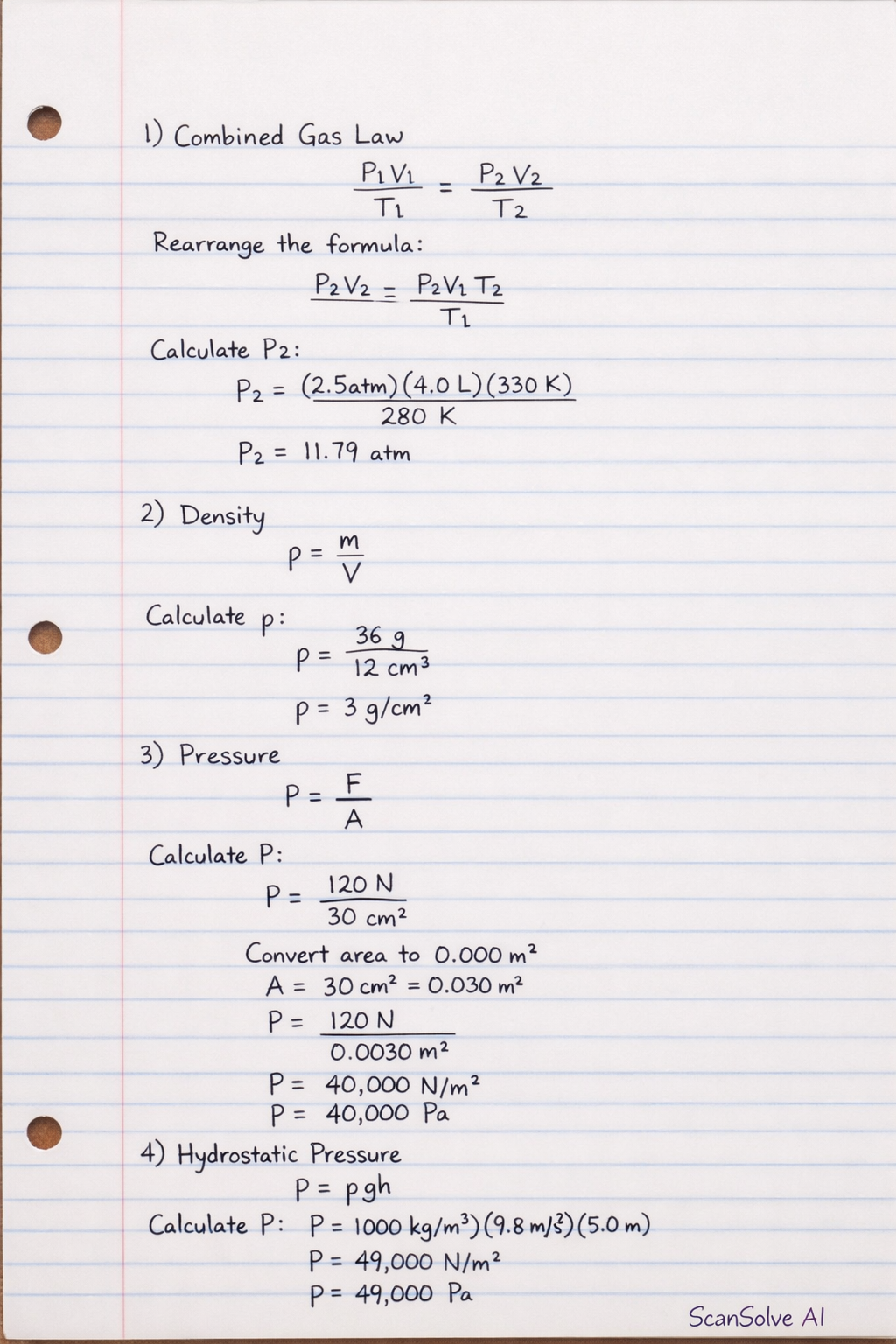
We read your photo as:
Explain the physics formulas: Combined Gas Law, Density, Pressure, and Hydrostatic Pressure.
ScanSolve AI Answer
Here are the explanations for the physics formulas shown in your notes:
-
The Combined Gas Law:
This formula relates the pressure (), volume (), and absolute temperature () of a fixed amount of gas. The subscripts 1 and 2 denote the initial and final states of the gas, respectively.
-
Density:
This formula defines density () as the mass () of a substance per unit volume ().
-
Pressure:
This is the fundamental definition of pressure (), which is the force () applied perpendicular to a surface divided by the area () over which the force is distributed.
-
Hydrostatic Pressure:
This formula calculates the hydrostatic pressure () at a certain depth within a fluid. Here, is the density of the fluid, is the acceleration due to gravity, and is the depth or height of the fluid column.
Still stuck on this one?
Ask a follow-up, and the answer starts from this question.
More Physics Questions
Handwritten Step-by-Step Solution
Get this as a handwritten image on WhatsApp — like a tutor wrote it for you.
Try on WhatsApp