
We read your photo as:
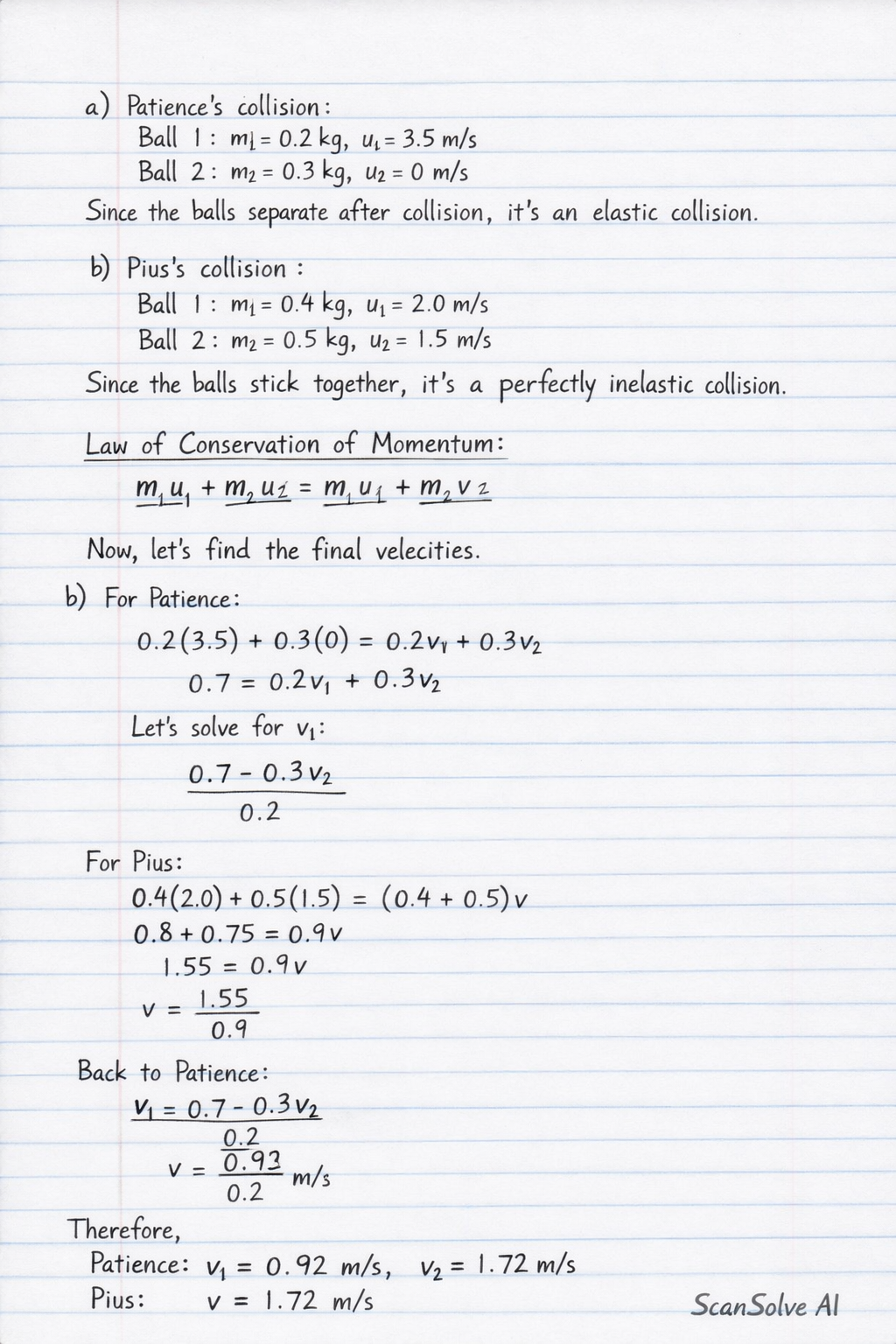
Identify the type of collision and state the law of conservation of momentum. Calculate final velocities after collision.
ScanSolve AI Answer
This answer stops before the end.
It was cut off when it was first written. Ask ScanSolve this question again for the full working.
ITEM 1: Collisions and Conservation of Momentum
a) Help Patience and Pius identify the type of collision that the pool balls moved with and state the law of conservation of momentum.
-
Patience's collision: The first ball collides with a stationary ball, and both balls move separately after the collision. This is an elastic collision (or partially elastic).
-
Pius's collision: The two balls collide and move together with the same final velocity. This is a perfectly inelastic collision.
-
Law of Conservation of Momentum: For a closed system, the total momentum before a collision is equal to the total momentum after the collision, provided no external forces act on the system. Mathematically, for two objects:
where is mass, is initial velocity, and is final velocity.
b) Support Patience and Pius to know the final velocities that the balls moved with after collision.
Patience's Collision:
Step 1: Identify given values and state assumption.
Ball 1: , ,
Ball 2: ,
Assuming the second pool ball has the same mass as the first, .
Step 2: Apply the law of conservation of momentum.
Step 3: Solve for .
The final velocity of the first ball is given as and the final velocity of the second ball is .
Pius's Collision:
Step 1: Identify given values.
Ball 1: ,
Ball 2: ,
Since they move together, their final velocity is .
Step 2: Apply the law of conservation of momentum for a perfectly inelastic collision.
Step 3: Solve for .
The final velocity of the two balls moving together is or approximately .
ITEM 2: Physics Phenomena
a) Why the colour of the dress changed.
The color of the dress changed due to a change in the color of the incident light. Objects appear a certain color because they reflect specific wavelengths of light and absorb others. If the lighting conditions change (e.g., from white light to colored light), the wavelengths available for reflection change, altering the perceived color of the dress.
b) Why the sound was reaching her after 0.05s.
Sound travels at a finite speed through a medium (like air). The time delay of 0.05s is the time it took for the sound waves to travel the distance from the loud speaker to the adjudicator's ears. This is because sound does not travel instantaneously.
ITEM 3: Material Properties and Construction
a) Confirm that iron is stronger than wood.
Step 1: Compare the forces withstood and extensions.
Iron: Withstands for an extension of .
Wood: Withstands for an extension of .
Both pieces have the same diameter () and length (), meaning their cross-sectional area () and original length () are identical.
Step 2: Calculate Young's Modulus () for both materials.
Young's Modulus is a measure of stiffness and strength, defined as .
For iron:
Still stuck on this one?
Ask a follow-up, and the answer starts from this question.
More Physics Questions
Handwritten Step-by-Step Solution
Get this as a handwritten image on WhatsApp — like a tutor wrote it for you.
Try on WhatsApp