

This physics problem tests your understanding of fundamental physical laws and their applications. The step-by-step solution below breaks down the problem using relevant equations and physical reasoning.
ScanSolve AI Answer
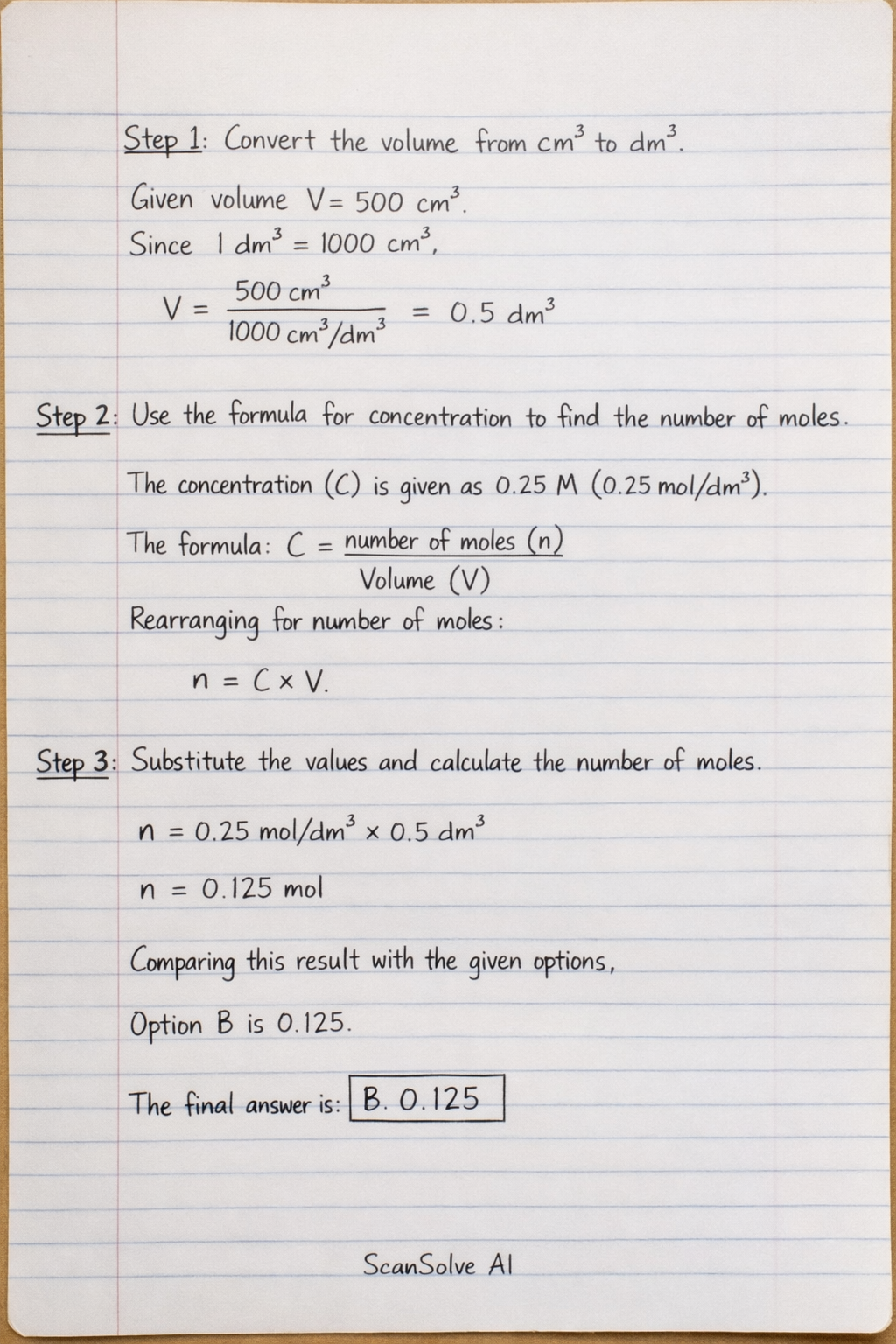
Step 1: Convert the volume from cm^3 to dm^3. Given volume V = 500 cm^3. Since 1 dm^3 = 1000 cm^3, V = 500 cm^31000 cm^3/dm^3 = 0.5 dm^3 Step 2: Use the formula for concentration to find the number of moles. The concentration (C) is given as 0.25 M (which is 0.25 mol/dm^3). The formula for concentration is C = number of moles (n)Volume (V). Rearranging for the number of moles: n = C × V. Step 3: Substitute the values and calculate the number of moles. n = 0.25 mol/dm^3 × 0.5 dm^3 n = 0.125 mol Comparing this result with the given options, option B is 0.125. The final answer is B. 0.125.