

This physics problem tests your understanding of fundamental physical laws and their applications. The step-by-step solution below breaks down the problem using relevant equations and physical reasoning.
ScanSolve AI Answer
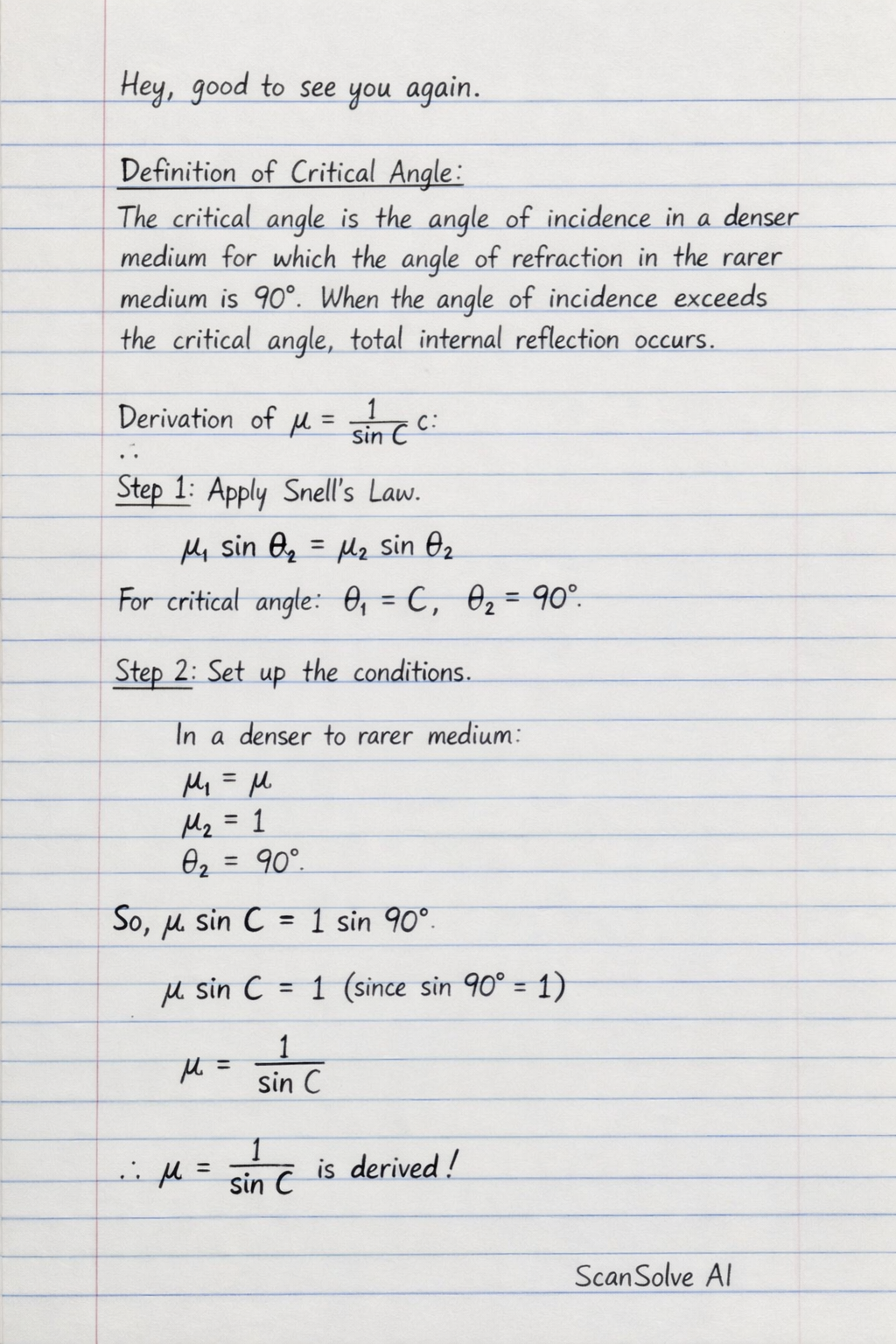
Hey, good to see you again. 10. What is critical angle? Show that = (1)/( C), where is refractive index of medium and C is critical angle. Definition of Critical Angle: The critical angle is the angle of incidence in a denser medium for which the angle of refraction in the rarer medium is 90^. When the angle of incidence exceeds the critical angle, total internal reflection occurs. Derivation of = (1)/( C): Step 1: Apply Snell's Law. Snell's Law states that _1 _1 = _2 _2, where _1 and _2 are the refractive indices of the first and second media, and _1 and _2 are the angles of incidence and refraction, respectively. Step 2: Define conditions for critical angle. For light traveling from a denser medium (refractive index ) to a rarer medium (refractive index _2 = 1, typically air or vacuum), the critical angle C is the angle of incidence (_1 = C) for which the angle of refraction is 90^ (_2 = 90^). Step 3: Substitute values into Snell's Law. C = 1 · 90^ Step 4: Simplify the equation. Since 90^ = 1: C = 1 Step 5: Solve for . = (1)/( C) This shows the relationship between the refractive index of the denser medium and the critical angle. 11. Derive mirror formula for a concave mirror. Assumptions: We consider paraxial rays (rays close to the principal axis and making small angles with it) and a small aperture concave mirror. Ray Diagram and Similar Triangles: Consider an object AB placed beyond the center of curvature C of a concave mirror. An image A'B' is formed between C and the focal point F. Let P be the pole of the mirror. 1. Draw a ray from B parallel to the principal axis, striking the mirror at D (close to P) and passing through the focal point F after reflection. 2. Draw a ray from B passing through the pole P, reflecting such that the angle of incidence equals the angle of reflection. From the geometry of the ray diagram: Consider similar triangles ABP and A'B'P. (AB)/(A'B') = (AP)/(A'P) (1) Consider similar triangles DFP and A'B'F. (Here, we assume D is very close to P, so the perpendicular from D to the principal axis is approximately at P, and DN is approximately AB). (DN)/(A'B') = (PF)/(A'F) Since DN ≈ AB (for paraxial rays), we have: (AB)/(A'B') = (PF)/(A'F) (2) Applying Sign Convention (Cartesian): Equating (1) and (2): (AP)/(A'P) = (PF)/(A'F) According to the Cartesian sign convention (pole as origin, incident light from left): Object distance u = -AP (object is to the left of the pole) Image distance v = -A'P (real image is to the left of the pole) Focal length f = -PF (focal point is to the left of the pole for a concave mirror) A'F = A'P - PF = (-v) - (-f) = f - v Substitution and Simplification: Substitute these values into the equation: (-u)/(-v) = (-f)/(f-v) (u)/(v) = (-f)/(f-v) Cross-multiply: u(f-v) = -fv uf - uv = -fv Divide the entire equation by uvf: (uf)/(uvf) - (uv)/(uvf) = (-fv)/(uvf) (1)/(v) - (1)/(f) = -(1)/(u) Rearrange the terms to get the mirror formula: (1)/(u) + (1)/(v) = (1)/(f) This is the mirror formula for a concave mirror. 12. Explain the Domain theory of Ferromagnetism. Ferromagnetism is a strong form of magnetism exhibited by certain materials like iron, nickel, and cobalt. The Domain theory* explains this phenomenon. According to this theory, ferromagnetic materials are composed of small, distinct regions called domains. Within each domain, the atomic magnetic moments are spontaneously aligned in the same direction due to strong exchange interactions*. In an unmagnetized* ferromagnetic material, these domains are randomly oriented, resulting in a net magnetic moment of zero for the entire material. When an external magnetic field* is applied, two main processes occur: domains that are already aligned with the field grow in size at the expense of misaligned domains, and domains that are not aligned rotate to align with the direction of the external field. This leads to a large net magnetization of the material. At very strong external fields, all domains become aligned, and the material reaches magnetic saturation. Even after the external field is removed, some alignment of domains persists, leading to residual magnetism (retentivity) and the phenomenon of hysteresis*. **13. A ball of mass 400 gm is dropped from tower of height 90 m. Find: i) Time to reach the ground. ii) Velocity with