
We read your photo as:
Which diagram shows two forces P and Q with their resultant force?
ScanSolve AI Answer
Answer
Step-by-step solution
3 stepsHere are the solutions to the problems from the image:
17. Which diagram shows two forces P and Q with their resultant force?
The resultant force of two vectors (like forces P and Q) can be found using the triangle rule of vector addition. This rule states that if two vectors are represented by two sides of a triangle taken in order (head-to-tail), then their resultant is represented by the third side of the triangle taken in the opposite order (from the tail of the first vector to the head of the second vector).
- A: Shows P, then Q from the head of P. The "resultant" is drawn from the head of Q back to the tail of P. This is incorrect for the resultant of P and Q.
- B: Shows P, then Q drawn from the head of P. The "resultant" is drawn from the tail of P to the head of Q. This perfectly matches the triangle rule for vector addition, where the resultant is .
- C: Shows P and Q drawn from the same origin (tail-to-tail). The "resultant" is drawn as the diagonal of the parallelogram formed by P and Q, starting from the common origin. This is also a correct method for finding the resultant (parallelogram rule). However, option B is a more direct representation of the head-to-tail vector addition. In multiple-choice questions where both methods are technically correct, the triangle method (B) is often the intended answer for its directness.
- D: Shows P, Q, and the "resultant" all originating from a central point. This is not a standard diagram for showing the resultant of P and Q.
Both B and C are valid methods for finding the resultant. However, B is a very clear and direct application of the triangle rule for vector addition.
The correct option is B.
18. A sealed plastic bottle is left outside on a hot, sunny day. What happens to the average speed of the gas molecules and to the pressure of the gas in the bottle as the temperature of the gas rises?
Analyze the effect of temperature on the average speed of gas molecules.
According to the kinetic theory of gases, the temperature of a gas is a measure of the average kinetic energy of its molecules. Kinetic energy is given by . If the temperature of the gas rises, the average kinetic energy of its molecules increases. Since the mass () of the gas molecules remains constant, their average speed () must increase.
Analyze the effect of temperature on the pressure of the gas.
The bottle is sealed, meaning the volume of the gas inside is constant. Gas pressure is caused by the force exerted by gas molecules colliding with the walls of the container. When the temperature rises and the average speed of the molecules increases:
- The molecules hit the walls more frequently.
- Each collision is more forceful (due to higher momentum). Both of these factors lead to an increase in the total force exerted on the walls, and thus an increase in the pressure of the gas. This is consistent with Gay-Lussac's Law, which states that for a fixed mass of gas at constant volume, pressure is directly proportional to absolute temperature.
Combine the findings.
As the temperature of the gas rises, the average speed of the gas molecules increases, and the pressure of the gas in the bottle increases.
The correct option is D.
Try one yourself
A new problem that tests the same skill.
Still stuck on this one?
Ask a follow-up, and the answer starts from this question.
More Physics Questions
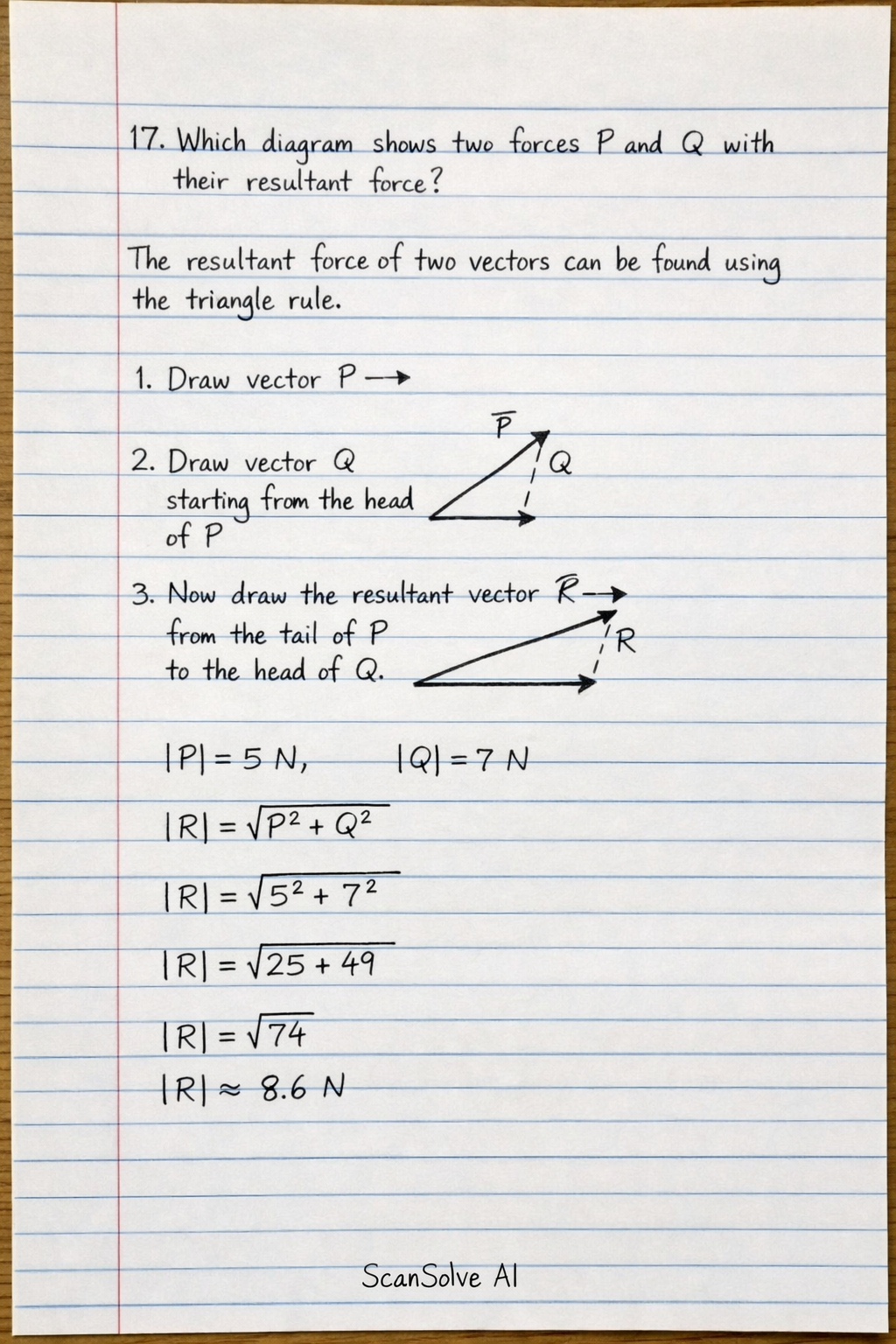
Handwritten Step-by-Step Solution
Get this as a handwritten image on WhatsApp — like a tutor wrote it for you.
Try on WhatsApp