
We read your photo as:
Differentiate between independent variable and dependent variable, fundamental unit and derived unit. What is a unit?
ScanSolve AI Answer
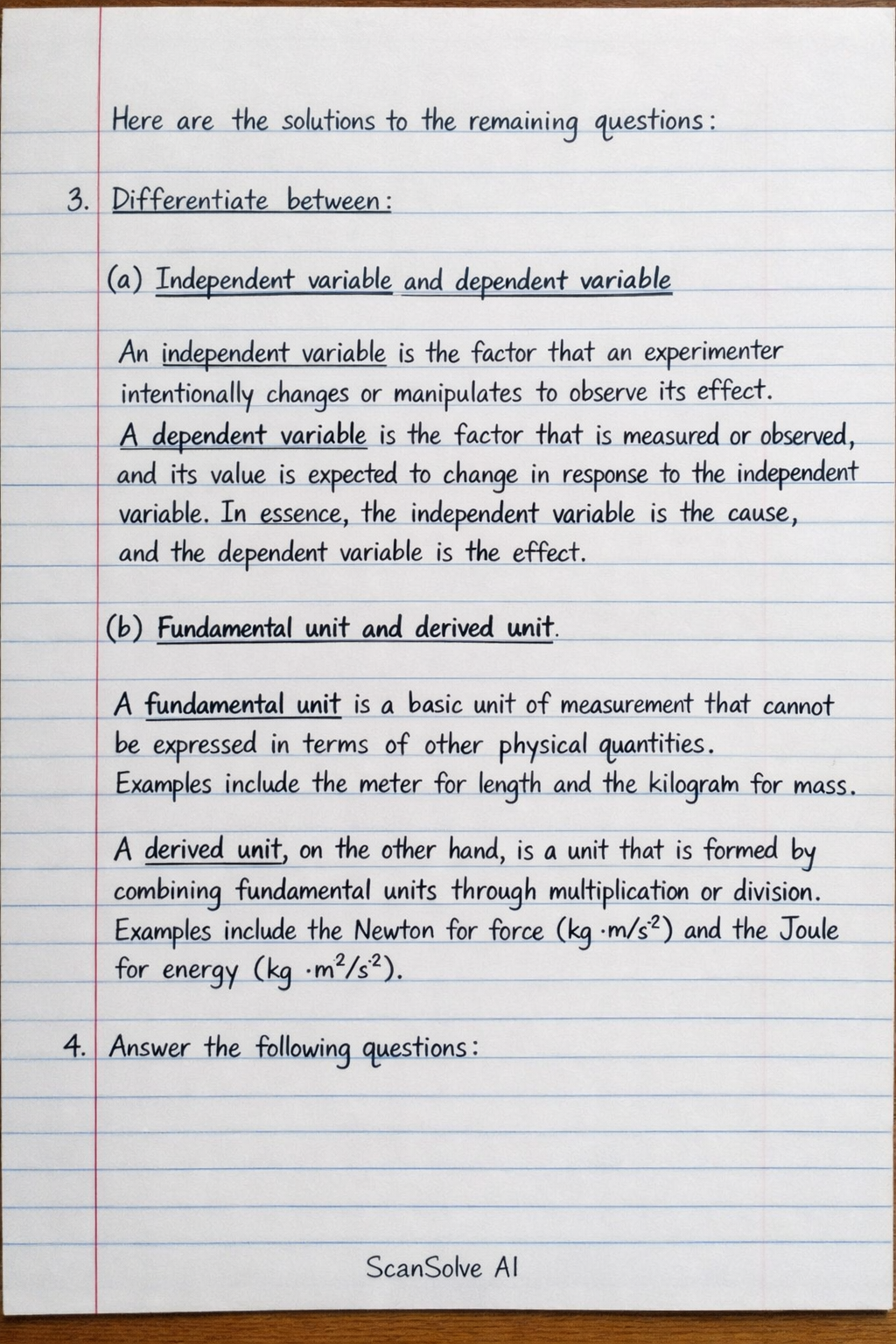
Here are the solutions to the remaining questions:
3. Differentiate between:
a) Independent variable and dependent variable
An independent variable is the factor that an experimenter intentionally changes or manipulates to observe its effect. A dependent variable is the factor that is measured or observed, and its value is expected to change in response to the independent variable. In essence, the independent variable is the cause, and the dependent variable is the effect.
b) Fundamental unit and derived unit
A fundamental unit is a basic unit of measurement that cannot be expressed in terms of other physical quantities. Examples include the meter for length and the kilogram for mass. A derived unit, on the other hand, is a unit that is formed by combining fundamental units through multiplication or division. Examples include the Newton for force () and the Joule for energy ().
4. Answer the following questions:
a) What is a unit?
A unit is a standard quantity used to measure a physical quantity. It provides a reference point for comparison, allowing us to express the magnitude of a physical quantity in a consistent and universally understood way. For example, the meter is a unit of length, and the second is a unit of time.
Still stuck on this one?
Ask a follow-up, and the answer starts from this question.
More Physics Questions
Handwritten Step-by-Step Solution
Get this as a handwritten image on WhatsApp — like a tutor wrote it for you.
Try on WhatsApp