
We read your photo as:
Write down the equation of a progressive wave that superimposes the above to form a stationary wave and determine the equation of the resultant stationary wave and state the amplitude.
ScanSolve AI Answer
Answers
4 partsStep-by-step solution
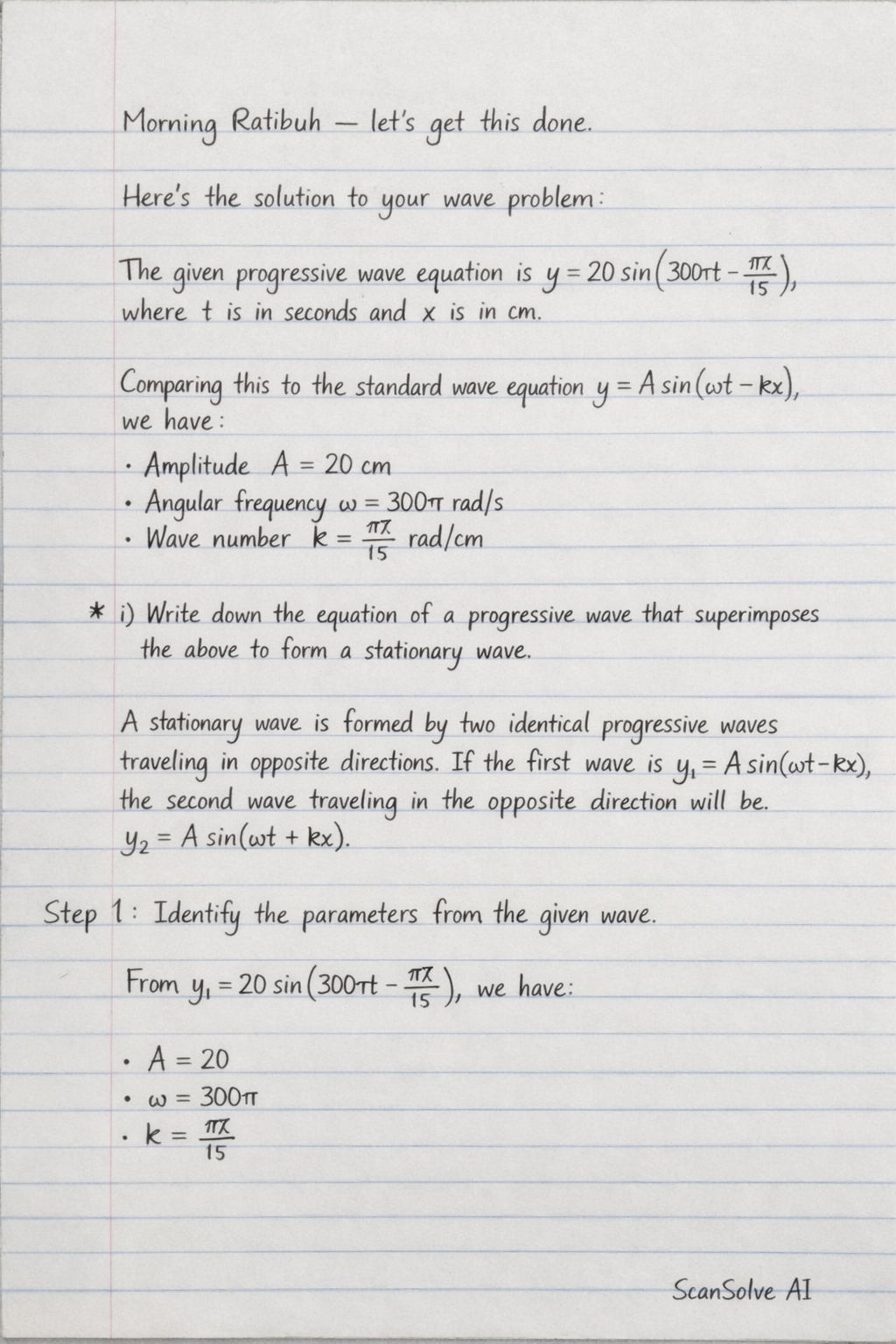
9 stepsHere's the solution to your wave problem:
The given progressive wave equation is , where is in seconds and is in cm.
Comparing this to the standard wave equation , we have:
Amplitude cm
Angular frequency rad/s
Wave number rad/cm
Part i· 2 steps
Write down the equation of a progressive wave that superimposes the above to form a stationary wave.
A stationary wave is formed by two identical progressive waves traveling in opposite directions. If the first wave is , the second wave traveling in the opposite direction will be .
Identify the parameters from the given wave.
From , we have , , and .
Write the equation for the second progressive wave.
The equation for the progressive wave traveling in the opposite direction is:
The equation of the progressive wave is .
Part ii
Using the given progressive wave equation and the equation within (i) above, determine the equation of the resultant stationary wave and state the amplitude.
The resultant stationary wave is the superposition of the two progressive waves: .
Apply the trigonometric identity .
Let and .
Substitute these into the identity.
State the amplitude of the stationary wave.
The amplitude of the stationary wave is given by the term multiplying , which is . The maximum amplitude occurs when .
The maximum amplitude of the stationary wave is 40 cm.
The equation of the resultant stationary wave is .
The maximum amplitude of the stationary wave is .
Part iii
Calculate the wavelength of a stationary wave.
The wavelength of a stationary wave is the same as the wavelength of the progressive waves that form it. We can find the wavelength from the wave number .
Use the relationship between wave number and wavelength.
The wave number . From the given equation, rad/cm.
Calculate the wavelength .
The wavelength of the stationary wave is .
Part iv
Determine the phase difference between two points of a progressive wave separated by 2.5 cm.
The phase difference between two points separated by a distance in a progressive wave is given by .
Identify the wave number and the separation .
From the given wave equation, rad/cm.
The separation cm.Calculate the phase difference.
The phase difference is .
Try one yourself
A new problem that tests the same skill.
Still stuck on this one?
Ask a follow-up, and the answer starts from this question.
More Physics Questions
Handwritten Step-by-Step Solution
Get this as a handwritten image on WhatsApp — like a tutor wrote it for you.
Try on WhatsApp