
We read your photo as:
Describe the effect of closing and opening switch S on the galvanometer connected to coil B, considering electromagnetic induction.
ScanSolve AI Answer
Step-by-step solution
3 stepsWhen the switch S is closed.
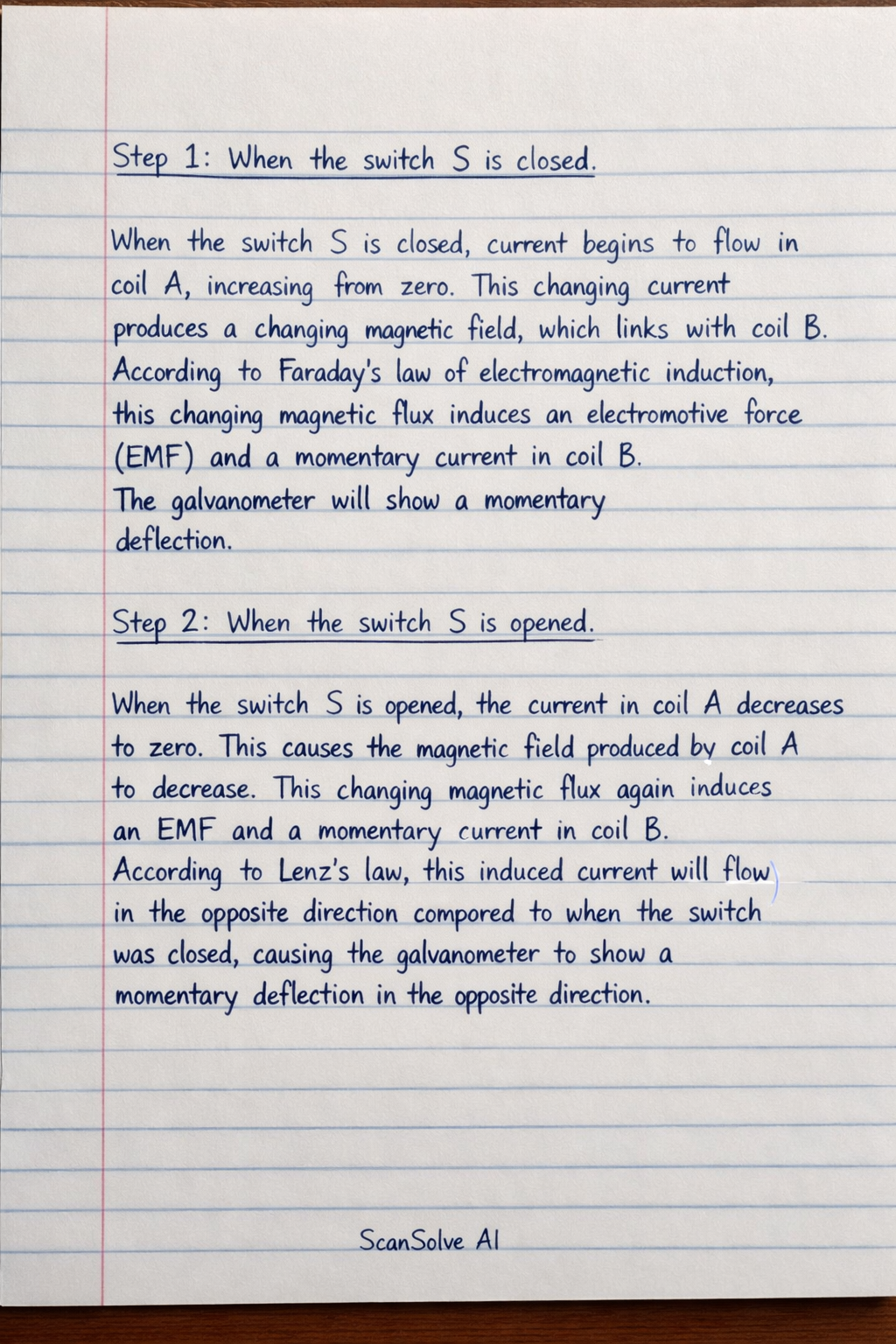
When the switch S is closed, current begins to flow in coil A, increasing from zero. This changing current produces a changing magnetic field, which links with coil B. According to Faraday's law of electromagnetic induction, this changing magnetic flux induces an electromotive force (EMF) and a momentary current in coil B. The galvanometer will show a momentary deflection.
When the switch S is opened.
When the switch S is opened, the current in coil A decreases to zero. This causes the magnetic field produced by coil A to decrease. This changing magnetic flux again induces an EMF and a momentary current in coil B. According to Lenz's law, this induced current will flow in the opposite direction compared to when the switch was closed, causing the galvanometer to show a momentary deflection in the opposite direction.
When the current in coil A is steady.
If the switch S remains closed and the current in coil A becomes steady, the magnetic field produced by coil A will also be constant. Since there is no change in magnetic flux linking with coil B, no EMF or current is induced in coil B. The galvanometer will show zero deflection.
Still stuck on this one?
Ask a follow-up, and the answer starts from this question.
More Physics Questions
Handwritten Step-by-Step Solution
Get this as a handwritten image on WhatsApp — like a tutor wrote it for you.
Try on WhatsApp