
We read your photo as:
Calculate the energy consumed by a bread toaster given voltage, current, and time.
ScanSolve AI Answer
Answers
3 partsStep-by-step solution
9 stepsPart 12· 4 steps
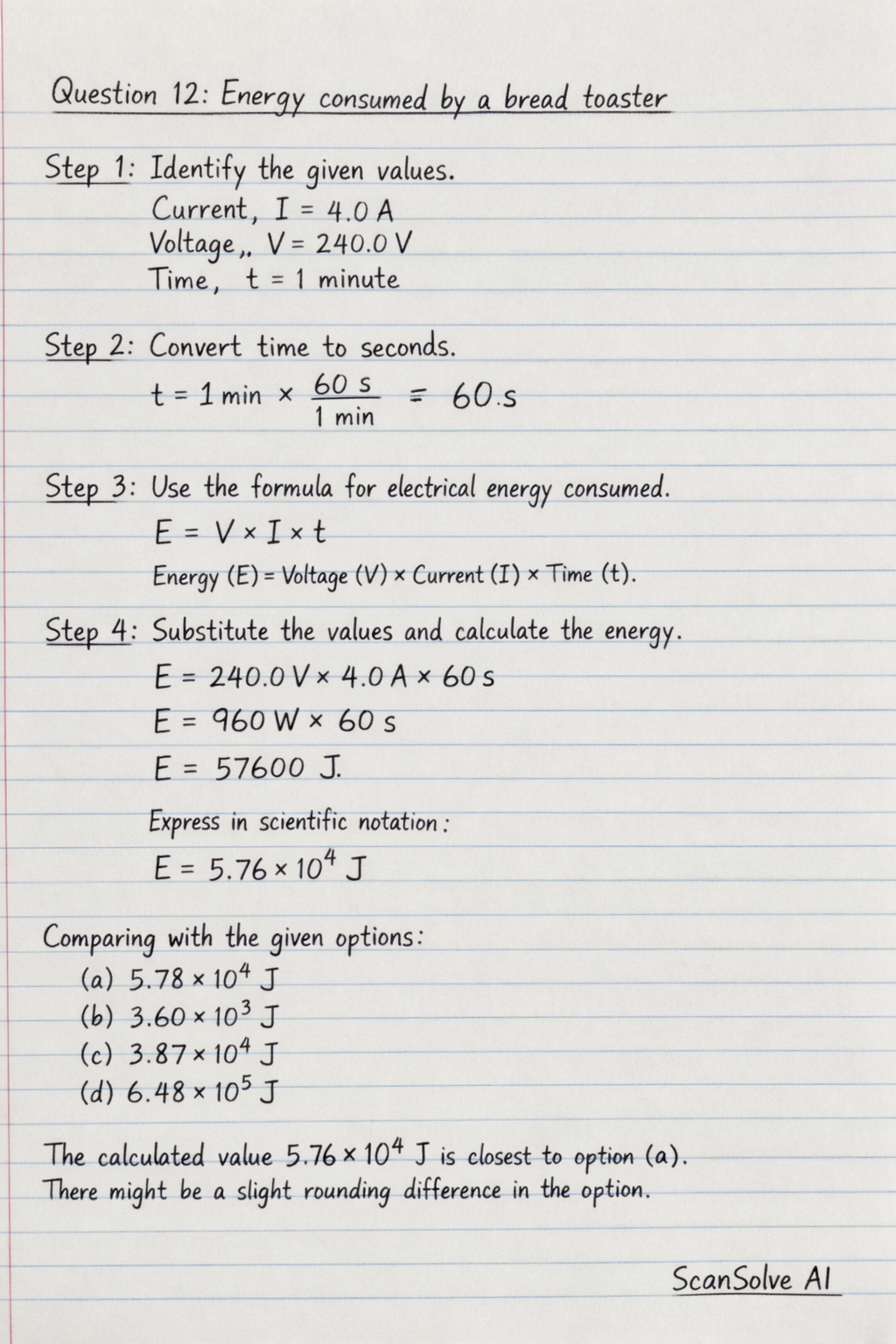
Energy consumed by a bread toaster
Identify the given values.
Current,
Voltage,
Time,Convert time to seconds.
Use the formula for electrical energy consumed.
Energy () is given by the product of voltage (), current (), and time ():
Substitute the values and calculate the energy.
Express in scientific notation:
Comparing with the given options:
Part a
Part b
Part c
Part d
The calculated value is closest to option (a). There might be a slight rounding difference in the option.
The energy consumed by the toaster is .
Part 13
Equivalent capacitance of three capacitors in series
Identify the given information.
Number of capacitors,
Capacitance of each capacitor,
Connection type: SeriesRecall the formula for equivalent capacitance in series.
For capacitors connected in series, the reciprocal of the equivalent capacitance () is the sum of the reciprocals of individual capacitances:
Substitute the given capacitances and solve for .
To find , take the reciprocal of both sides:
The equivalent capacitance is .
Part 14
Hooke's Law proportionality
Recall Hooke's Law.
Hooke's Law states that the force () required to extend or compress a spring by some distance () is directly proportional to that distance, provided the elastic limit is not exceeded.
Mathematically, this is expressed as:Where is the spring constant.
Apply Hooke's Law to the given problem.
The problem states that the force needed to elongate an elastic object by an amount "S" is proportional to "S".
According to Hooke's Law, the force () is directly proportional to the elongation ().The force needed to elongate an elastic object by an amount "S" is proportional to .
Try one yourself
A new problem that tests the same skill.
Still stuck on this one?
Ask a follow-up, and the answer starts from this question.
More Physics Questions
Handwritten Step-by-Step Solution
Get this as a handwritten image on WhatsApp — like a tutor wrote it for you.
Try on WhatsApp