
We read your photo as:
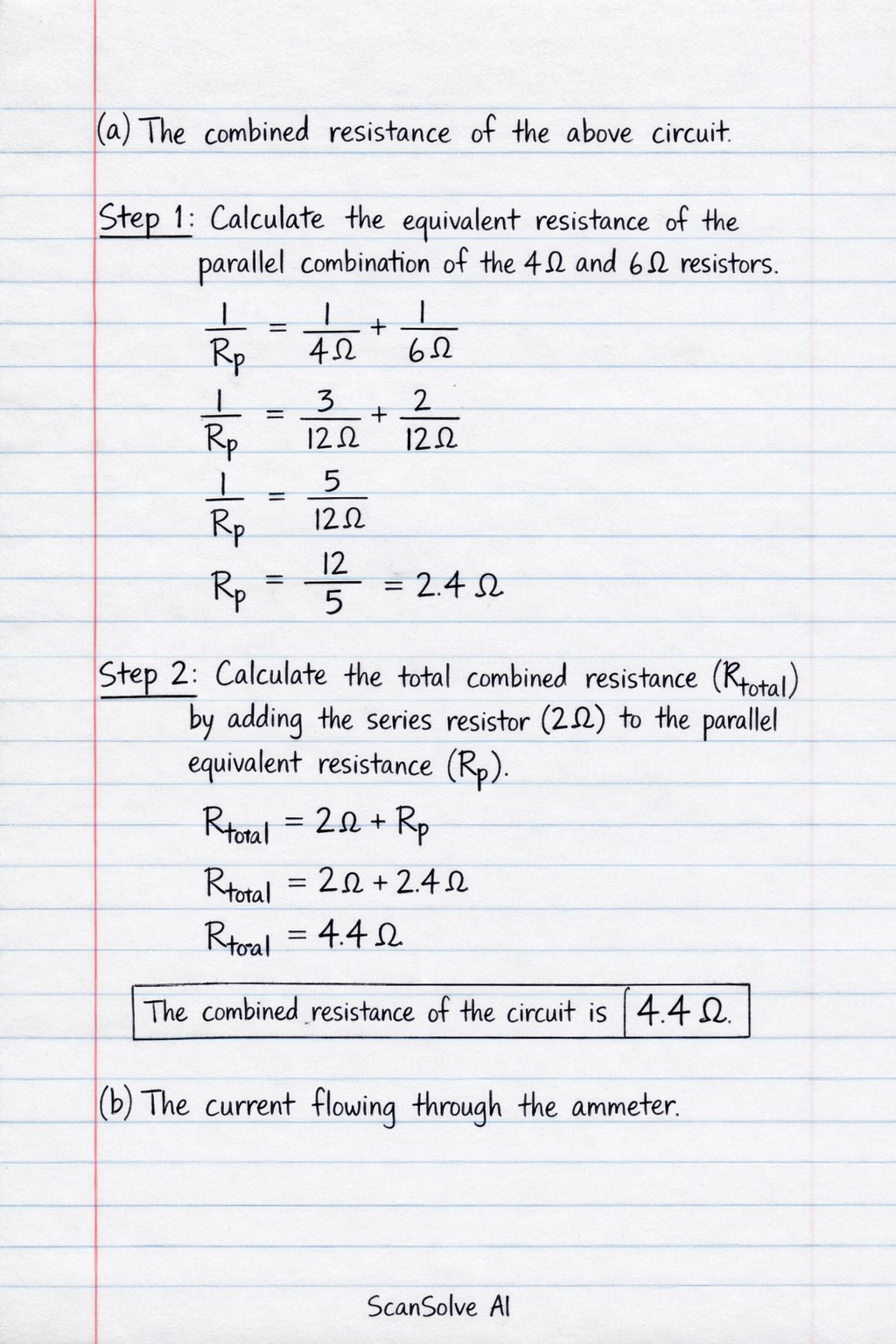
Calculate the equivalent resistance of the parallel combination of the 4 and 6 resistors.
Physics
ScanSolve AI Answer
Step-by-step solution
3 stepsPart a· 2 steps
The combined resistance of the above circuit.
Calculate the equivalent resistance of the parallel combination of the and resistors.
Calculate the total combined resistance () by adding the series resistor () to the parallel equivalent resistance ().
The combined resistance of the circuit is .
Part b· 1 step
The current flowing through the ammeter.
Use Ohm's Law () to find the total current () flowing from the voltage source, which is measured by the ammeter.
The current flowing through the ammeter is .
Was this helpful?
Still stuck on this one?
Ask a follow-up, and the answer starts from this question.
Got a different question?Ask your own question
More Physics Questions
QDetermine the equivalent resistance for parallel resistors.QCalculate the combined resistance of the 2 and 3 resistors.QCalculate the total equivalent resistance of the circuit.QCalculate the equivalent resistance (R_p) of the two parallel resistors.QCalculate the equivalent resistance of two resistors, 300 Ω and 200 Ω, connected in parallel.
Browse by topic:Electrical Engineering
Handwritten Step-by-Step Solution
Get this as a handwritten image on WhatsApp — like a tutor wrote it for you.
Try on WhatsApp