We read your photo as:

Example 3. A rigid body is spinning with an angular velocity of 3 radians per second about an axes parallel in 2i - 3k. Find the velocity of the particle at the point (3, -4, 1).

Physics

ScanSolve AI Answer

Step-by-step solution

3 steps

To find the velocity of a particle in a rigid body spinning about an axis, we use the formula v⃗=ω⃗×r⃗\vec{v} = \vec{\omega} \times \vec{r}, where ω⃗\vec{\omega} is the angular velocity vector and r⃗\vec{r} is the position vector from a point on the axis of rotation to the particle's position.

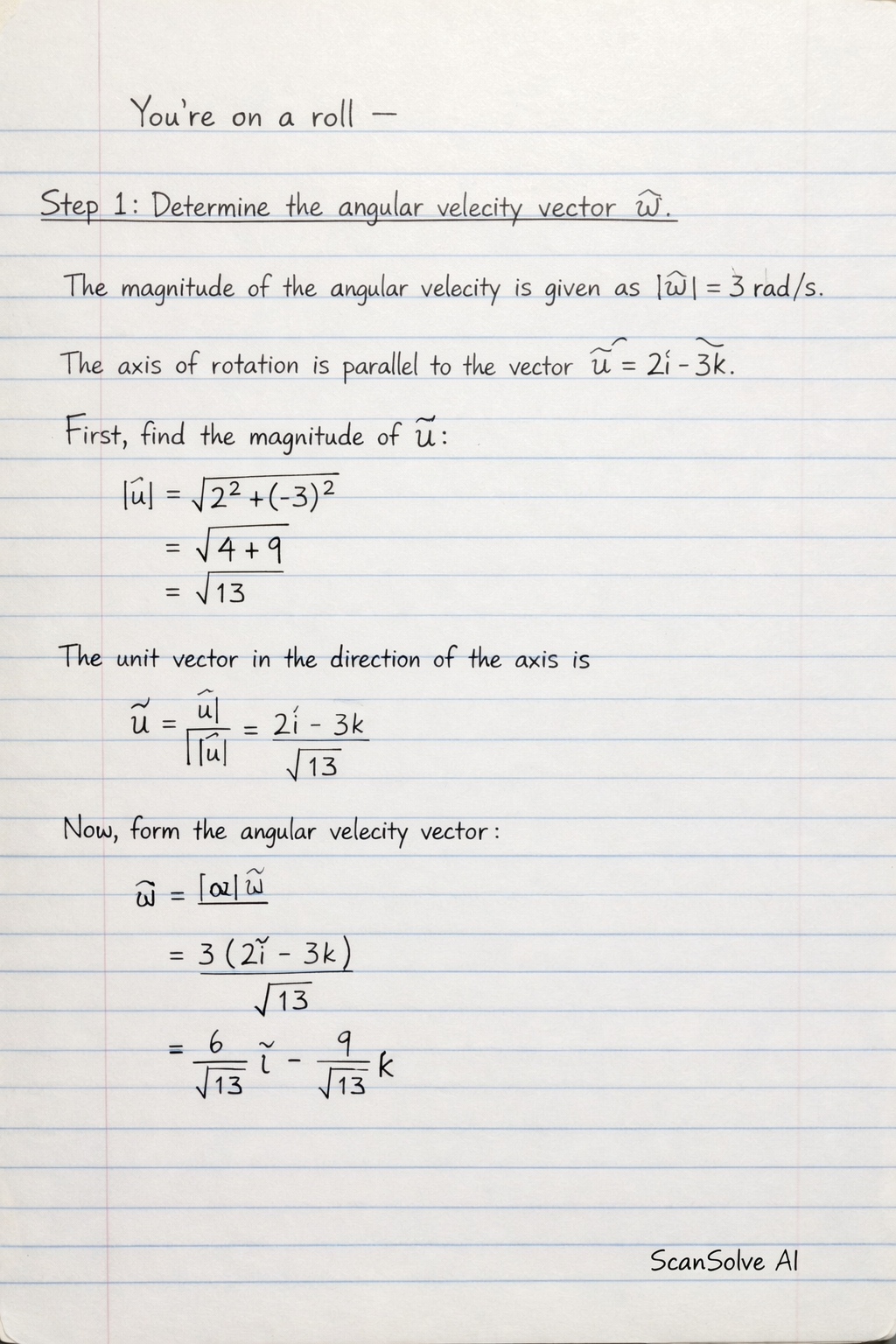
  1. Determine the angular velocity vector ω⃗\vec{\omega}.

    The magnitude of the angular velocity is given as ∣ω⃗∣=3|\vec{\omega}| = 3 rad/s.
    The axis of rotation is parallel to the vector u⃗=2i^−3k^\vec{u} = 2\hat{i} - 3\hat{k}.
    First, find the magnitude of u⃗\vec{u}:

    ∣u⃗∣=22+(−3)2=4+9=13|\vec{u}| = \sqrt{2^2 + (-3)^2} = \sqrt{4 + 9} = \sqrt{13}

    The unit vector in the direction of the axis is u^=u⃗∣u⃗∣=2i^−3k^13\hat{u} = \frac{\vec{u}}{|\vec{u}|} = \frac{2\hat{i} - 3\hat{k}}{\sqrt{13}}.
    Now, form the angular velocity vector:

    ω⃗=∣ω⃗∣u^=3(2i^−3k^13)=613i^−913k^\vec{\omega} = |\vec{\omega}| \hat{u} = 3 \left( \frac{2\hat{i} - 3\hat{k}}{\sqrt{13}} \right) = \frac{6}{\sqrt{13}}\hat{i} - \frac{9}{\sqrt{13}}\hat{k}
  2. Determine the position vector r⃗\vec{r}.

    The axis passes through point A=(1,−3,−1)A = (1, -3, -1).
    The particle is at point P=(3,−4,1)P = (3, -4, 1).
    The position vector r⃗\vec{r} from a point on the axis (A) to the particle (P) is r⃗=P⃗−A⃗\vec{r} = \vec{P} - \vec{A}.

    r⃗=(3−1)i^+(−4−(−3))j^+(1−(−1))k^\vec{r} = (3-1)\hat{i} + (-4 - (-3))\hat{j} + (1 - (-1))\hat{k} r⃗=2i^+(−4+3)j^+(1+1)k^\vec{r} = 2\hat{i} + (-4+3)\hat{j} + (1+1)\hat{k} r⃗=2i^−j^+2k^\vec{r} = 2\hat{i} - \hat{j} + 2\hat{k}
  3. Calculate the velocity v⃗=ω⃗×r⃗\vec{v} = \vec{\omega} \times \vec{r}.

    v⃗=(613i^−913k^)×(2i^−j^+2k^)\vec{v} = \left( \frac{6}{\sqrt{13}}\hat{i} - \frac{9}{\sqrt{13}}\hat{k} \right) \times (2\hat{i} - \hat{j} + 2\hat{k})

    Factor out 113\frac{1}{\sqrt{13}}:

    v⃗=113(6i^+0j^−9k^)×(2i^−j^+2k^)\vec{v} = \frac{1}{\sqrt{13}} (6\hat{i} + 0\hat{j} - 9\hat{k}) \times (2\hat{i} - \hat{j} + 2\hat{k})

    Compute the cross product:

    (6i^−9k^)×(2i^−j^+2k^)=∣i^j^k^60−92−12∣(6\hat{i} - 9\hat{k}) \times (2\hat{i} - \hat{j} + 2\hat{k}) = \begin{vmatrix} \hat{i} & \hat{j} & \hat{k} \\ 6 & 0 & -9 \\ 2 & -1 & 2 \end{vmatrix} =((0)(2)−(−9)(−1))i^−((6)(2)−(−9)(2))j^+((6)(−1)−(0)(2))k^= ((0)(2) - (-9)(-1))\hat{i} - ((6)(2) - (-9)(2))\hat{j} + ((6)(-1) - (0)(2))\hat{k} =(0−9)i^−(12−(−18))j^+(−6−0)k^= (0 - 9)\hat{i} - (12 - (-18))\hat{j} + (-6 - 0)\hat{k} =−9i^−(12+18)j^−6k^= -9\hat{i} - (12 + 18)\hat{j} - 6\hat{k} =−9i^−30j^−6k^= -9\hat{i} - 30\hat{j} - 6\hat{k}

    Now, multiply by the scalar factor:

    v⃗=113(−9i^−30j^−6k^)\vec{v} = \frac{1}{\sqrt{13}} (-9\hat{i} - 30\hat{j} - 6\hat{k}) v⃗=−913i^−3013j^−613k^ m/s\vec{v} = -\frac{9}{\sqrt{13}}\hat{i} - \frac{30}{\sqrt{13}}\hat{j} - \frac{6}{\sqrt{13}}\hat{k} \text{ m/s}

    The velocity of the particle is −913i^−3013j^−613k^ m/s\boxed{-\frac{9}{\sqrt{13}}\hat{i} - \frac{30}{\sqrt{13}}\hat{j} - \frac{6}{\sqrt{13}}\hat{k} \text{ m/s}}.

Was this helpful?

Still stuck on this one?

Ask a follow-up, and the answer starts from this question.

Got a different question?Ask your own question
Handwritten step-by-step solution preview

Handwritten Step-by-Step Solution

Get this as a handwritten image on WhatsApp — like a tutor wrote it for you.

Try on WhatsApp