

This physics problem tests your understanding of fundamental physical laws and their applications. The step-by-step solution below breaks down the problem using relevant equations and physical reasoning.
ScanSolve AI Answer
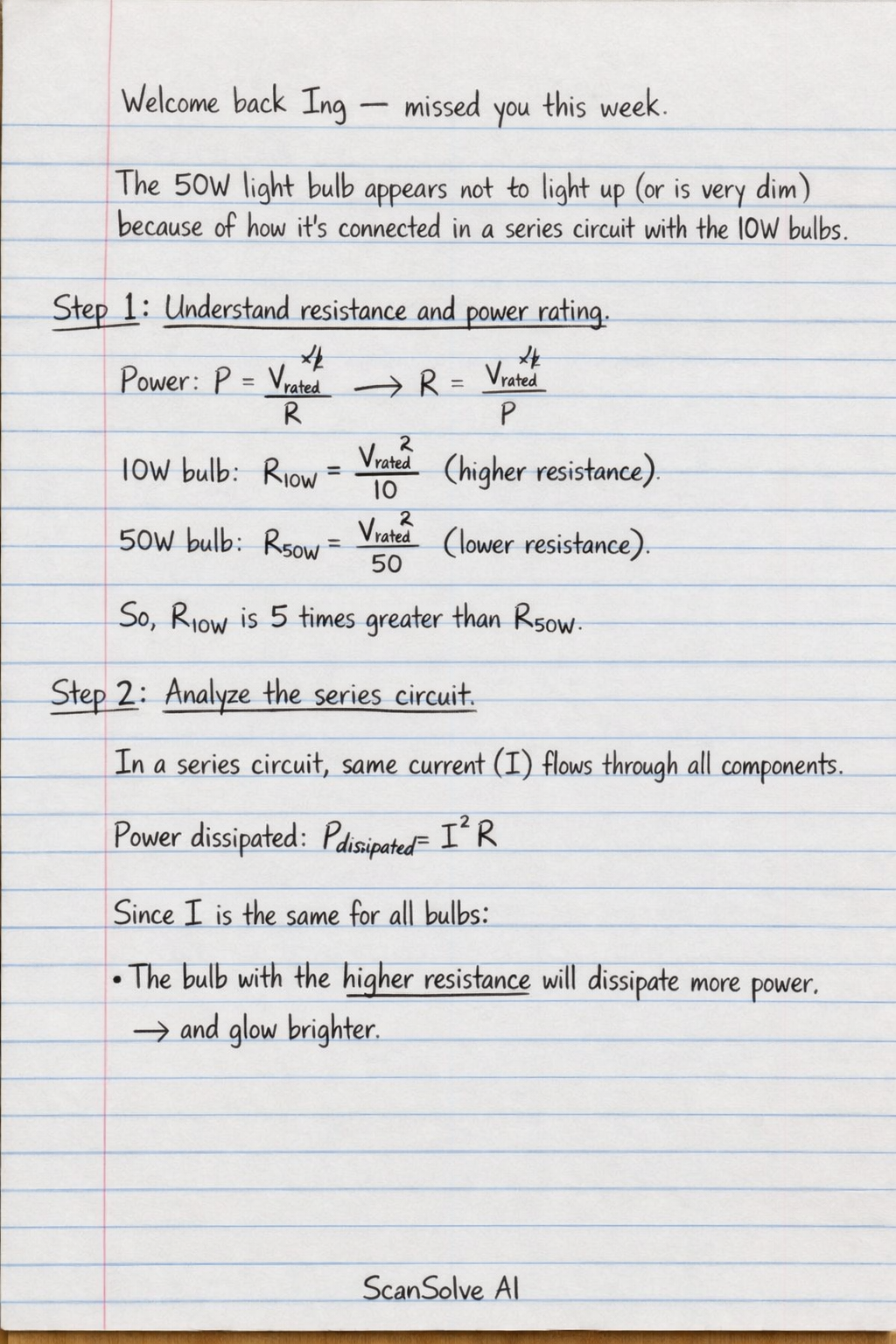
The 50W light bulb appears not to light up (or is very dim) because of how it's connected in a series circuit with the 10W bulbs. Here's why: Step 1: Understand resistance and power rating. The power rating of a bulb (P) is typically given for a standard operating voltage (V_rated). The resistance (R) of a bulb can be calculated using the formula P = V_rated^2R, which means R = V_rated^2P. • A 10W bulb has a higher resistance (R_10W = V_rated^2/10). • A 50W bulb has a lower resistance (R_50W = V_rated^2/50). Specifically, R_10W is 5 times greater than R_50W. Step 2: Analyze the series circuit. In a series circuit, the same current (I) flows through all components. The power dissipated by each bulb in a series circuit is given by P_dissipated = I^2R. • Since the current I is the same for all bulbs, the bulb with the higher resistance will dissipate more power and therefore glow brighter. Step 3: Compare the brightness. Because the 10W bulbs have a higher resistance than the 50W bulb, they will dissipate more power and glow much brighter in this series circuit. The 50W bulb, having a lower resistance, will dissipate significantly less power and will be very dim, possibly appearing as if it's not lit at all. The 50W light bulb does light up, but it is so dim compared to the 10W bulbs that it might appear to be off. This is because it has a lower resistance and therefore dissipates less power in a series circuit where the current is constant. Drop the next question. 📸