
We read your photo as:
Solve for the unknown node voltage V_X in the given circuit diagram.
ScanSolve AI Answer
Answer
Step-by-step solution
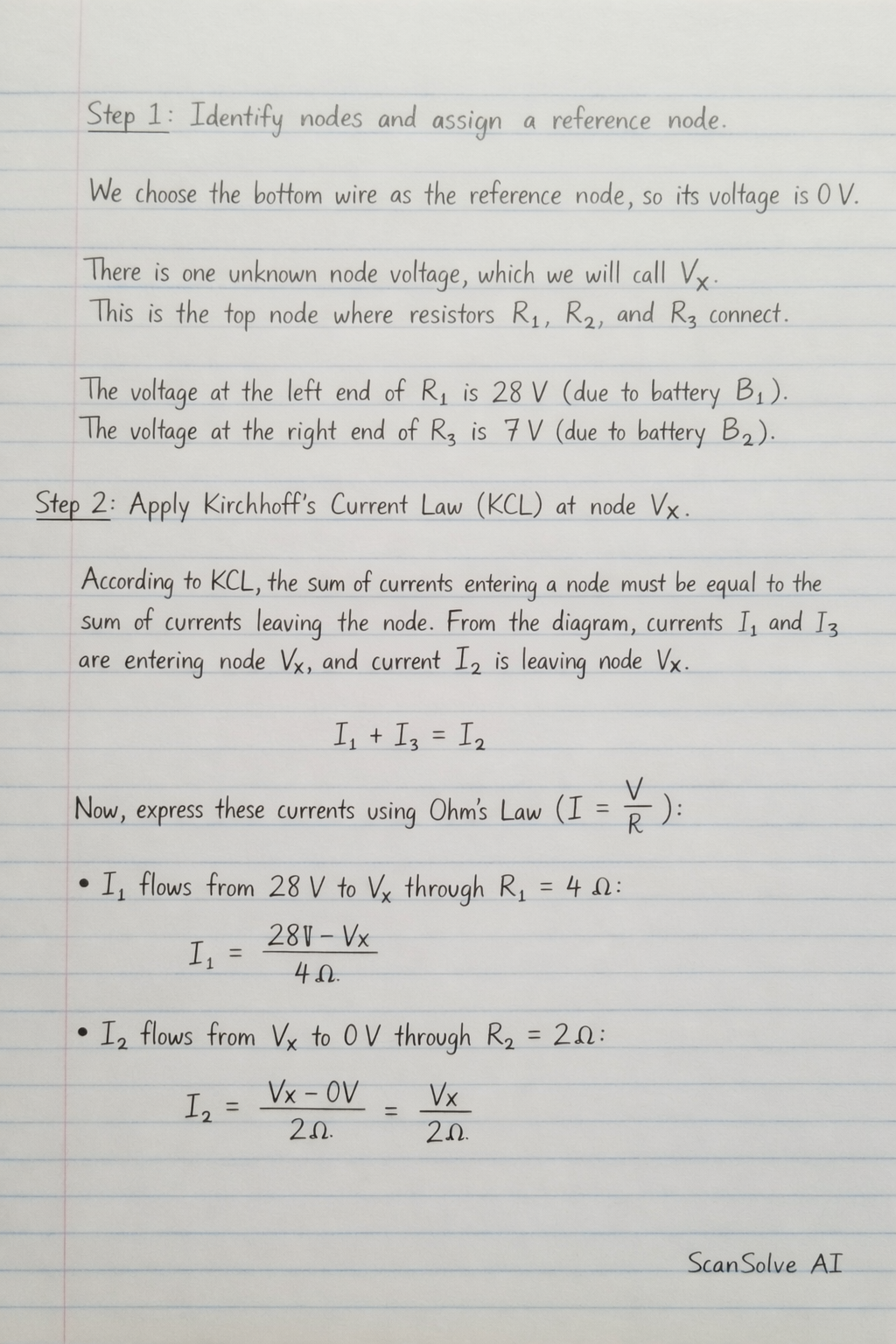
3 stepsIdentify nodes and assign a reference node.
We choose the bottom wire as the reference node, so its voltage is .
There is one unknown node voltage, which we will call . This is the top node where resistors , , and connect.
The voltage at the left end of is (due to battery ).
The voltage at the right end of is (due to battery ).Apply Kirchhoff's Current Law (KCL) at node .
According to KCL, the sum of currents entering a node must be equal to the sum of currents leaving the node. From the diagram, currents and are entering node , and current is leaving node .
Now, express these currents using Ohm's Law ():
- flows from to through :
- flows from to through :
- flows from to through :
Substitute these expressions into the KCL equation:
Solve the equation for .
To eliminate the denominators, multiply the entire equation by the least common multiple of 4, 1, and 2, which is 4:
Distribute the 4:
Combine like terms:
Add to both sides:
Divide by 7:
The voltage at the top node is .
Try one yourself
A new problem that tests the same skill.
Still stuck on this one?
Ask a follow-up, and the answer starts from this question.
More Physics Questions
Handwritten Step-by-Step Solution
Get this as a handwritten image on WhatsApp — like a tutor wrote it for you.
Try on WhatsApp