
Four materials that do not obey ohms law of resistance
Physics
ScanSolve AI Answer
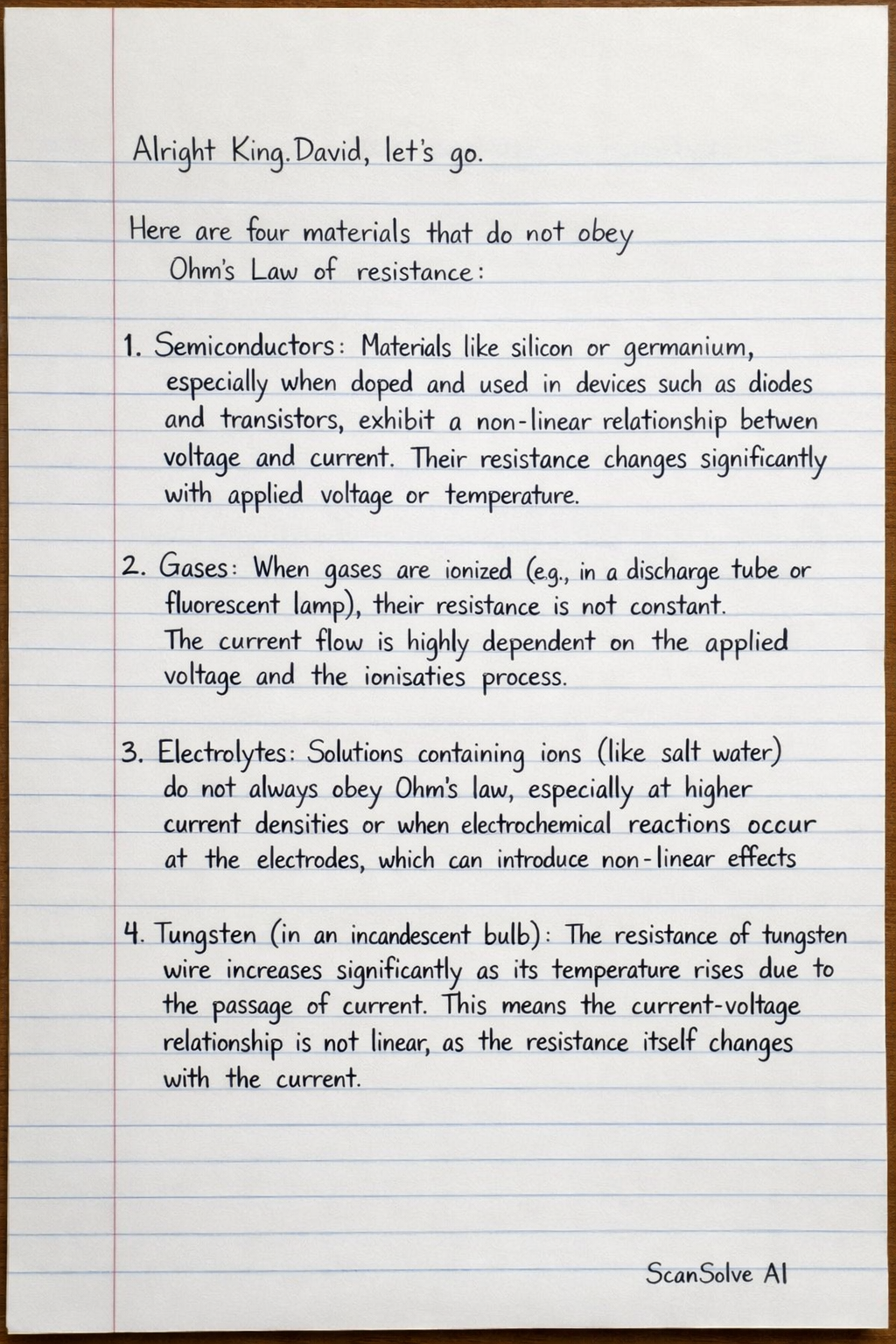
Here are four materials that do not obey Ohm's law of resistance:
- Semiconductors: Materials like silicon or germanium, especially when doped and used in devices such as diodes and transistors, exhibit a non-linear relationship between voltage and current. Their resistance changes significantly with applied voltage or temperature.
- Gases: When gases are ionized (e.g., in a discharge tube or fluorescent lamp), their resistance is not constant. The current flow is highly dependent on the applied voltage and the ionization process.
- Electrolytes: Solutions containing ions (like salt water) do not always obey Ohm's law, especially at higher current densities or when electrochemical reactions occur at the electrodes, which can introduce non-linear effects.
- Tungsten (in an incandescent bulb): The resistance of tungsten wire increases significantly as its temperature rises due to the passage of current. This means the current-voltage relationship is not linear, as the resistance itself changes with the current.
Was this helpful?
Still stuck on this one?
Ask a follow-up, and the answer starts from this question.
Got a different question?Ask your own question
More Physics Questions
QDevices that do not obey ohms lawQDescribe Ohm's law, classify given materials into conductors and insulators, provide an example of a…QUsing Ohm's Law (V=IR), calculate the current, resistance, and voltage for the following circuits:QList two requirements of a conductor material to be used in resistance measurement.QThe table shows the resistivity of some materials at 20°C. Which of the following is the best…
Browse by topic:Electrical Engineering
Handwritten Step-by-Step Solution
Get this as a handwritten image on WhatsApp — like a tutor wrote it for you.
Try on WhatsApp