

This physics problem tests your understanding of fundamental physical laws and their applications. The step-by-step solution below breaks down the problem using relevant equations and physical reasoning.
ScanSolve AI Answer
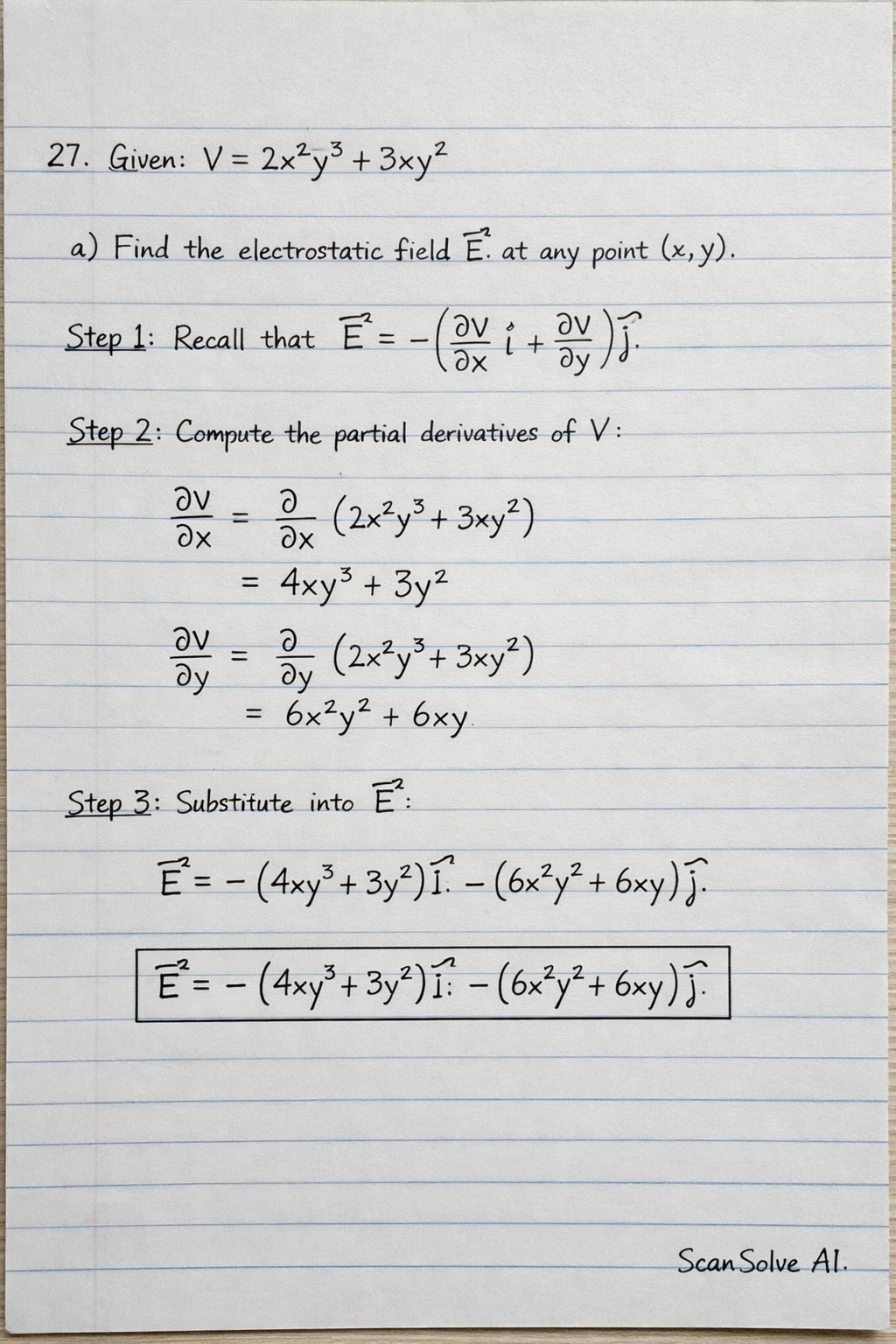
You're on a roll — here are the solutions to the problems. 27. The electrostatic potential is given by V = 2x^2y^3 + 3xy^2. a) Obtain the electrostatic field strength E at any location (x,y) in the plane. Step 1: Recall the relationship between electric field strength and electric potential. The electric field strength E is the negative gradient of the electric potential V: E = -( ( V)/( x) i + ( V)/( y) j ) Step 2: Calculate the partial derivatives of V with respect to x and y. ( V)/( x) = ()/( x) (2x^2y^3 + 3xy^2) = 4xy^3 + 3y^2 ( V)/( y) = ()/( y) (2x^2y^3 + 3xy^2) = 6x^2y^2 + 6xy Step 3: Substitute the partial derivatives into the formula for E. E = -(4xy^3 + 3y^2)i - (6x^2y^2 + 6xy)j The electrostatic field strength is E = -(4xy^3 + 3y^2)i - (6x^2y^2 + 6xy)j. b) Calculate the electric potential at the position x=1, y=2. Step 1: Substitute x=1 and y=2 into the potential function V. V(x,y) = 2x^2y^3 + 3xy^2 V(1,2) = 2(1)^2(2)^3 + 3(1)(2)^2 V(1,2) = 2(1)(8) + 3(1)(4) V(1,2) = 16 + 12 V(1,2) = 28 \, V The electric potential at (1,2) is 28 V. c) Calculate the electrostatic field strength in the same position, x=1, y=2. Step 1: Substitute x=1 and y=2 into the expression for E found in part (a). E(1,2) = -(4(1)(2)^3 + 3(2)^2)i - (6(1)^2(2)^2 + 6(1)(2))j E(1,2) = -(4(8) + 3(4))i - (6(4) + 12)j E(1,2) = -(32 + 12)i - (24 + 12)j E(1,2) = -44i - 36j \, N/C The electrostatic field strength at (1,2) is E = -44i - 36j \, N/C. d) If a negative charge q = -2.3 × 10^-5 \, C is located at x=1, y=2, calculate the electrostatic force on the charge. Step 1: Use the formula for electrostatic force F = qE. Given charge q = -2.3 × 10^-5 \, C. From part (c), E = -44i - 36j \, N/C at (1,2). F = (-2.3 × 10^-5 \, C) × (-44i - 36j \, N/C) F = ((-2.3) × (-44) × 10^-5)i + ((-2.3) × (-36) × 10^-5)j \, N F = (101.2 × 10^-5)i + (82.8 × 10^-5)j \, N F = (1.012 × 10^-3)i + (0.828 × 10^-3)j \, N The electrostatic force on the charge is F = (1.012 × 10^-3)i + (0.828 × 10^-3)j \, N. 28. a) What is corona discharge? Corona discharge is an electrical discharge caused by the ionization of a fluid (such as air) surrounding a conductor, which occurs when the electric field strength is high enough to cause ionization but not high enough to cause a complete electrical breakdown or arc. It often appears as a faint glow. b) Explain how corona discharge is applied in the making of a Van de Graaff electrostatic generator. In a Van de Graaff generator, corona discharge is used at two points: • At the lower comb, sharp points create a very high electric field, causing air molecules to ionize. This allows charge to be sprayed from the comb onto the moving insulating belt. • At the upper comb, another set of sharp points creates a high electric field, causing corona discharge that collects the charge from the belt and transfers it to the large metallic sphere, building up a high potential. c) i) Take two metal spheres A and B of radius r and R respectively where R is bigger than r (R > r). Which of A or B will take smaller quantity of charge to be raised to a given potential and why? Sphere A (with radius r) will take a smaller quantity of charge to be raised to a given potential. The potential V of an isolated conducting sphere with charge Q and radius r is given by V = (kQ)/(r), where k is Coulomb's constant. Rearranging for charge, Q = (Vr)/(k). For a given potential V, the charge Q is directly proportional to the radius r. Since sphere A has a smaller radius (r < R), it requires less charge to reach the same potential compared to sphere B. ii) Calculate the charge required to raise the potential of an isolated metallic sphere of radius 2m from zero to 3.4 × 10^5 \, V. Step 1: Identify the given values and the formula for potential of an isolated sphere. Radius (r) = 2 \, m. Potential (V) = 3.4 × 10^5 \, V. Coulomb's constant (k) = 9 × 10^9 \, N · m^2/C^2. The potential of an isolated sphere is V = (kQ)/(r). Step 2: Rearrange the formula to solve for the charge Q. Q = (Vr)/(k) Step 3: Substitute the values and calculate Q. Q = (3.4 × 10^5 \, V) × (2 \, m)9 × 10^9 \, N · m^2/C^2 Q = (6.8 × 10^5)/(9 × 10^9) \, C Q = (6.8)/(9) × 10^5-9 \, C Q ≈ 0.7555 × 10^-4 \, C Q ≈ 7.56 × 10^-5 \, C The charge required is 7.56 × 10^-5 \, C. Got more? Send 'em!