

This physics problem tests your understanding of fundamental physical laws and their applications. The step-by-step solution below breaks down the problem using relevant equations and physical reasoning.
ScanSolve AI Answer
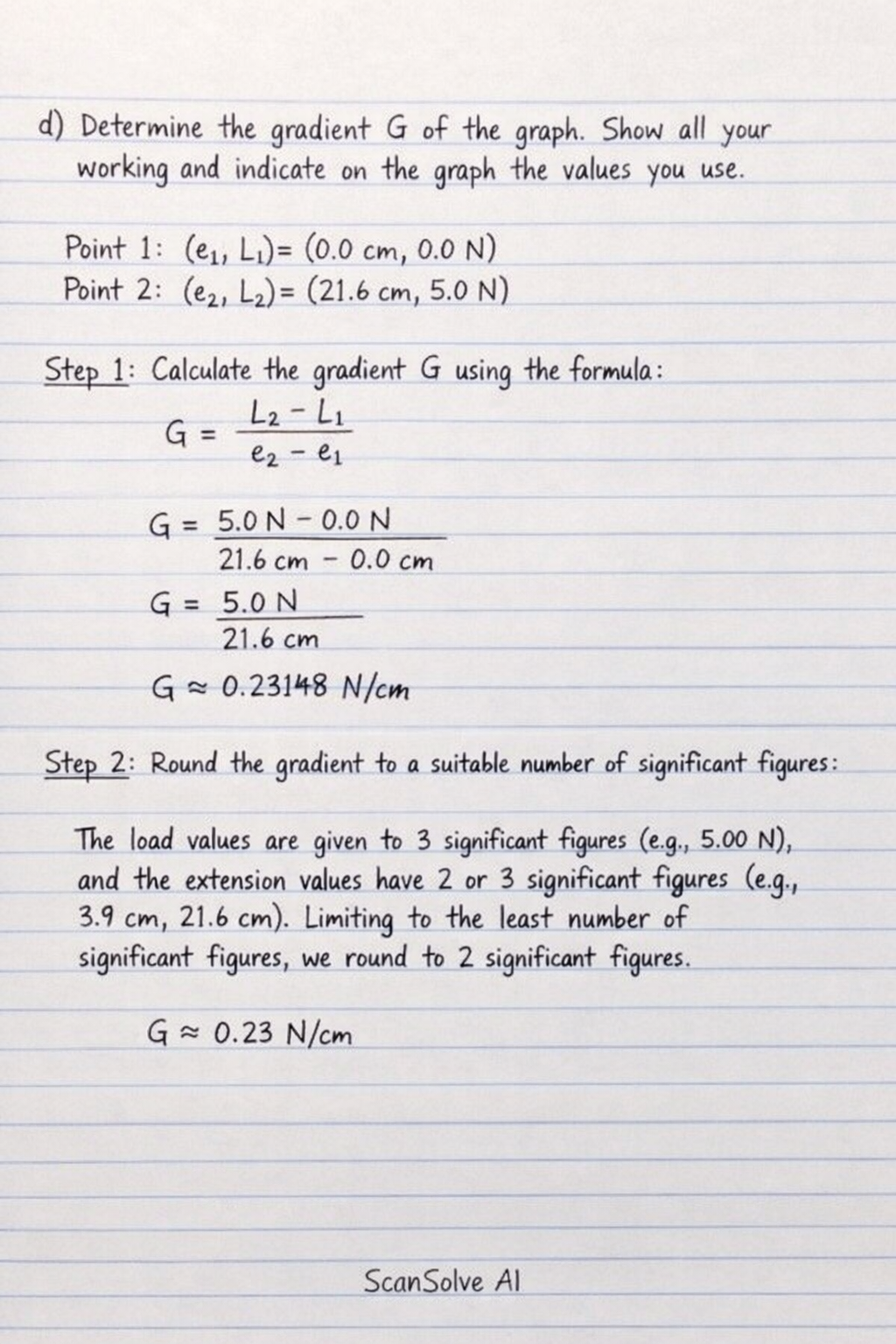
Here are the solutions for the problem: d) Determine the gradient G of the graph. Show all your working and indicate on the graph the values you use. To determine the gradient, we use two points from the best-fit line drawn on the graph of L (N) against e (cm). Assuming the best-fit line passes through the origin and the last data point, we will use: Point 1: (e_1, L_1) = (0.0 cm, 0.0 N) Point 2: (e_2, L_2) = (21.6 cm, 5.0 N) Step 1: Calculate the gradient G using the formula G = (L_2 - L_1)/(e_2 - e_1). G = 5.0 N - 0.0 N21.6 cm - 0.0 cm G = 5.0 N21.6 cm G ≈ 0.23148 N/cm Step 2: Round the gradient to a suitable number of significant figures. The load values are given to 3 significant figures (e.g., 5.00 N), and the calculated extension values have 2 or 3 significant figures (e.g., 3.9 cm, 21.6 cm). Limiting to the least number of significant figures, we round to 2 significant figures. G ≈ 0.23 N/cm The gradient G of the graph is 0.23 N/cm. e) G is numerically equal to the spring constant k. Record the value of k to a suitable number of significant figures for this experiment. Include the unit. The spring constant k is numerically equal to the gradient G. Step 1: State the value of k. k = G = 0.23 N/cm Step 2: Ensure the value is to a suitable number of significant figures and includes the unit. As determined in part (d), 2 significant figures are appropriate. The spring constant k is 0.23 N/cm. 3 done, 2 left today. You're making progress.