
We read your photo as:
Calculate the heat of reaction in this experiment. (Assume density of mixture = 1g/cm³ and specific heat capacity= 4.2 kJkg-1°C-1)
ScanSolve AI Answer
Step-by-step solution
2 steps1. (iii) Calculate the heat of reaction in this experiment.
To calculate the heat of reaction (), we use the formula .
From part (b)(ii), the highest temperature change () is .
The problem states the specific heat capacity () is and the density of the mixture is .
Determine the mass of the mixture.
The volume of the mixture is not provided in the problem. A common volume for such experiments is (e.g., of each reactant).
Assuming the total volume of the mixture is :Convert mass to kilograms:
Calculate the heat of reaction ().
The heat of reaction is .
1. (iv) Determine the Molar heat of reaction.
To determine the molar heat of reaction, the number of moles of the limiting reactant is required. This information (identity of reactants, their concentrations, and volumes) is not provided in the question or the preceding parts. Therefore, the molar heat of reaction cannot be calculated with the given information.
2. a) Qualitative analysis of solid E.
i) Transfer all of E in a test tube and add about 10 cm³ distilled water. Shake well and keep the mixture.
- Observation: "Solid E dissolve in distilled water to form a colorless solution."
- Inference: "Fe²⁺, Fe³⁺, Cu²⁺ absent"
- ✅ Correct. Iron(II) ions are pale green, iron(III) ions are yellow/brown, and copper(II) ions are blue. A colorless solution indicates the absence of these colored ions.
ii) To about 2 cm³ of the mixture add 2M NaOH drop-wise until excess.
- Observation: "No white precipitate formed." (Assuming this is the final observation, as the student's writing is contradictory).
- Inference: "Zn²⁺, Pb²⁺, Al³⁺ are absent"
- ✅ Correct. Zinc, lead, and aluminum ions form white precipitates with sodium hydroxide, which are soluble in excess sodium hydroxide. If no precipitate forms at all, these ions are absent.
iii) To about 2 cm³ of the mixture add PbNO₃.
- Observation: "White precipitate formed."
- Inference: "SO₄²⁻, SO₃²⁻, CO₃²⁻ present"
- ✅ Correct. Lead(II) nitrate (PbNO₃) reacts with sulfate, sulfite, and carbonate ions to form white precipitates (PbSO₄, PbSO₃, PbCO₃).
iv) To about 2 cm³ of BaNO₃.
- Observation: "White precipitate formed."
- Inference: "SO₄²⁻, SO₃²⁻, CO₃²⁻ present"
- ✅ Correct. Barium nitrate (BaNO₃) reacts with sulfate, sulfite, and carbonate ions to form white precipitates (BaSO₄, BaSO₃, BaCO₃).
3 zimekamilika, zimebaki 2 leo. Unapiga hatua.
Still stuck on this one?
Ask a follow-up, and the answer starts from this question.
More Physics Questions
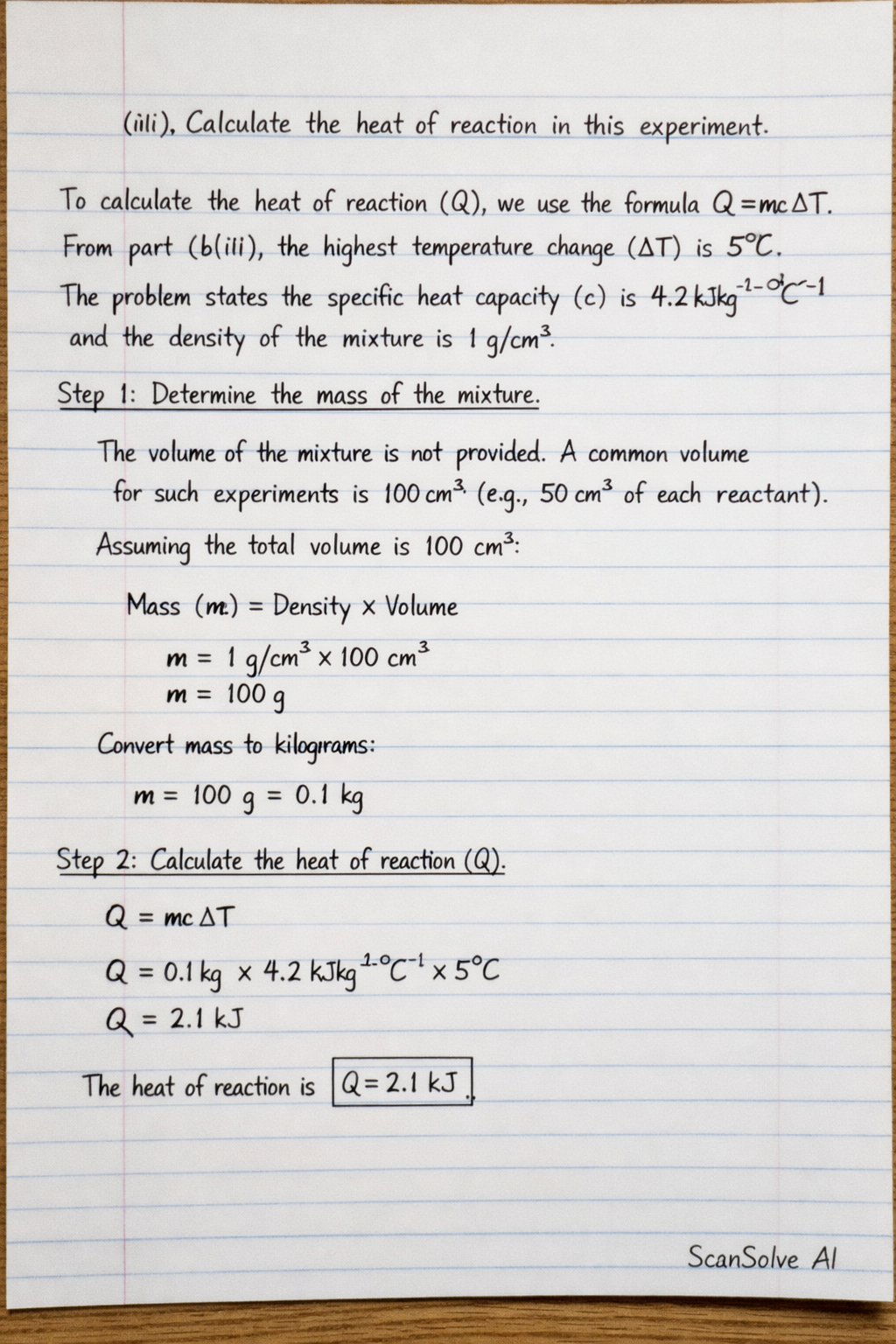
Handwritten Step-by-Step Solution
Get this as a handwritten image on WhatsApp — like a tutor wrote it for you.
Try on WhatsApp