
We read your photo as:
I) Draw a circuit diagram for the arrangement.
ScanSolve AI Answer
Answers
2 partsStep-by-step solution
4 stepsHere is the solution for part c):
Part c(i)
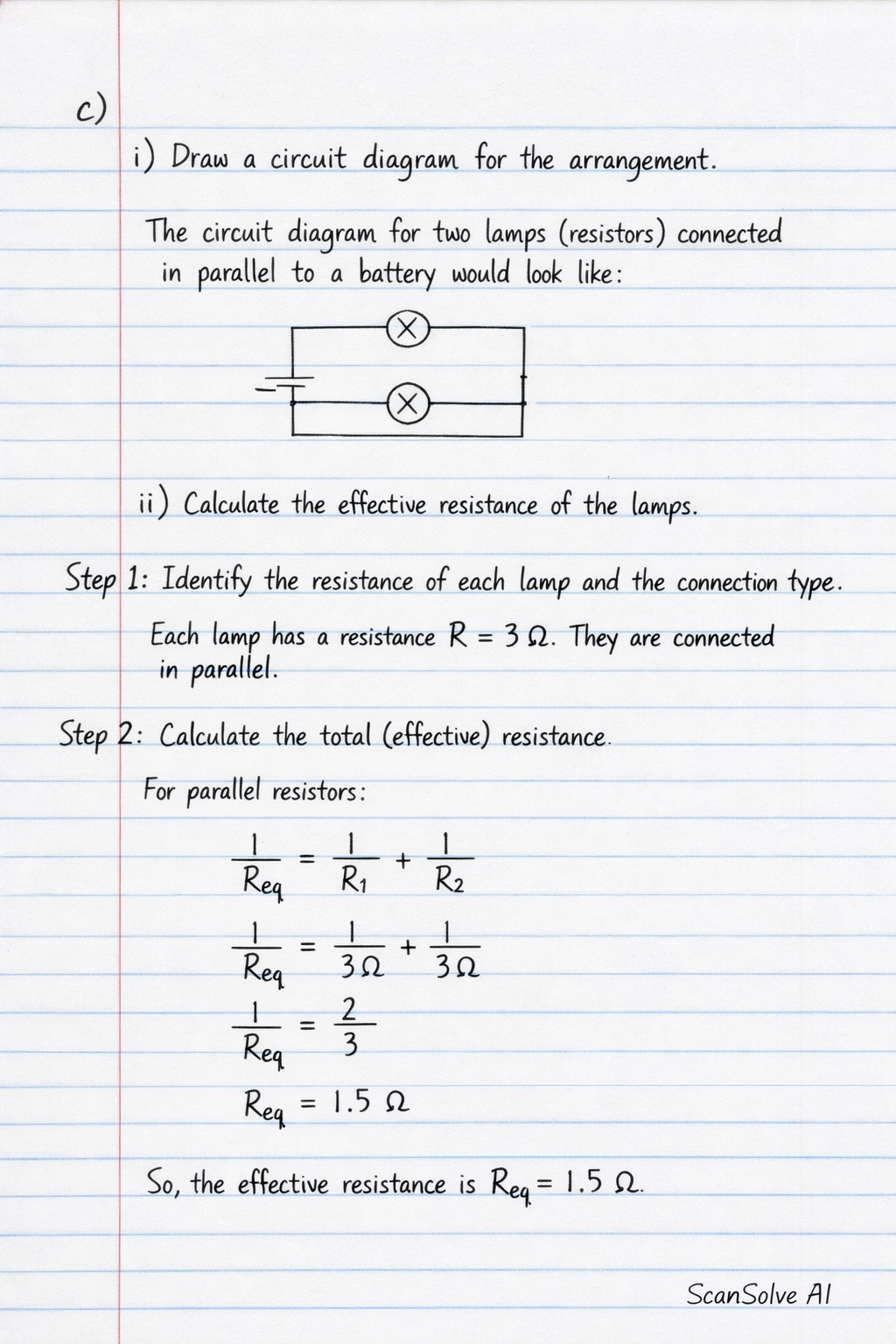
Draw a circuit diagram for the arrangement.
The circuit diagram for two lamps (resistors) connected in parallel to a battery would show:
- A battery symbol (a long line for the positive terminal and a shorter line for the negative terminal).
- Two parallel branches extending from the battery terminals.
- Each branch containing a lamp symbol (a circle with a cross inside, or a zigzag line representing a resistor).
- The two parallel branches rejoining to connect back to the other terminal of the battery.
Part c(ii)
Calculate the effective resistance of the lamps.
Identify the resistance of each lamp and the connection type.
Each lamp has a resistance . They are connected in parallel.
Use the formula for effective resistance in a parallel circuit.
For two resistors in parallel, the formula is:
Substitute the given resistance values:
To find , take the reciprocal of both sides:
The effective resistance is .
Part c(iii)
Calculate the total current in the circuit.
Identify the total voltage and effective resistance.
The battery voltage .
The effective resistance (calculated in part ii).Use Ohm's Law to calculate the total current.
Ohm's Law states .
The total current in the circuit is .
Try one yourself
A new problem that tests the same skill.
Still stuck on this one?
Ask a follow-up, and the answer starts from this question.
More Physics Questions
Handwritten Step-by-Step Solution
Get this as a handwritten image on WhatsApp — like a tutor wrote it for you.
Try on WhatsApp