
We read your photo as:
I) Find the relation connecting R, L and r. ii) Calculate the resistance of the same type of copper wire 750m long and radius 0.25cm.
ScanSolve AI Answer
Answers
4 partsStep-by-step solution
15 stepsPart 4
Part i
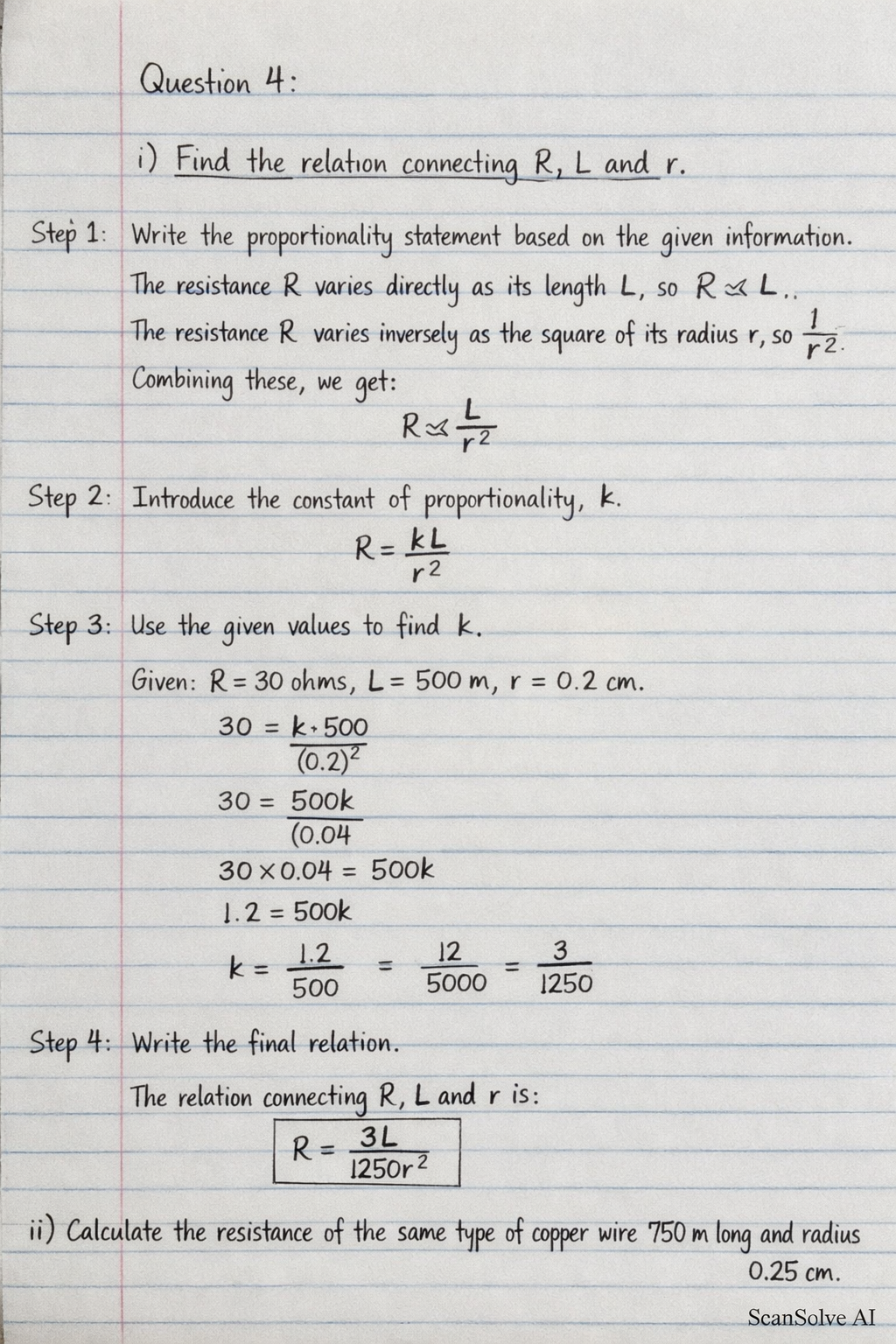
Find the relation connecting and .
Write the proportionality statement based on the given information.
The resistance varies directly as its length , so .
The resistance varies inversely as the square of its radius , so .
Combining these, we get:Introduce the constant of proportionality, .
Use the given values to find .
Given: , , .
Write the final relation.
The relation connecting and is:
Part ii
Calculate the resistance of the same type of copper wire long and radius .
Use the relation found in part i) with the new values.
Given: , , and .
Simplify the expression.
Alternatively, simplify the fraction:
The resistance of the wire is:
Part 5
Part a239
Use the distributive property to expand and simplify .
Apply the distributive property.
Simplify the first term.
Simplify the second term.
Add the simplified terms.
The simplified expression is:
Part b
Without using calculators, simplify , leaving your answer as a fraction in its lowest term.
Express all numbers as powers of prime bases.
Apply exponent rules and .
Group terms with the same base and apply .
Evaluate the powers.
Multiply to get the final fraction.
The simplified expression in its lowest term is:
Try one yourself
A new problem that tests the same skill.
Still stuck on this one?
Ask a follow-up, and the answer starts from this question.
More Physics Questions
Handwritten Step-by-Step Solution
Get this as a handwritten image on WhatsApp — like a tutor wrote it for you.
Try on WhatsApp