

This physics problem tests your understanding of fundamental physical laws and their applications. The step-by-step solution below breaks down the problem using relevant equations and physical reasoning.
ScanSolve AI Answer
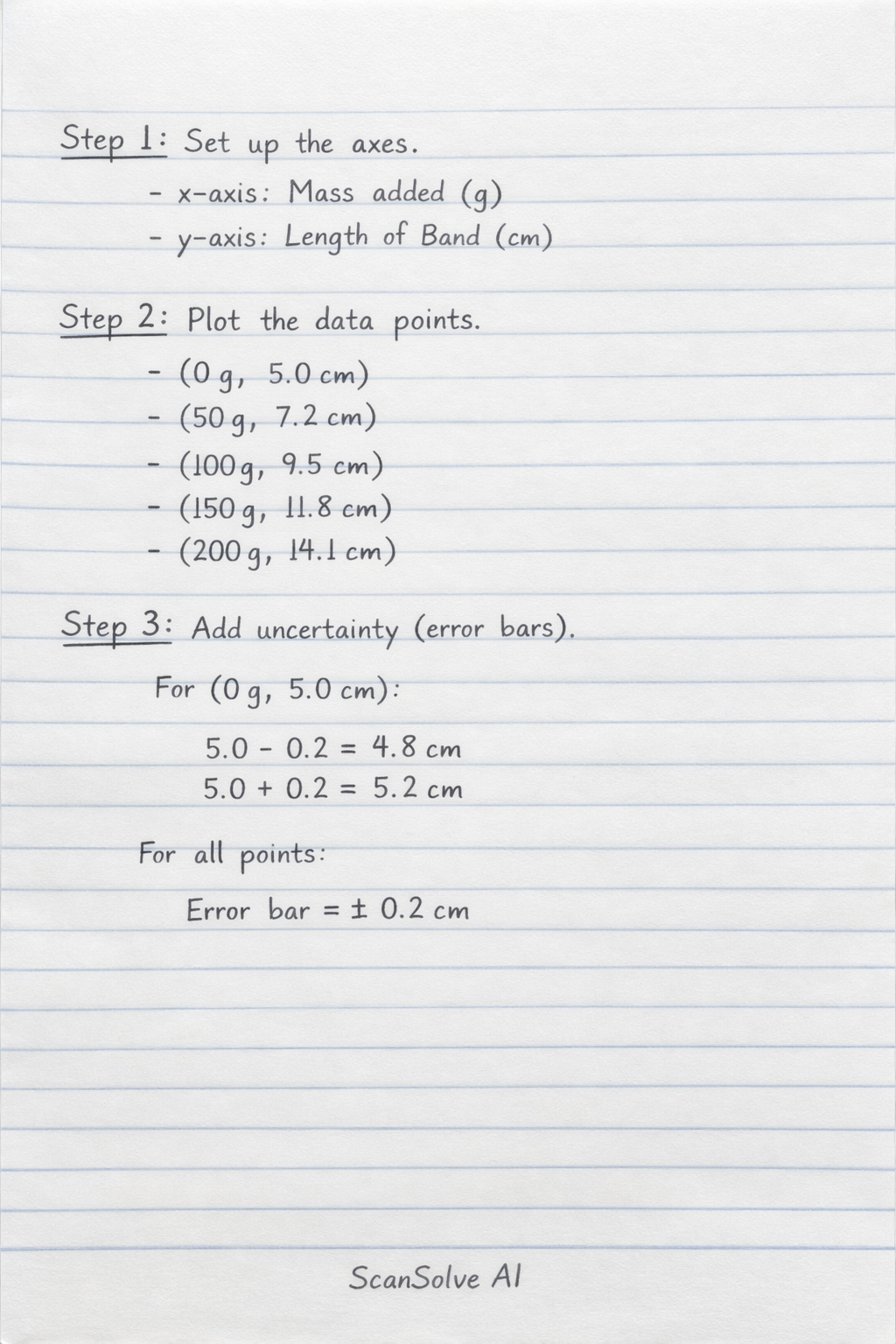
To construct your graph based on the provided data, follow these steps: Step 1: Set up your axes. • The independent variable (Mass added) should be plotted on the x-axis. Label it: Mass added (g). • The dependent variable (Length of Band) should be plotted on the y-axis. Label it: Length of Band (cm). Step 2: Plot the data points. Plot each pair of (Mass added, Length of Band) as a point on your graph: • (0 g, 5.0 cm) • (50 g, 7.2 cm) • (100 g, 9.5 cm) • (150 g, 11.8 cm) • (200 g, 14.1 cm) Step 3: Add uncertainty (error bars) to the y-axis values. For each data point, draw a vertical error bar extending ± 0.2 \, cm from the plotted length value. For example, for the first point (0 g, 5.0 cm), the error bar will range from 5.0 - 0.2 = 4.8 \, cm to 5.0 + 0.2 = 5.2 \, cm. All points will have an error bar of ± 0.2 \, cm. Step 4: Draw a line of best fit. Once all points and error bars are plotted, draw a straight line that best represents the trend of the data. This line should pass through or be close to as many error bars as possible. That's 2 down. 3 left today — send the next one.