
We read your photo as:
Identify the symbols labelled II, III and IV. Draw a circuit diagram using symbols I, II, III, IV and V. Determine the value of II in S.I. units if V reads 5 units and IV reads 5 units.
ScanSolve AI Answer
Step-by-step solution
9 stepsPart c· 3 steps
Circuit Symbols
-
(c)(i) Name the symbols labelled II, III and IV.
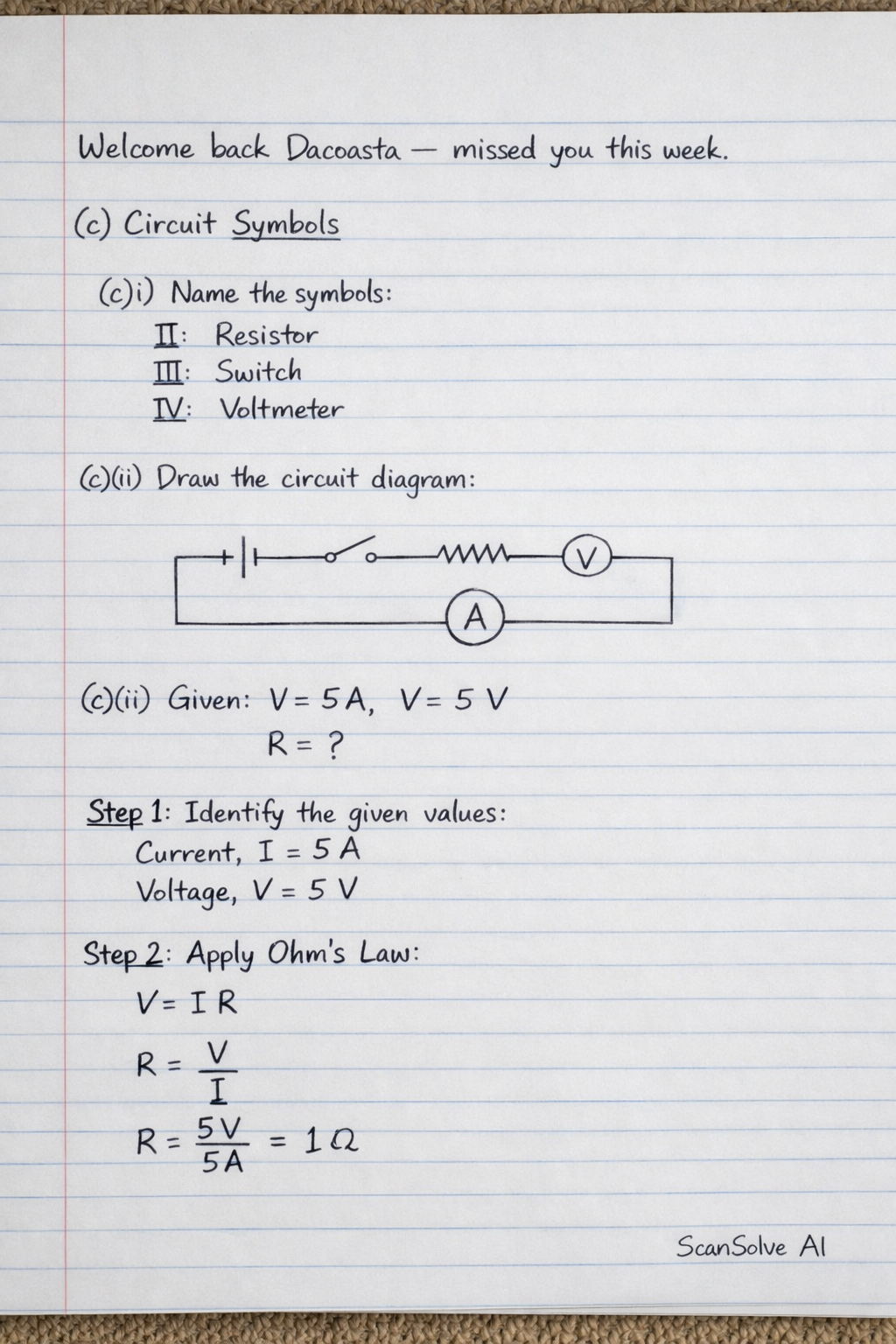
- II: Resistor
- III: Switch
- IV: Voltmeter
-
(c)(ii) Draw a circuit diagram using all the symbols labelled I, II, III, IV and V. The circuit diagram should show a cell (I), a switch (III), a resistor (II), and an ammeter (V) connected in series. A voltmeter (IV) should be connected in parallel across the resistor (II).
-
(c)(iii) If the circuit is closed and V reads 5 units with IV reading 5 units, determine the value of II in S.I. units.
Identify the given values.
Symbol V represents an ammeter, so the current $I = 5$ A. Symbol IV represents a voltmeter, so the voltage $V = 5$ V. Symbol II represents a resistor, $R$.Apply Ohm's Law.
Ohm's Law states that $V = IR$. To find the resistance $R$, we rearrange the formula: $$ R = \frac{V}{I} $$Substitute the values and calculate.
$$
R = \frac{5 \text{ V}}{5 \text{ A}}
$$
$$
R = 1 \text{ } \Omega
$$
The value of II (the resistor) is $\boxed{\text{1 Ohm}}$.
Part d· 6 steps
pH and Solutions
-
(d)(i) Identify the solution that would have a pH value equal to:
- (a) 7: This corresponds to a neutral solution. Sodium chloride (NaCl) is a salt of a strong acid and a strong base, making its solution neutral.
- Solution:
- (b) 14: This corresponds to a very strong basic solution. Sodium hydroxide (NaOH) is a strong base.
- Solution:
- (a) 7: This corresponds to a neutral solution. Sodium chloride (NaCl) is a salt of a strong acid and a strong base, making its solution neutral.
-
(d)(ii) Identify the solution that can be classified as a/an:
- (a) strong acid: Hydrochloric acid (HCl) is a strong acid.
- Solution:
- (b) neutral: Sodium chloride (NaCl) is a neutral salt.
- Solution:
- (c) weak base: Ammonia (NH₃) is a weak base.
- Solution:
- (d) weak acid: Ethanoic acid (CH₃COOH) is a weak acid.
- Solution:
- (a) strong acid: Hydrochloric acid (HCl) is a strong acid.
-
(d)(iii) Suggest the pH value of solution A.
Identify the solution and its concentration.
Solution A is 0.1 mol dm⁻³ HCl. HCl is a strong acid.Determine the hydrogen ion concentration.
For a strong acid, the concentration of hydrogen ions is equal to the acid's concentration. $$ [\text{H}^{+}] = 0.1 \text{ mol dm}^{-3} = 10^{-1} \text{ mol dm}^{-3} $$Calculate the pH.
The pH is calculated using the formula $\text{pH} = -\log_{10}[\text{H}^{+}]$. $$ \text{pH} = -\log_{10}(10^{-1}) $$ $$ \text{pH} = -(-1) $$ $$ \text{pH} = 1 $$ The pH value of solution A is $\boxed{\text{1}}$.-
(d)(iv) Identify two solutions in the table that will react to form salt and water. This reaction is a neutralization reaction between an acid and a base. From the table, acids are A (HCl) and B (CH₃COOH). Bases are D (NH₃) and E (NaOH). Two solutions that will react to form salt and water are .
-
(d)(v) What would be the colour of solution C upon addition of drops of universal indicator.
-
Identify solution C.
Solution C is 0.1 mol dm⁻³ NaCl.Determine the nature of solution C.
NaCl is a salt formed from a strong acid (HCl) and a strong base (NaOH), making it a neutral solution with a pH of 7.State the universal indicator color for a neutral solution.
Universal indicator turns $\boxed{\text{green}}$ in a neutral solution.
Still stuck on this one?
Ask a follow-up, and the answer starts from this question.
More Physics Questions
Handwritten Step-by-Step Solution
Get this as a handwritten image on WhatsApp — like a tutor wrote it for you.
Try on WhatsApp