
We read your photo as:
(ii)Use the average velocity to derive S= ut + 1/2 at2 (4 marks)
ScanSolve AI Answer
Answer
Step-by-step solution
5 stepsDefine average velocity.
For an object moving with constant acceleration, the average velocity () is the arithmetic mean of its initial velocity () and final velocity ().
Relate displacement to average velocity and time.
Displacement () is the product of average velocity and time ().
Substitute the expression for from Step 1 into this equation:
Use the first equation of motion.
The first equation of motion states that the final velocity () is equal to the initial velocity () plus the product of acceleration () and time ().
Substitute the expression for into the displacement equation.
Substitute into the equation for from Step 2:
Simplify the expression.
Distribute :
This is the required kinematic equation.
Try one yourself
A new problem that tests the same skill.
Still stuck on this one?
Ask a follow-up, and the answer starts from this question.
More Physics Questions
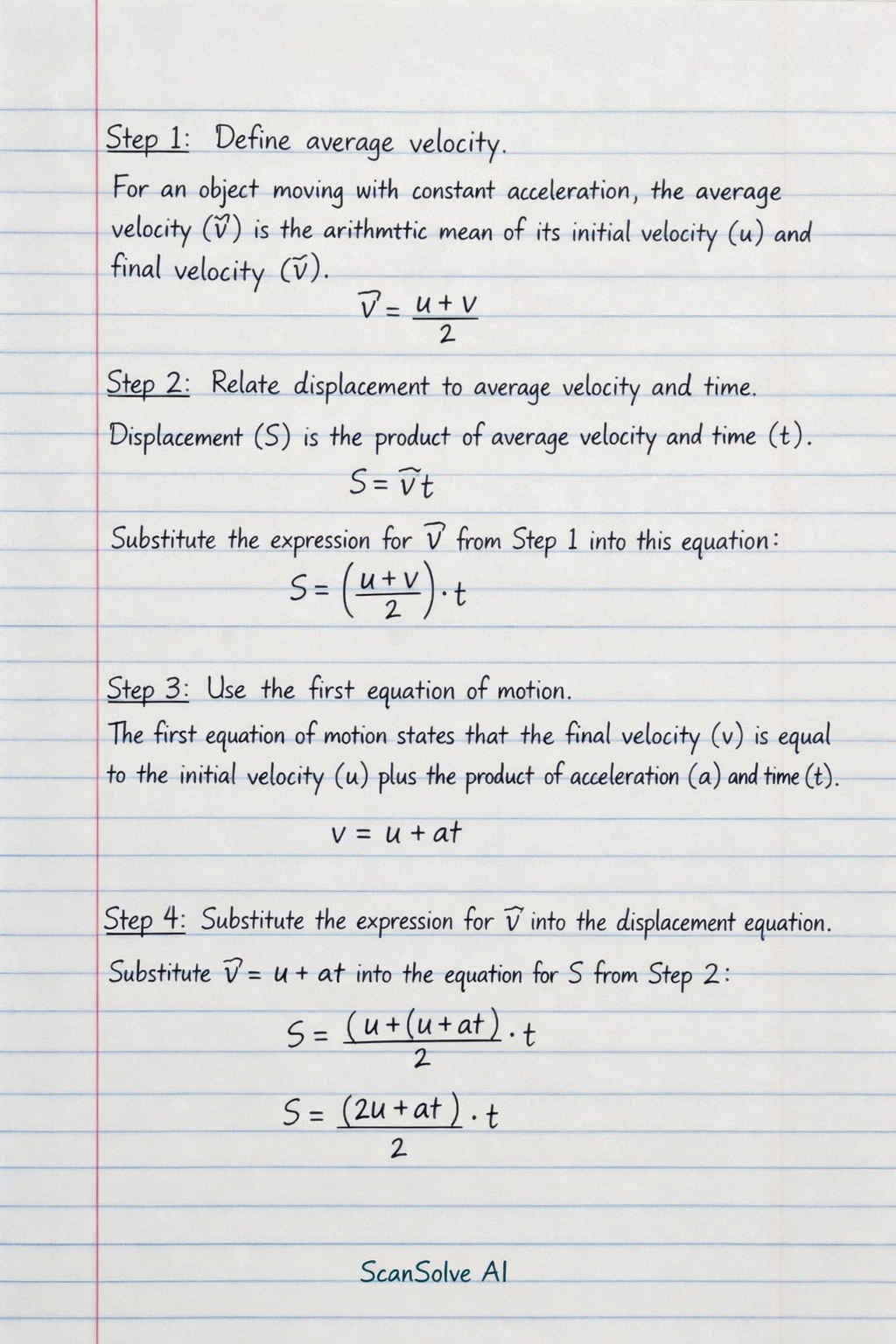
Handwritten Step-by-Step Solution
Get this as a handwritten image on WhatsApp — like a tutor wrote it for you.
Try on WhatsApp