
We read your photo as:
Calculate the impulse experienced by a 60 kg patient hitting a surface with an initial velocity of 1 m/s and coming to a stop.
Physics
ScanSolve AI Answer
Answer
Step-by-step solution
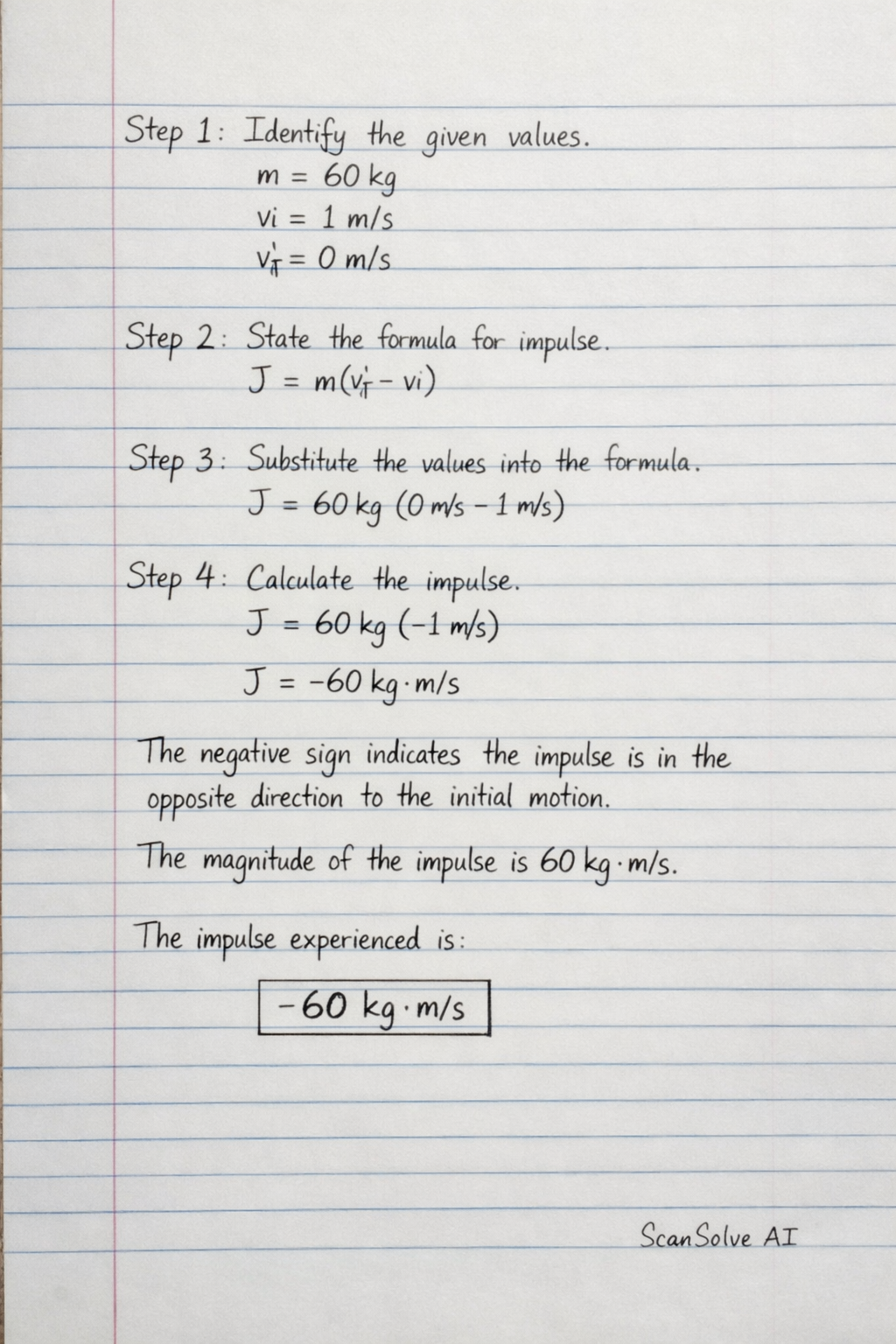
4 stepsIdentify the given values.
The mass of the patient is .
The initial velocity upon impact is .
The final velocity after stopping is .State the formula for impulse.
Impulse () is the change in momentum, given by the formula:
Substitute the values into the formula.
Calculate the impulse.
The negative sign indicates that the impulse is in the opposite direction to the initial motion. The magnitude of the impulse is .
The impulse experienced is .
Was this helpful?
Try one yourself
A new problem that tests the same skill.
Still stuck on this one?
Ask a follow-up, and the answer starts from this question.
Got a different question?Ask your own question
More Physics Questions
QExplain impulse and calculate the impulse experienced by a ball during a collision, and determine…Q1.1 Define the term impulse. 3.1.2 Calculate the magnitude of the force that the truck exerts on the…QCalculate the potential energy of a 50 kg body at a height of 1.5 m, and its kinetic energy if it…QA body of 25 kg falls from a height of 6 m and comes to rest. Calculate its potential energy…QA body of mass 5kg starts from rest and is acted upon by a force 1000N. The acceleration in ms⁻² and…
Browse by topic:Mechanics
Handwritten Step-by-Step Solution
Get this as a handwritten image on WhatsApp — like a tutor wrote it for you.
Try on WhatsApp