
We read your photo as:
In a meter bridge, initially the balance point is found at 50 cm. When the resistance in the left gap is increased by 5 ohms, the balance point shifts to 60 cm. Calculate the original resistances in t
ScanSolve AI Answer
Answer
Step-by-step solution
5 stepsUnderstand the meter bridge principle.
In a meter bridge, the balance condition is given by the ratio of resistances being equal to the ratio of the corresponding lengths:
Since the total length of the wire is , if is the length from one end, then .
So, the formula becomes:Apply the initial condition.
Initially, the balance point is at .
Substituting this into the formula:This implies that . Let's call this original resistance . So, and .
Determine which resistance was increased.
The balance point shifts from to . This means increased.
For to increase, the ratio must increase.
If is increased, then would be greater than , causing to increase.
If is increased, then would be less than , causing to decrease.
Since the balance point shifted from to (an increase in ), it means the resistance (the one corresponding to ) was increased by .Apply the final condition.
The new resistance in the first gap is .
The resistance in the second gap remains .
The new balance point is .
Substituting these values into the meter bridge formula:Solve for .
Simplify the ratio :
Cross-multiply:
Subtract from both sides:
The original resistances were and .
Therefore, the original resistances are and .The original resistances are .
Try one yourself
A new problem that tests the same skill.
Still stuck on this one?
Ask a follow-up, and the answer starts from this question.
More Physics Questions
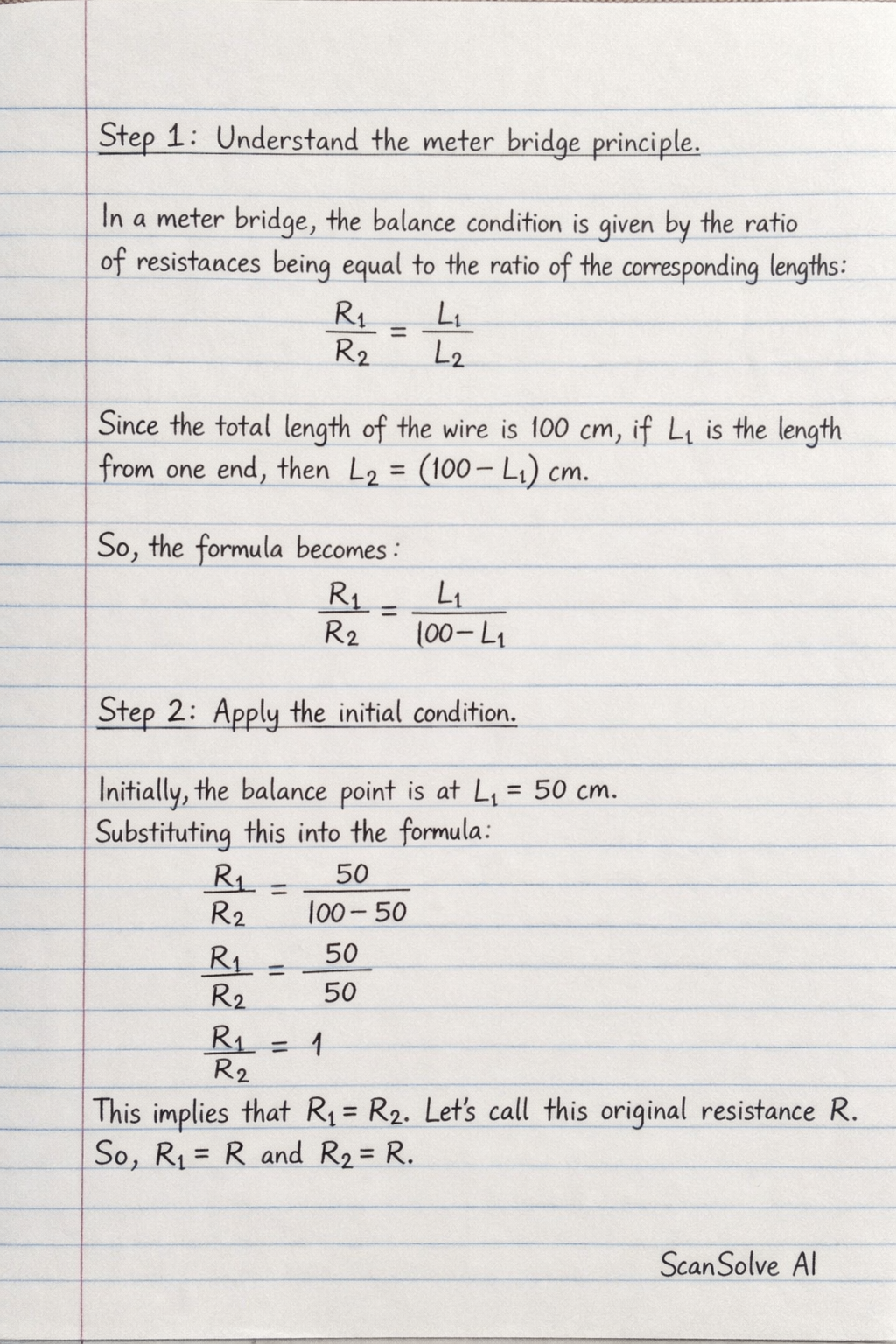
Handwritten Step-by-Step Solution
Get this as a handwritten image on WhatsApp — like a tutor wrote it for you.
Try on WhatsApp