
We read your photo as:
In an experiment the tension of a vibration string was kept constant while its length was varied so as to tune the string to series of vibrating tuning forks. A student obtained the following result: Draw a graph for the set of observation and fit the "best" straight line to them.
ScanSolve AI Answer
Answers
3 partsStep-by-step solution
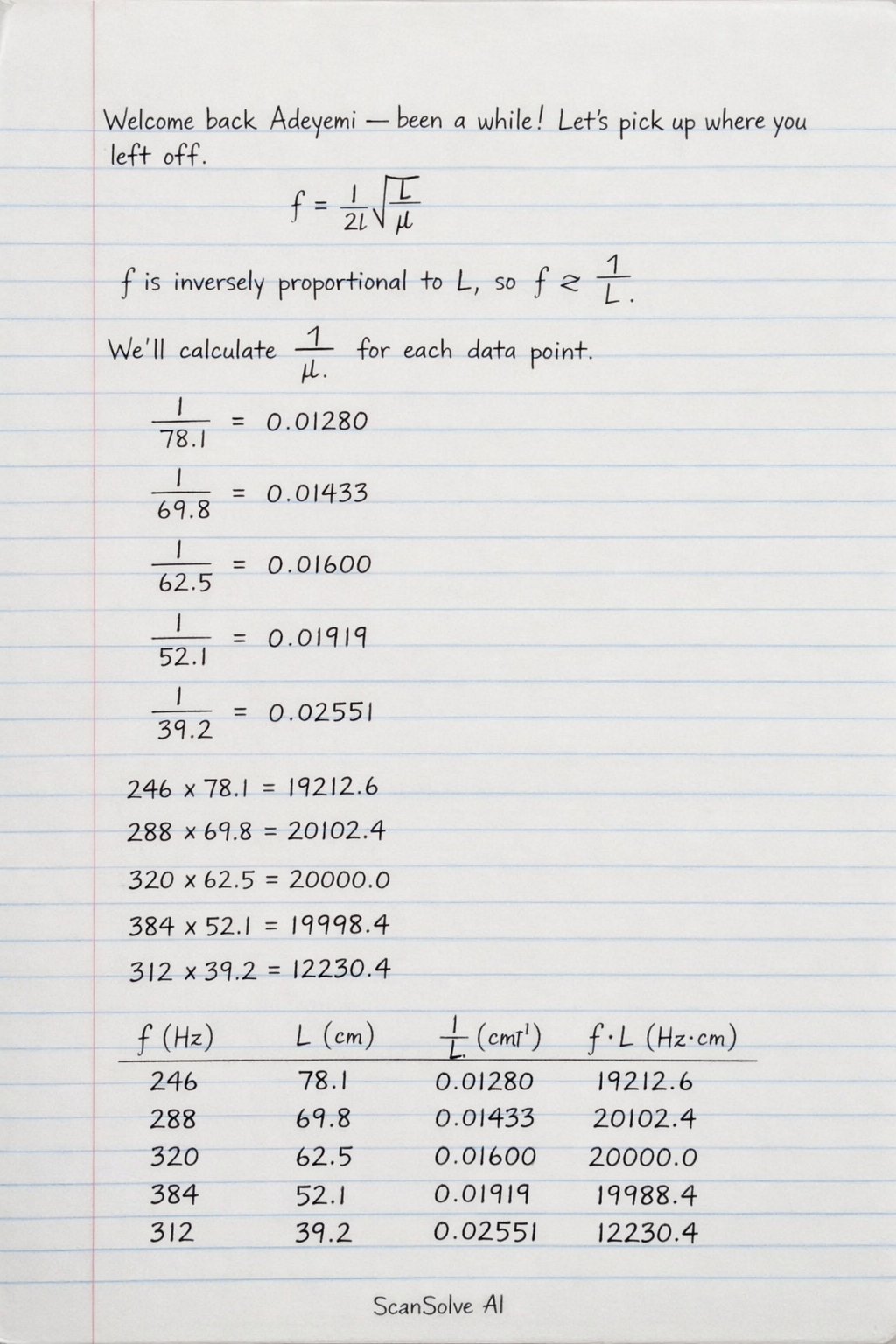
8 stepsThe relationship between the frequency () and length () of a vibrating string with constant tension is given by , where is tension and is linear density. This implies that is inversely proportional to , or . To obtain a straight line graph, we should plot against .
First, let's calculate for each data point.
| Frequency (Hz) | Length (cm) | (cm⁻¹) | (Hz·cm) |
|---|---|---|---|
| 246 | 78.1 | 0.01280 | 19212.6 |
| 288 | 69.8 | 0.01433 | 20102.4 |
| 320 | 62.5 | 0.01600 | 20000.0 |
| 384 | 52.1 | 0.01919 | 19998.4 |
| 312 | 39.2 | 0.02551 | 12230.4 |
Notice that the product is approximately constant for the first four points (around 20000 Hz·cm), but the last point (312 Hz, 39.2 cm) gives a significantly different product (12230.4 Hz·cm). This indicates that the last data point is an outlier. For the "best" straight line fit, we will exclude this outlier and use the first four data points for the linear regression.
Part a· 2 steps
**Draw a graph for the set of observation and fit the "best" straight line to them.
Prepare the data for plotting.
Calculate the inverse of the length, , for each of the first four data points:
- For ,
- For ,
- For ,
- For ,
Describe how to draw the graph.
Plot frequency (in Hz) on the y-axis and (in cm⁻¹) on the x-axis. Mark the four data points: , , , and . Draw a straight line that best fits these four points. This line should pass close to the origin, as theoretically, when (i.e., ).
Part b
**Find the slope and intercept of the graph.
Calculate sums for linear regression using the first four points.
Let and .
Calculate the slope () and intercept ().
The formulas for linear regression are:
Substitute the calculated sums:
Rounding to four significant figures, the slope is .
Rounding to three significant figures, the intercept is .
Part c
**Find the relationship between the frequency (f) of the vibration and the length (l) of the stretched string.
State the theoretical relationship.
The theoretical relationship for a vibrating string is , where is a constant.
State the experimental relationship.
Using the calculated slope () and intercept () from part (b), the experimental relationship is in the form .
Substituting the values:The relationship is , where is in Hz and is in cm.
Part d
**What is the frequency of an unmarked fork which was in tune with a length of 45.0 cm?
Use the relationship found in part (c).
Given .
Substitute the value of and calculate .
Rounding to one decimal place, the frequency is .
Try one yourself
A new problem that tests the same skill.
Still stuck on this one?
Ask a follow-up, and the answer starts from this question.
More Physics Questions
Handwritten Step-by-Step Solution
Get this as a handwritten image on WhatsApp — like a tutor wrote it for you.
Try on WhatsApp