
We read your photo as:
Describe the magnetic fields for Figure 6 (a), (b), and (c) using the Right Hand Rule.
Physics
ScanSolve AI Answer
Step-by-step solution
4 stepsDescribe the magnetic fields for Figure 6 (a), (b), and (c) using the Right Hand Rule.
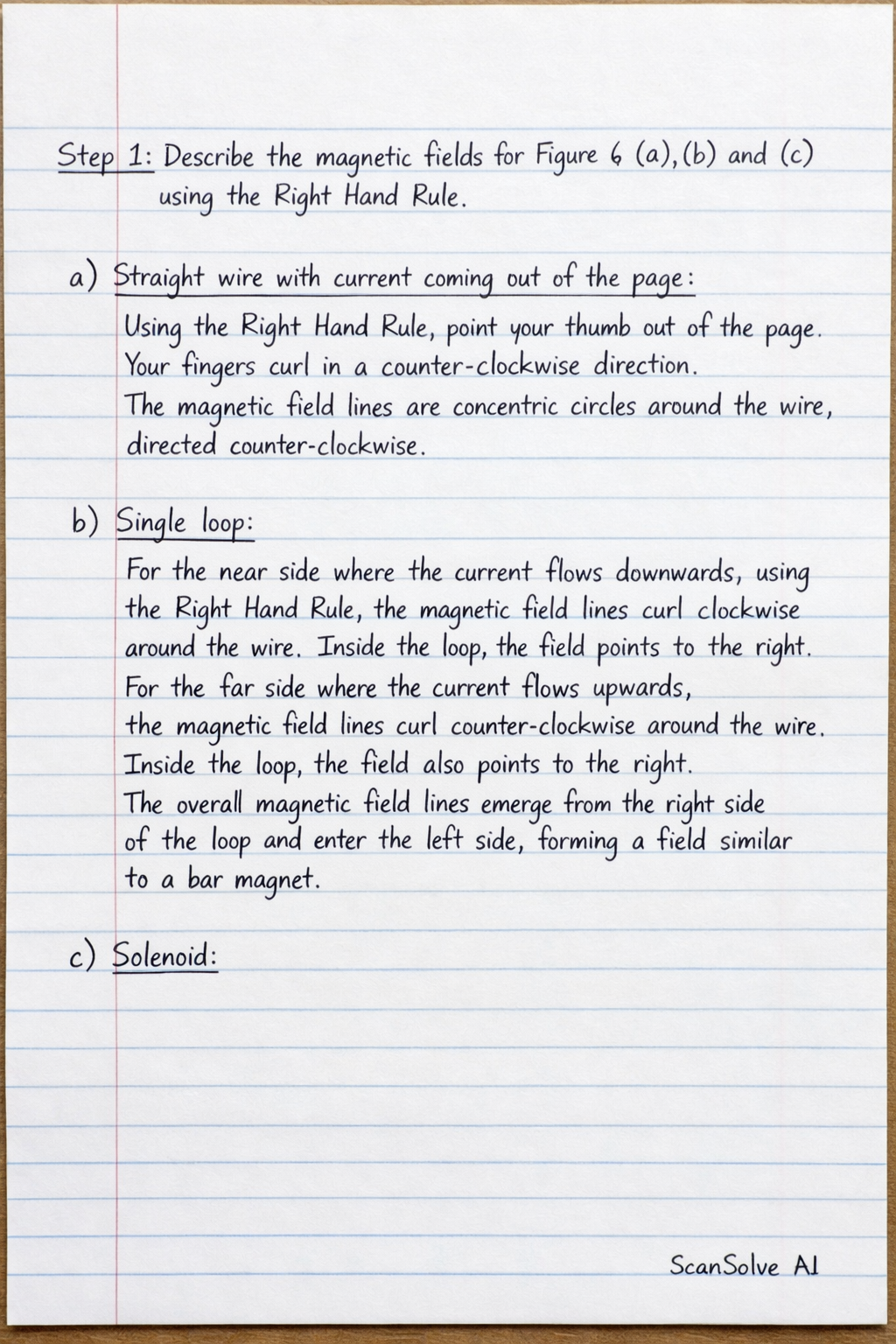
- a) Straight wire with current coming out of the page: Using the Right Hand Rule, point your thumb out of the page. Your fingers curl in a counter-clockwise direction. The magnetic field lines are concentric circles around the wire, directed counter-clockwise.
- b) Single loop: For the near side where the current flows downwards, using the Right Hand Rule, the magnetic field lines curl clockwise around the wire. Inside the loop, the field points to the right. For the far side where the current flows upwards, the magnetic field lines curl counter-clockwise around the wire. Inside the loop, the field also points to the right. The overall magnetic field lines emerge from the right side of the loop and enter the left side, forming a field similar to a bar magnet.
- c) Solenoid: Using the Right Hand Solenoid Rule, curl your fingers in the direction of the current (downwards on the front side of the coils). Your thumb points to the left. The magnetic field lines inside the solenoid are parallel and uniform, directed to the left. Outside the solenoid, the field lines loop from the left end to the right end.
Indicate regions of strongest magnetic field and solenoid poles.
- a) Straight wire: The magnetic field is strongest closest to the wire.
- b) Single loop: The magnetic field is strongest inside the loop, particularly at its center, and also closest to the wire itself.
- c) Solenoid: The magnetic field is strongest inside the solenoid, where it is uniform. Based on the Right Hand Solenoid Rule, the left end of the solenoid acts as the North pole, and the right end acts as the South pole.
Explain how to decrease the magnetic field of the solenoid.
To decrease the magnetic field of a solenoid, the current flowing through it must be reduced. According to Ohm's Law, , where is current, is voltage, and is resistance. To decrease the current () while the voltage () remains constant, the resistance () of the variable resistor must be increased.
Discuss environmental concerns and safety precautions for transmission lines and overhead cables.
- Environmental Concerns:
- Visual impact: Large transmission towers and lines can be aesthetically disruptive to landscapes.
- Habitat disruption: Construction of new lines can lead to deforestation and disturbance of wildlife habitats.
- Electromagnetic fields (EMF): There are ongoing public concerns about potential health effects from EMFs, although scientific consensus generally indicates that typical exposure levels are safe.
- Bird collisions: Birds can collide with power lines, leading to injury or death.
- Safety Precautions:
- Clearance distances: Strict regulations require maintaining safe distances between power lines and buildings, trees, and other structures to prevent arcing and contact.
- Warning signs: High voltage warning signs are posted on towers and near substations to alert the public to danger.
- Insulation and grounding: Wires are insulated, and systems are properly grounded to prevent electrical shocks and short circuits.
- Regular maintenance: Routine inspections and maintenance are crucial to identify and repair damaged lines or equipment, preventing failures and hazards.
- Public awareness: Education campaigns inform the public about the dangers of power lines and what to do in an emergency.
- Environmental Concerns:
Was this helpful?
Still stuck on this one?
Ask a follow-up, and the answer starts from this question.
Got a different question?Ask your own question
More Physics Questions
QDetermine the direction of the magnetic field.QIdentify the polarity of end D and describe the direction of magnetic field lines between the…QA) Explain how the plotting compasses show that bar AB is a magnet. b) Draw the magnetic field lines…QDraw the magnetic field lines for a bar magnetQExplain the observations and conclusions about induced currents from magnetic field changes, and…
Browse by topic:Electromagnetism
Handwritten Step-by-Step Solution
Get this as a handwritten image on WhatsApp — like a tutor wrote it for you.
Try on WhatsApp