
We read your photo as:
Calculate the magnitude and direction of the resultant force of two forces: an 8 N horizontal force and a 5 N force at 45 degrees to the horizontal.
ScanSolve AI Answer
Answer
Step-by-step solution
4 stepsHere's the solution for the resultant force:
Define the two forces and resolve them into components.
Let be the horizontal force of 8 N.
Let be the force of 5 N inclined at to the horizontal.For :
Since it's a horizontal force, its components are:For :
The force is 5 N at to the horizontal.Sum the x-components and y-components to find the resultant force components.
Let the resultant force be .
Total x-component ():Total y-component ():
Calculate the magnitude of the resultant force.
The magnitude of the resultant force, , is found using the Pythagorean theorem:
Calculate the direction of the resultant force.
The direction is found using the arctangent function, measured from the horizontal axis:
Since both and are positive, the direction is above the horizontal.
The magnitude of the resultant force is and its direction is .
Try one yourself
A new problem that tests the same skill.
Still stuck on this one?
Ask a follow-up, and the answer starts from this question.
More Physics Questions
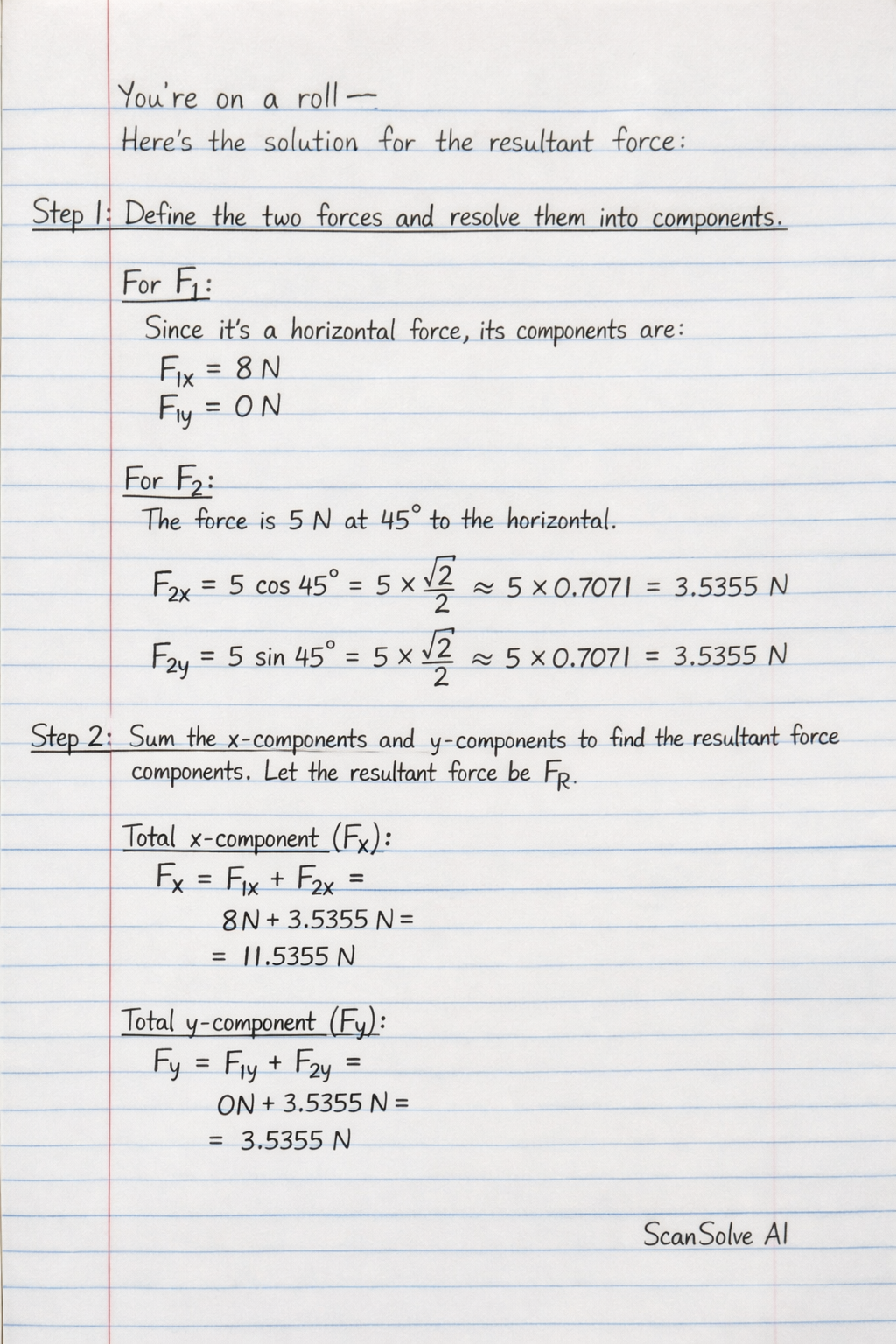
Handwritten Step-by-Step Solution
Get this as a handwritten image on WhatsApp — like a tutor wrote it for you.
Try on WhatsApp