
We read your photo as:
Explain the mirror formula and sign conventions.
Physics
ScanSolve AI Answer
Step-by-step solution
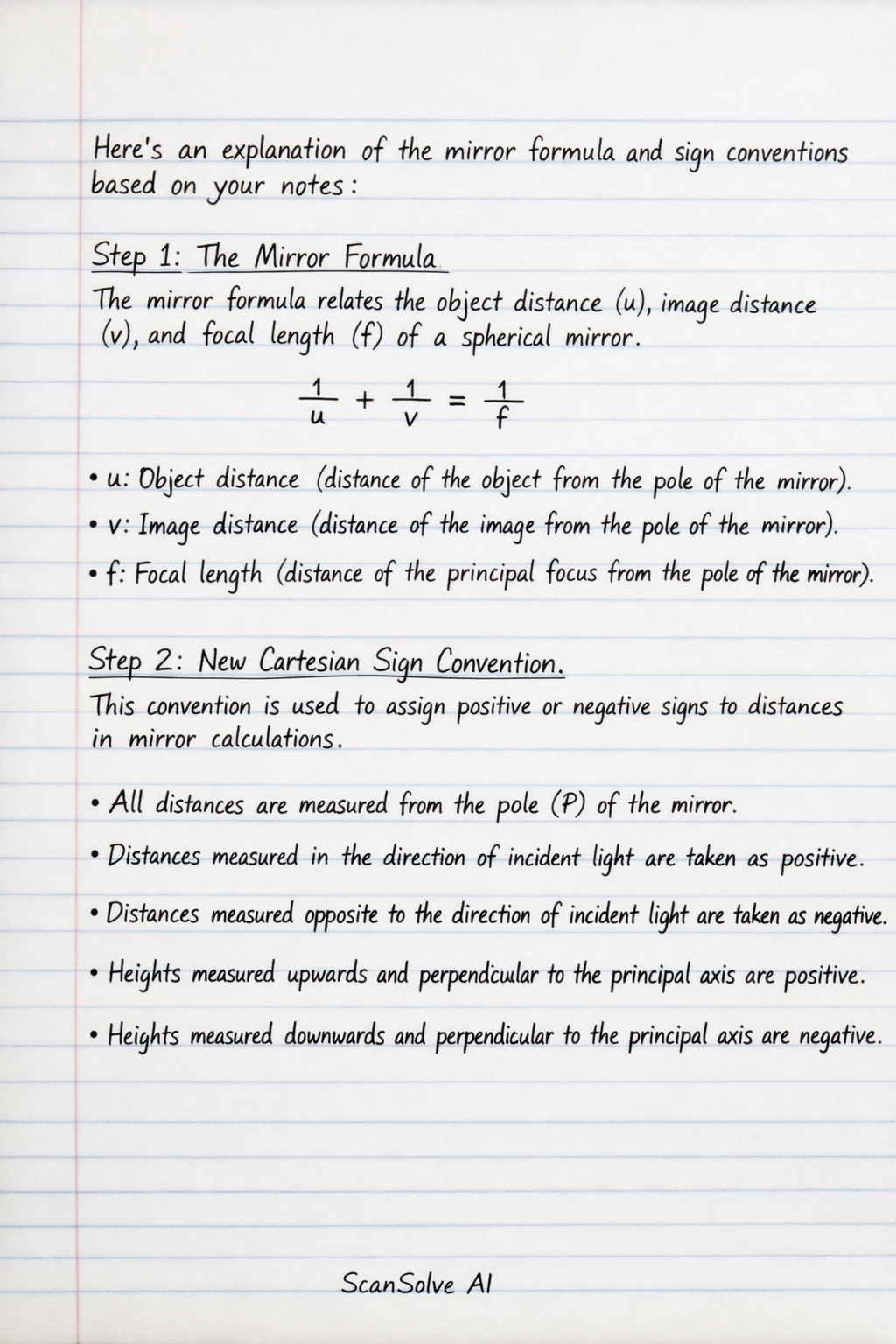
3 stepsHere's an explanation of the mirror formula and sign conventions based on your notes:
The Mirror Formula
The mirror formula relates the object distance (), image distance (), and focal length () of a spherical mirror.
- : Object distance (distance of the object from the pole of the mirror).
- : Image distance (distance of the image from the pole of the mirror).
- : Focal length (distance of the principal focus from the pole of the mirror).
New Cartesian Sign Convention
This convention is used to assign positive or negative signs to distances in mirror calculations.
- All distances are measured from the pole (P) of the mirror.
- Distances measured in the direction of incident light are taken as positive.
- Distances measured opposite to the direction of incident light are taken as negative.
- Heights measured upwards and perpendicular to the principal axis are positive.
- Heights measured downwards and perpendicular to the principal axis are negative.
Applying these rules:
- Object distance (): For a real object placed in front of the mirror, incident light travels from the object towards the mirror. Distances are measured from the pole against the direction of incident light, so is always negative.
- Image distance ():
- For a real image (formed in front of the mirror), is negative.
- For a virtual image (formed behind the mirror), is positive.
- Focal length ():
- For a concave mirror, the focal point is in front of the mirror, so is negative.
- For a convex mirror, the focal point is behind the mirror, so is positive.
Image Characteristics
- Concave Mirror (Object between P and F): As shown in your top diagram, when an object is placed between the pole and the focal point of a concave mirror, the image formed is upright, magnified, virtual, and located behind the mirror.
- Convex Mirror: As shown in your second diagram, a convex mirror always forms an image that is erect (upright), diminished (smaller than the object), virtual, and located between the pole and the focal point behind the mirror.
Was this helpful?
Still stuck on this one?
Ask a follow-up, and the answer starts from this question.
Got a different question?Ask your own question
More Physics Questions
QComplete the table showing which letters undergo lateral inversion in a plane mirror.QComplete the diagram to show the position of the object formed by a convex mirror.QWhat is mirror in physicsQHow do you draw a ray diagram for a convex mirror, and what are the characteristics of the image…QProvide a typical curved Mirror and label all the parts
Handwritten Step-by-Step Solution
Get this as a handwritten image on WhatsApp — like a tutor wrote it for you.
Try on WhatsApp