
We read your photo as:
Calculate the moment of inertia and initial angular momentum of a turntable.
ScanSolve AI Answer
This answer stops before the end.
It was cut off when it was first written. Ask ScanSolve this question again for the full working.
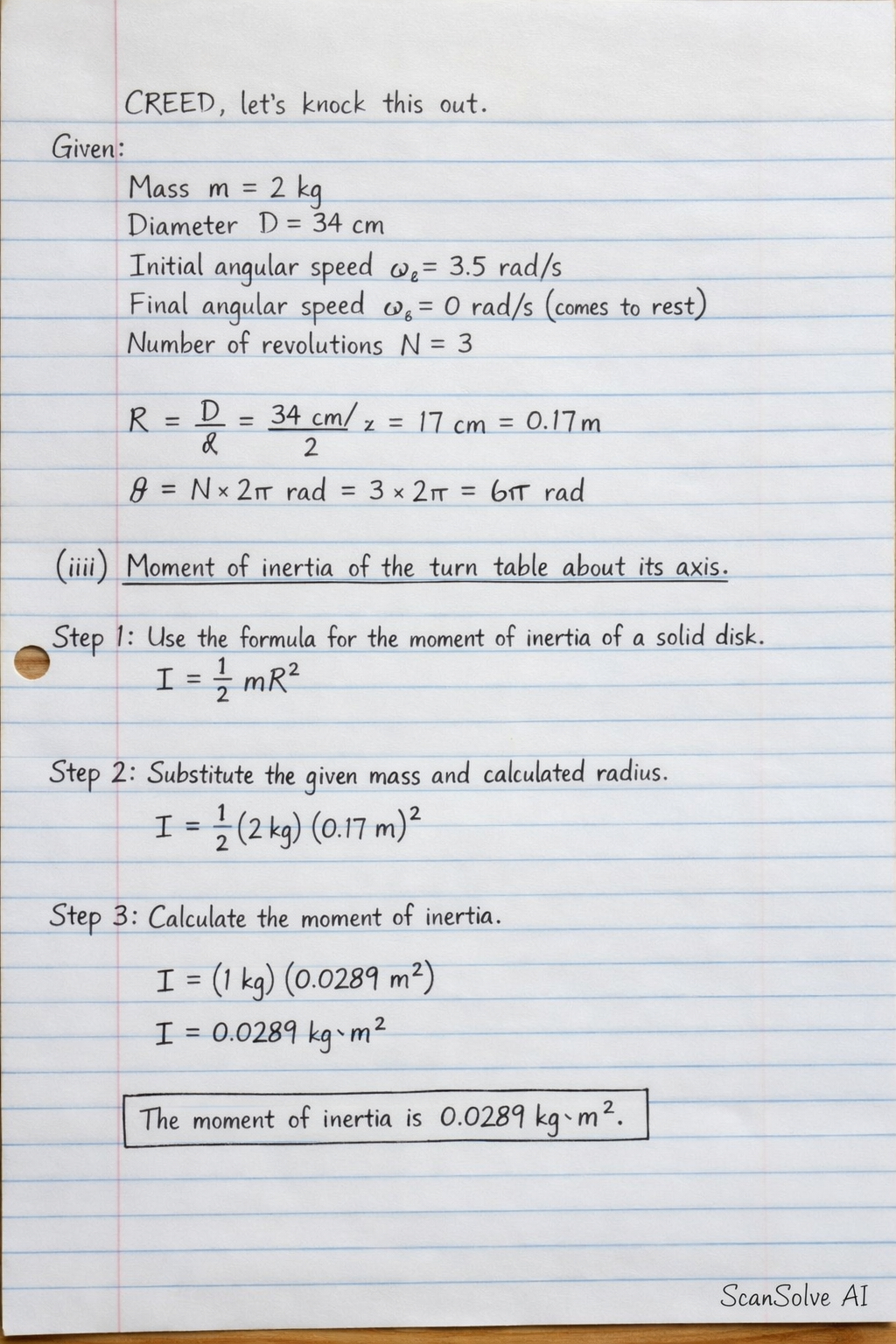
Given:
Mass
Diameter
Initial angular speed
Final angular speed (comes to rest)
Number of revolutions
First, convert the diameter to radius in meters and calculate the total angular displacement:
Radius
Angular displacement
(iii) Moment of inertia of the turn table about its axis.
Step 1: Use the formula for the moment of inertia of a solid disk.
For a solid disk rotating about its central axis, the moment of inertia is given by:
Step 2: Substitute the given mass and calculated radius.
Step 3: Calculate the moment of inertia.
The moment of inertia is .
(i) Angular momentum
Step 1: Use the formula for angular momentum.
Angular momentum is given by . Since the question refers to an initial speed, we calculate the initial angular momentum .
Step 2: Substitute the calculated moment of inertia and initial angular speed.
Step 3: Calculate the initial angular momentum.
The initial angular momentum is .
(ii) The time taken for it to come to rest after it is switched off.
Step 1: Calculate the angular acceleration () using rotational kinematics.
We use the equation:
Still stuck on this one?
Ask a follow-up, and the answer starts from this question.
More Physics Questions
Handwritten Step-by-Step Solution
Get this as a handwritten image on WhatsApp — like a tutor wrote it for you.
Try on WhatsApp