
We read your photo as:
Calculate the net force on charge q1, given the charges and distances of q2 and q3 relative to q1.
ScanSolve AI Answer
Answer
Step-by-step solution
3 stepsLet's go through the solution you provided for the net force on .
First, let's recall the charges and distances from the previous context:
- Distance between and is .
- Distance between and is .
The solution you provided makes a reasonable assumption about the arrangement of the charges, which was not explicitly stated in the original problem. It assumes a linear arrangement where and are on opposite sides of . This means the distance between and is the sum of their distances from : .
Let's verify the steps:
Calculate the force of on ().
The formula for Coulomb's Law is , where .
Since and are both positive, the force is repulsive. The value is a correctly rounded value.
Calculate the force of on ().
The distance between and is .
Since is positive and is negative, the force is attractive. This calculation is correct.
Determine the net force on .
Given the assumed linear arrangement (e.g., ), the force (repulsive from ) acts away from , and the force (attractive from ) acts towards . These two forces are in opposite directions. Therefore, the net force is the difference between their magnitudes.
The value in your provided solution is slightly different due to rounding to before subtraction. If we use , then . This is consistent with the rounding in the provided solution.
The solution you provided is ✅ Correct based on the implied linear arrangement of charges where and are on opposite sides of .
The net force on is .
Try one yourself
A new problem that tests the same skill.
Still stuck on this one?
Ask a follow-up, and the answer starts from this question.
More Physics Questions
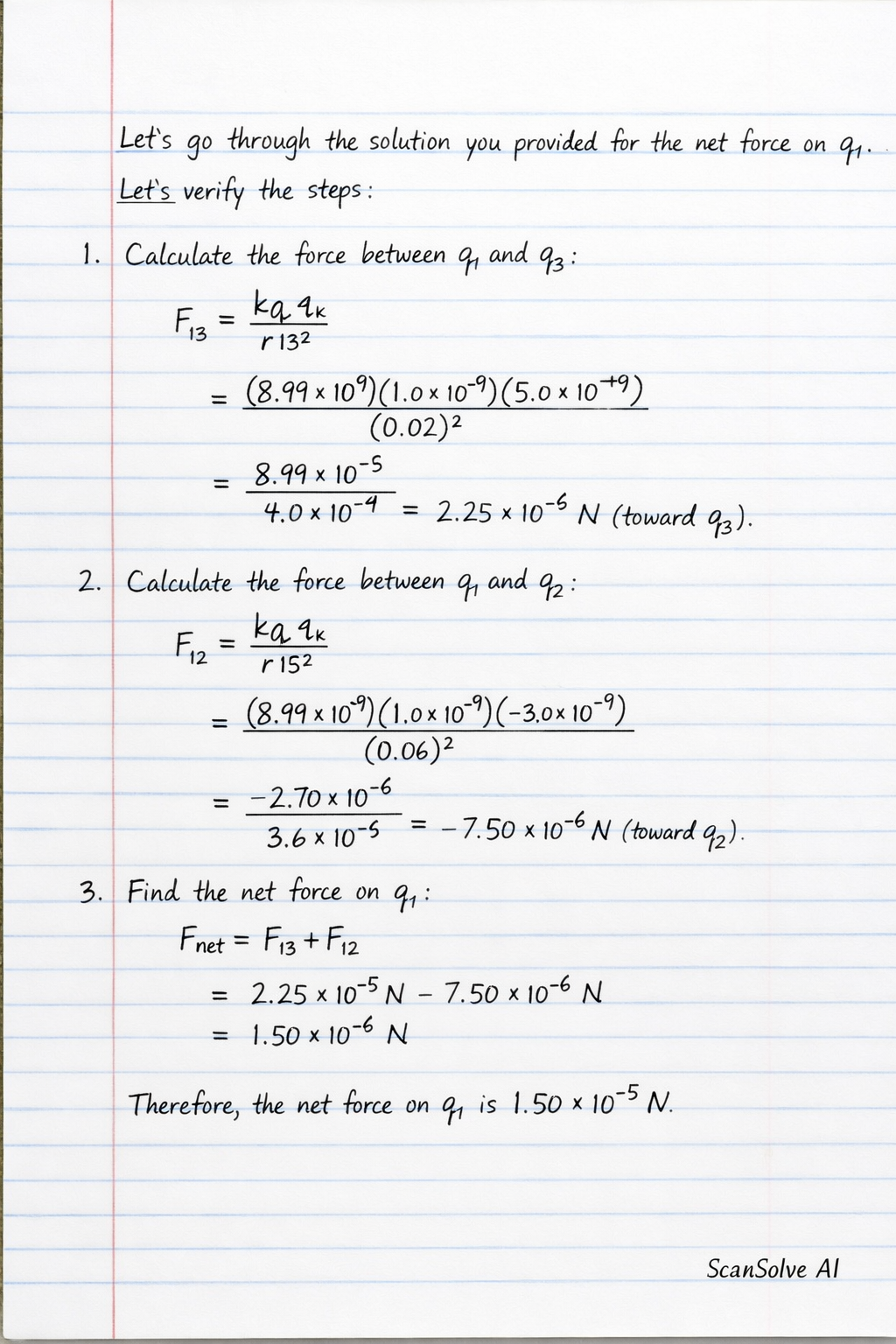
Handwritten Step-by-Step Solution
Get this as a handwritten image on WhatsApp — like a tutor wrote it for you.
Try on WhatsApp