
We read your photo as:
Describe the nuclear reaction shown and identify the isotope with the longest half-life and calculate the relative atomic mass of uranium.
ScanSolve AI Answer
Step-by-step solution
14 steps4. (a)
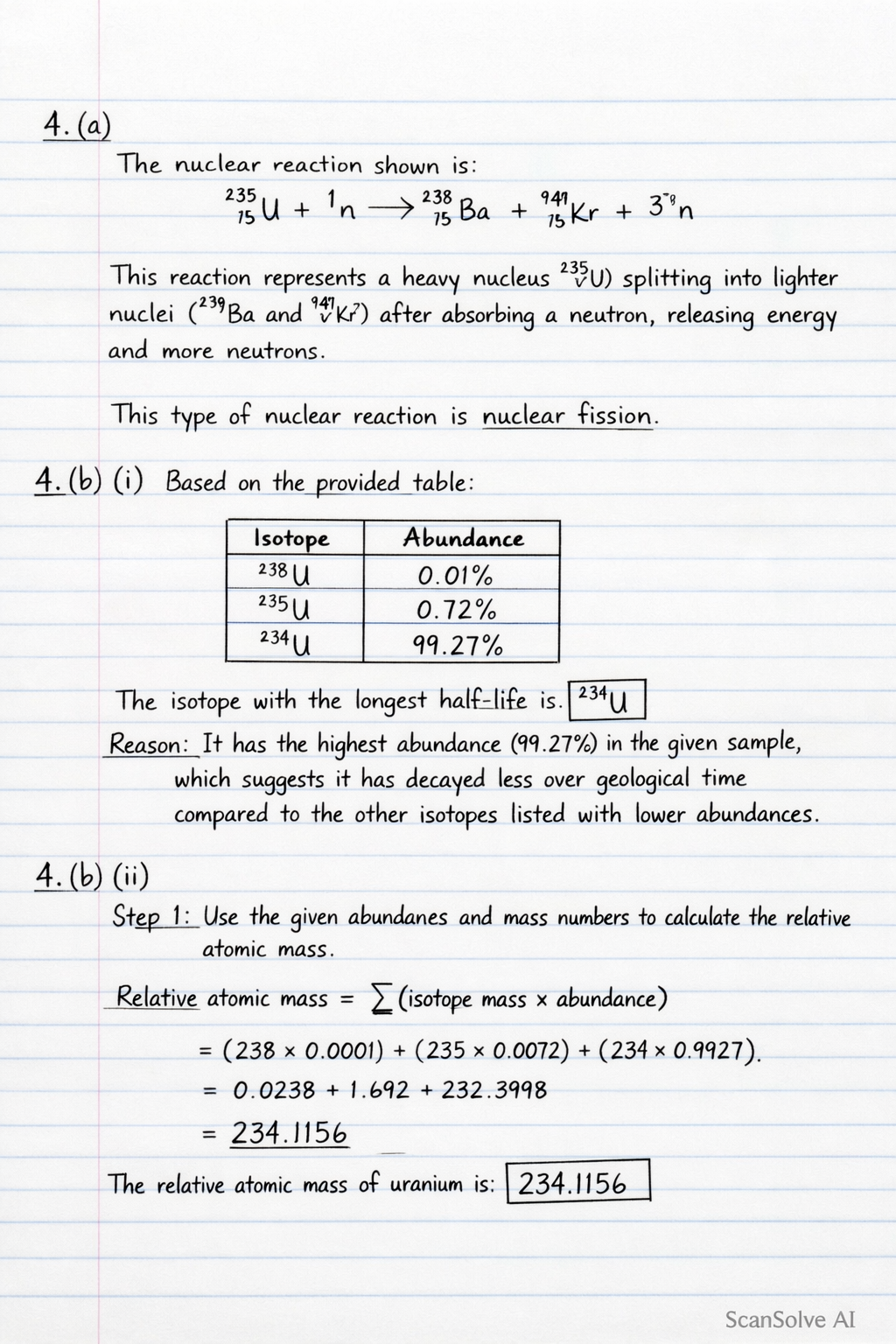
The nuclear reaction shown is:
This reaction represents a heavy nucleus () splitting into lighter nuclei ( and ) after absorbing a neutron, releasing energy and more neutrons.
This type of nuclear reaction is nuclear fission.
4. (b) (i)
Based on the provided table:
| Isotope | Abundance |
|---|---|
| 0.01% | |
| 0.72% | |
| 99.27% |
The isotope with the longest half-life is .
Reason: It has the highest abundance (99.27%) in the given sample, which suggests it has decayed less over geological time compared to the other isotopes listed with lower abundances.
4. (b) (ii)
Use the given abundances and mass numbers to calculate the relative atomic mass.
Relative atomic mass =
The relative atomic mass of uranium is .
4. (b) (iii)
Write the incomplete nuclear equation for alpha decay of to Thorium (Th).
Balance the mass numbers (superscripts).
Balance the atomic numbers (subscripts).
Write the complete nuclear equation.
4. (b) (iv)
One use of radioactive isotopes in the paper industry is to .5. (a)
Write the incomplete nuclear equation for the decay of carbon-14 () to nitrogen ().
Balance the mass numbers (superscripts).
Balance the atomic numbers (subscripts).
Identify the emitted particle.
A particle with mass number 0 and atomic number -1 is a beta particle ().
Write the complete nuclear equation.
5. (b) (i)
Locate 50% on the y-axis (percentage of carbon-14 left).
Draw a horizontal line from 50% to intersect the decay curve.
From the intersection point on the curve, draw a vertical line down to the x-axis (age of sample in years).
Read the value on the x-axis.
The value is approximately years.
The half-life of carbon-14 from the graph is .
Still stuck on this one?
Ask a follow-up, and the answer starts from this question.
More Physics Questions
Handwritten Step-by-Step Solution
Get this as a handwritten image on WhatsApp — like a tutor wrote it for you.
Try on WhatsApp