

This physics problem tests your understanding of fundamental physical laws and their applications. The step-by-step solution below breaks down the problem using relevant equations and physical reasoning.
ScanSolve AI Answer
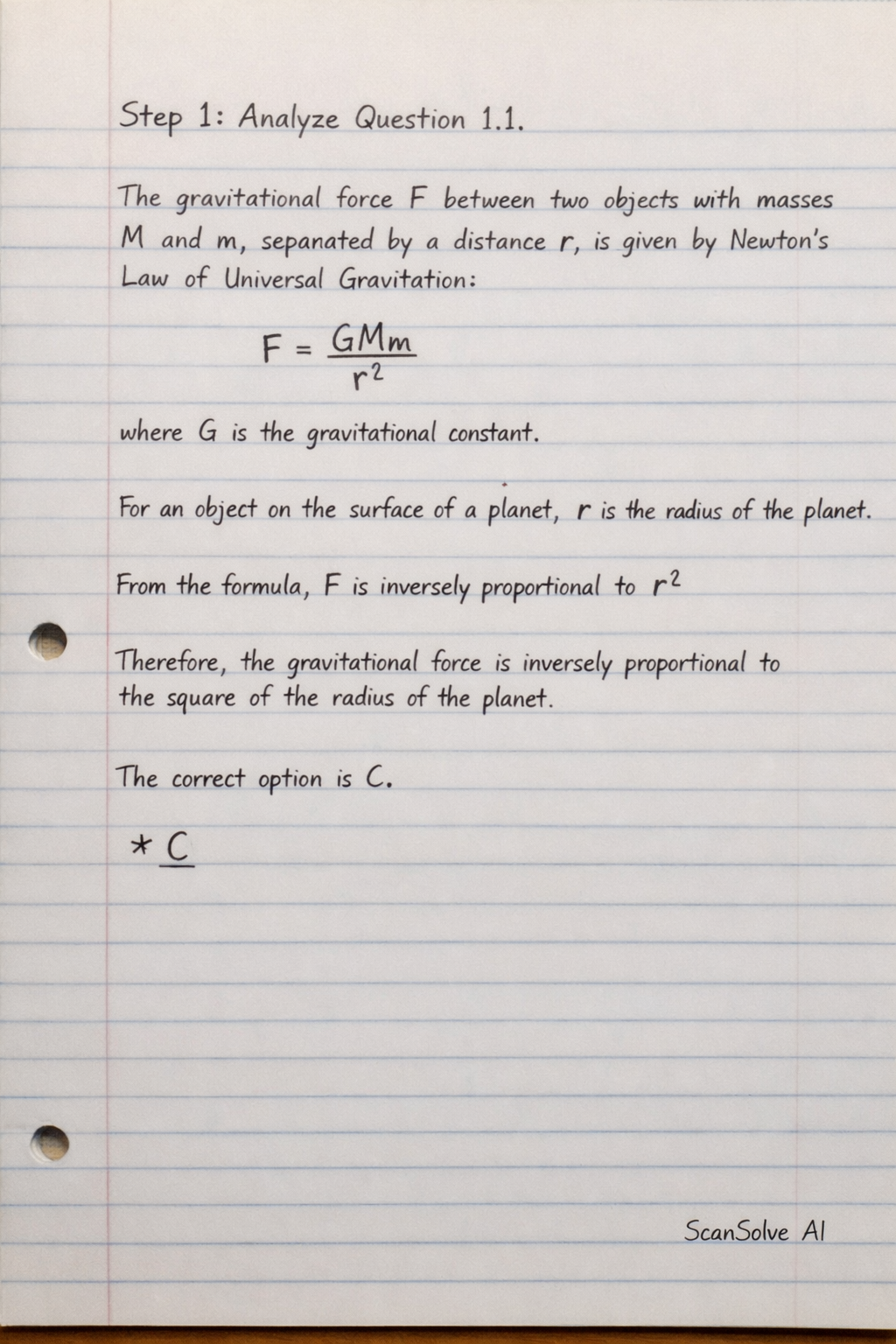
Step 1: Analyze Question 1.1. The gravitational force F between two objects with masses M and m, separated by a distance r, is given by Newton's Law of Universal Gravitation: F = (GMm)/(r^2) where G is the gravitational constant. For an object on the surface of a planet, r is the radius of the planet. From the formula, F is inversely proportional to r^2. Therefore, the gravitational force is inversely proportional to the square of the radius of the planet. The correct option is C. C Step 2: Analyze Question 1.2. The block starts from rest and moves to the right at constant acceleration. • If there is constant acceleration, the net force on the block is non-zero (F_net = ma, where a > 0). • Since the block is accelerating, its velocity is increasing. • Momentum is defined as p = mv. If velocity v increases, then momentum p increases. • Net work done W_net = K = K_f - K_i. Since velocity increases, kinetic energy K = (1)/(2)mv^2 increases, so K > 0. Thus, the net work done is not zero. • On a horizontal surface, the normal force is equal to the weight of the block, assuming no vertical acceleration. Based on this analysis, the momentum of the block increases. The correct option is B. B Step 3: Analyze Question 1.3. For an object thrown vertically upwards, we can use the kinematic equation: v_f^2 = v_i^2 + 2a y At maximum height, the final velocity v_f = 0. The acceleration a = -g (due to gravity). The displacement y is the maximum height h_max. Substituting these values: 0^2 = v_i^2 + 2(-g)h_max 0 = v_i^2 - 2gh_max 2gh_max = v_i^2 h_max = (v_i^2)/(2g) For object A: Initial velocity v_A = v. Maximum height h_A = h. So, h = (v^2)/(2g) For object B: Initial velocity v_B = 2v. Let its maximum height be h_B. Using the formula for h_max: h_B = ((2v)^2)/(2g) h_B = (4v^2)/(2g) We can rewrite this as: h_B = 4 ((v^2)/(2g)) Since h = (v^2)/(2g), we substitute h into the equation for h_B: h_B = 4h The maximum height reached by object B is 4h. The correct option is D. D