
We read your photo as:
Which of the following is a scalar quantity? a) Force b) Velocity c) Mass d) Acceleration
ScanSolve AI Answer
Answer
Step-by-step solution
6 stepsHere are the solutions to the questions:
16. Two events that cannot occur at the same time are called mutually exclusive events.
The correct option is C.
- Mutually exclusive events are events that have no common outcomes and therefore cannot happen simultaneously.
17. If events A and B are independent, then the probability of both A and B occurring, denoted as , is the product of their individual probabilities.
The correct option is B.
- For independent events, the occurrence of one does not affect the probability of the other.
18. The probability of an event and the probability of its complement always sum to 1. If is the probability of an event A, then is the probability of its complement, and .
The correct option is B.
- The sum of the probabilities of an event and its complement covers all possible outcomes.
19. A scalar quantity is defined by its magnitude only, without any direction.
The correct option is A.
- Magnitude only is the defining characteristic of a scalar quantity.
20. Among the given options:
- Force is a vector quantity (has magnitude and direction).
- Velocity is a vector quantity (has magnitude and direction).
- Mass is a scalar quantity (has magnitude only).
- Acceleration is a vector quantity (has magnitude and direction). The correct option is C.
- Mass is a measure of the amount of matter in an object and does not have a direction.
21. To find the vector from point A to point B , we subtract the coordinates of A from the coordinates of B.
Given A and B :
The correct option is B.
- The components of the vector are the differences in the x and y coordinates.
22. The magnitude of a vector is calculated using the formula .
Given :
The correct option is A.
- The magnitude represents the length of the vector.
23. A unit vector is a vector that has a magnitude of 1. It is used to indicate direction.
The correct option is B.
- By definition, a unit vector has a length of one unit.
24. In a right-angled triangle, the sine of an angle is defined as the ratio of the length of the side opposite the angle to the length of the hypotenuse.
The correct option is A.
- This is a fundamental trigonometric ratio (SOH in SOH CAH TOA).
25. In a right-angled triangle, the cosine of an angle is defined as the ratio of the length of the side adjacent to the angle to the length of the hypotenuse.
The correct option is B.
- This is a fundamental trigonometric ratio (CAH in SOH CAH TOA).
26. The angle of elevation is the angle formed by the line of sight and the horizontal line when an observer looks upwards at an object. Therefore, it is measured above the horizontal.
The correct option is B.
- The angle of elevation always points upwards from a horizontal reference.
27. The angle of depression is the angle formed by the line of sight and the horizontal line when an observer looks downwards at an object. Therefore, it is measured below the horizontal.
The correct option is A.
- The angle of depression always points downwards from a horizontal reference.
28. We are given . We can use the Pythagorean identity .
Substitute the value of .
Square the term and simplify.
Isolate .
Take the square root to find .
The correct option is B.
- The Pythagorean identity relates sine and cosine for any angle.
29. Cosecant () is defined as the reciprocal of .
The correct option is C.
- This is one of the reciprocal trigonometric identities.
30. The sum of the first natural numbers can be found using the formula .
For the first 100 natural numbers, .Substitute into the formula.
Calculate the sum.
The correct option is C.
- This formula is a special case of the sum of an arithmetic progression.
31. The conversion factor for 1 UK gallon to litres is approximately 4.546 litres.
The correct option is B.
- This is a standard unit conversion.
Try one yourself
A new problem that tests the same skill.
Still stuck on this one?
Ask a follow-up, and the answer starts from this question.
More Physics Questions
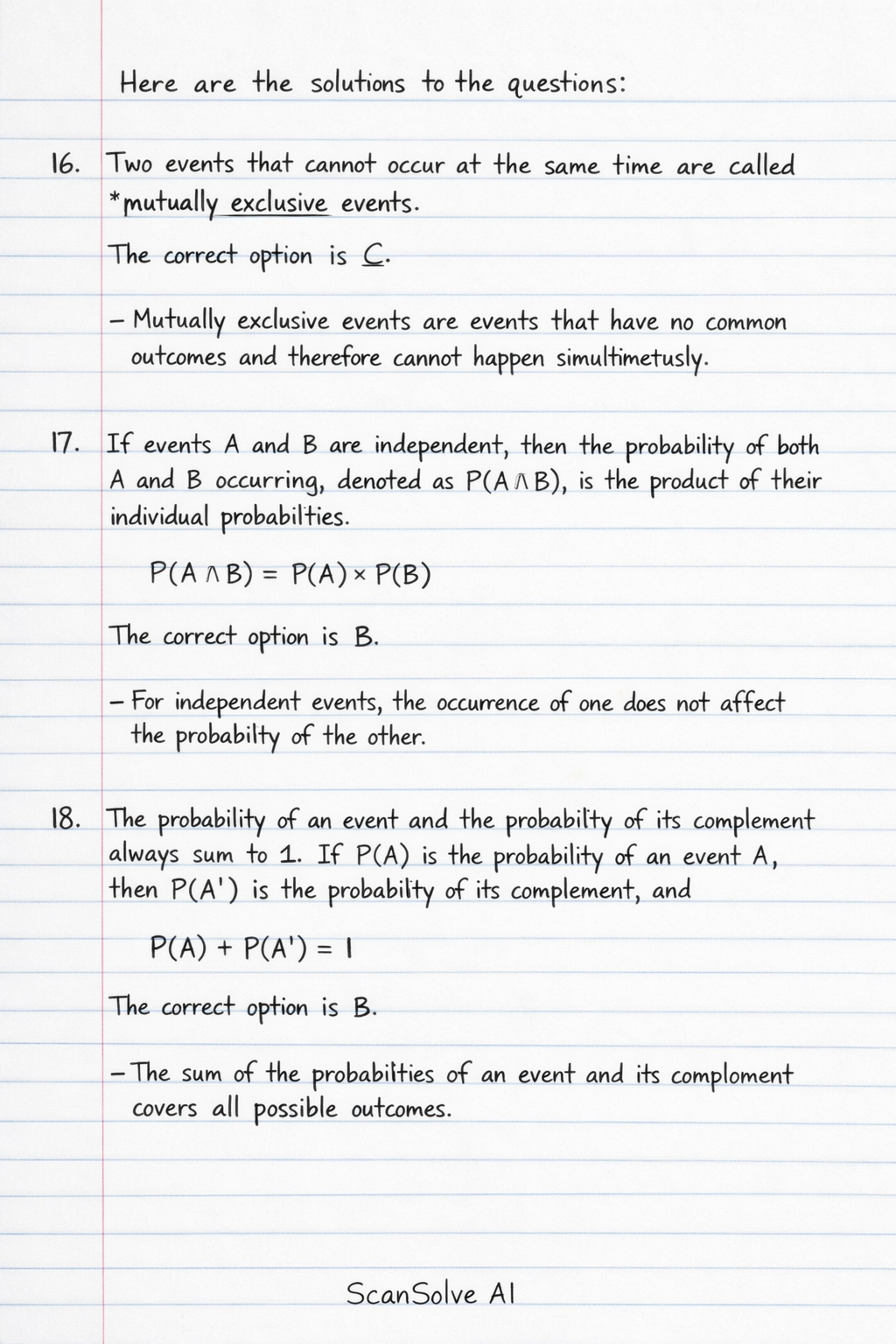
Handwritten Step-by-Step Solution
Get this as a handwritten image on WhatsApp — like a tutor wrote it for you.
Try on WhatsApp