
Oxidation in terms of the addition of oxygen or removal of hydrogen Reduction as removal of oxygen or addition of hydrogen. Oxidation and reduction in terms of electron transfer . Use of oxidation numbers Oxidation and reduction treated as change in oxidation numbers and use of oxidation numbers in balancing simple equations. Iupac nomenclature of in organic compounds using oxidation member Tests for oxidizing and reducing agents.
ScanSolve AI Answer
-
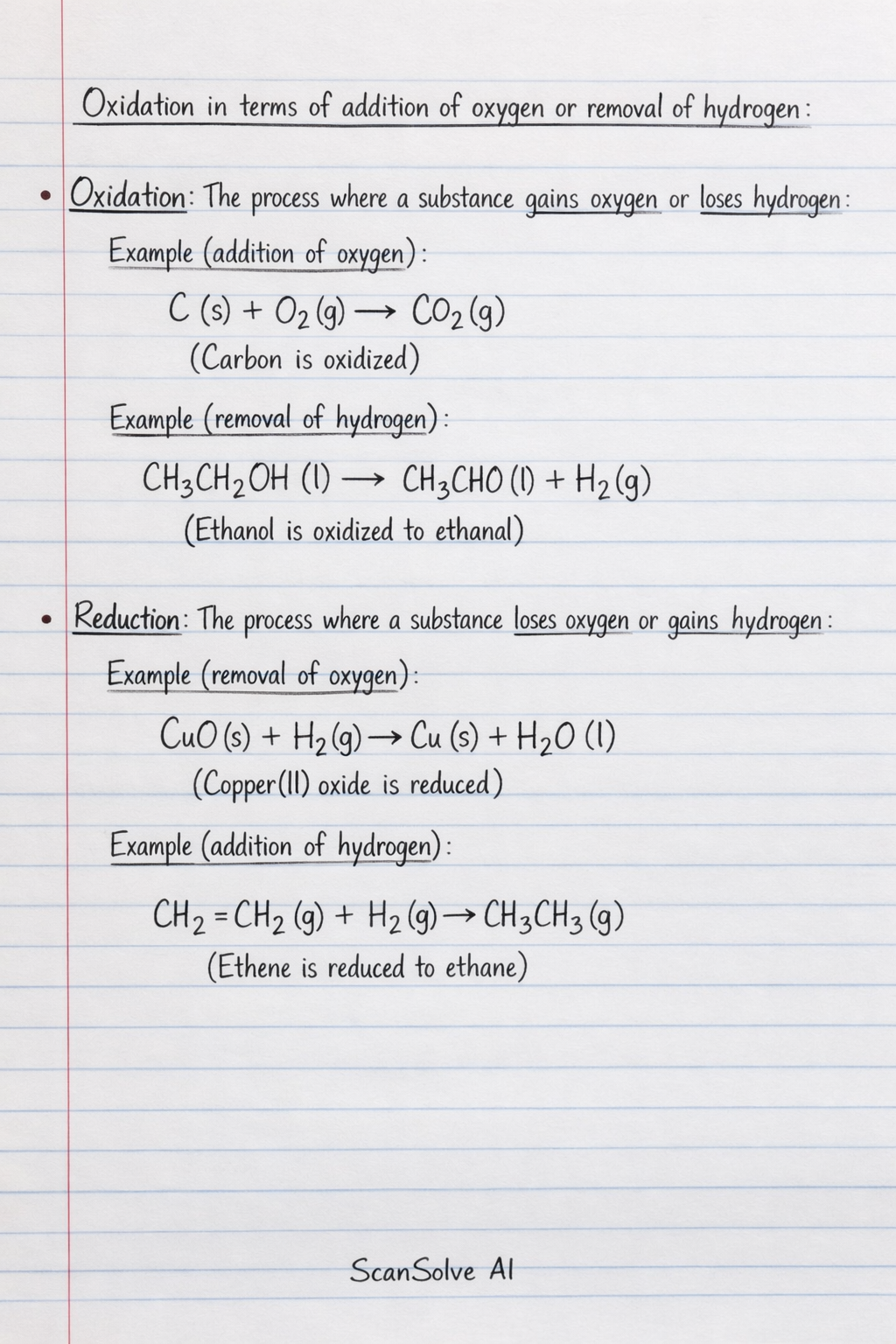
Oxidation in terms of addition of oxygen or removal of hydrogen:
- Oxidation: The process where a substance gains oxygen or loses hydrogen.
- Example (addition of oxygen): (Carbon is oxidized)
- Example (removal of hydrogen): (Ethanol is oxidized to ethanal)
- Reduction: The process where a substance loses oxygen or gains hydrogen.
- Example (removal of oxygen): (Copper(II) oxide is reduced)
- Example (addition of hydrogen): (Ethene is reduced to ethane)
- Oxidation: The process where a substance gains oxygen or loses hydrogen.
-
Oxidation and reduction in terms of electron transfer:
- Oxidation: The process of losing electrons.
- Reduction: The process of gaining electrons.
- Mnemonic: OIL RIG (Oxidation Is Loss, Reduction Is Gain of electrons).
-
Use of Oxidation Numbers:
- An oxidation number (or oxidation state) is a hypothetical charge an atom would have if all bonds were purely ionic. It helps track electron transfer in redox reactions.
- Rules for assigning oxidation numbers:
- An atom in its elemental form has an oxidation number of 0 (e.g., , , ).
- For a monatomic ion, the oxidation number is equal to its charge (e.g., is , is ).
- Oxygen usually has an oxidation number of in compounds, except in peroxides (e.g., ) where it is , and with fluorine (e.g., ) where it is .
- Hydrogen usually has an oxidation number of in compounds, except in metal hydrides (e.g., ) where it is .
- Group 1 metals are always , Group 2 metals are always .
- Fluorine is always . Other halogens are usually , except when bonded to oxygen or a more electronegative halogen.
- The sum of oxidation numbers in a neutral compound is 0.
- The sum of oxidation numbers in a polyatomic ion equals the charge of the ion.
-
Oxidation and reduction treated as change in oxidation numbers:
- Oxidation: An increase in oxidation number.
- Reduction: A decrease in oxidation number.
-
Use of oxidation numbers in balancing simple equations:
- Step 1: Assign oxidation numbers to all atoms in the unbalanced equation.
- Step 2: Identify atoms that undergo a change in oxidation number.
- Step 3: Determine the total change in oxidation number for the oxidized and reduced species.
- Step 4: Balance the changes in oxidation numbers by using coefficients in front of the species.
- Step 5: Balance the remaining atoms (usually oxygen and hydrogen) by inspection, adding and (for acidic solutions) or (for basic solutions).
Example (Acidic solution): Balance
- Assign oxidation numbers: in is . is . is . is . is .
- Changes: : (decrease of 5, reduction) : (increase of 1, oxidation)
- Balance changes: To balance the 5 decrease in with the 1 increase in , we need 5 ions.
- Balance oxygen (with ) and hydrogen (with ): There are 4 oxygen atoms on the left in . Add to the right. Now there are 8 hydrogen atoms on the right in . Add to the left. (Check charges: Left: . Right: . Charges are balanced.)
-
IUPAC nomenclature of inorganic compounds using oxidation number:
- For compounds containing metals that can have multiple oxidation states (e.g., transition metals), the oxidation number is indicated by a Roman numeral in parentheses immediately following the metal's name.
- Example:
- : Iron(II) chloride (Iron has an oxidation state of )
- : Iron(III) chloride (Iron has an oxidation state of )
- : Copper(II) oxide (Copper has an oxidation state of )
- : Copper(I) oxide (Copper has an oxidation state of )
-
Tests for oxidizing and reducing agents:
-
An oxidizing agent (or oxidant) causes another substance to be oxidized while itself being reduced.
-
A reducing agent (or reductant) causes another substance to be reduced while itself being oxidized.
-
Tests for Oxidizing Agents: Oxidizing agents typically oxidize indicator substances, causing a visible color change.
- Potassium iodide (): Oxidizing agents will oxidize ions to (iodine), which is brown in solution or turns starch indicator blue-black.
- Example: (purple) + (colorless) (colorless) + (brown)
- Acidified potassium manganate(VII) (): Strong oxidizing agents will remain purple or change color less readily than when reacting with a reducing agent. (This is more commonly used to test for reducing agents, as it is itself a strong oxidizing agent).
- Acidified potassium dichromate(VI) (): Strong oxidizing agents will remain orange or change color less readily.
- Potassium iodide (): Oxidizing agents will oxidize ions to (iodine), which is brown in solution or turns starch indicator blue-black.
-
Tests for Reducing Agents: Reducing agents typically reduce indicator substances, causing a visible color change.
- Acidified potassium manganate(VII) (): Reducing agents will reduce the purple ion to the colorless ion. The purple solution will decolorize.
- Example: (pale green) + (purple) (yellow-brown) + (colorless)
- Acidified potassium dichromate(VI) (): Reducing agents will reduce the orange ion to the green ion. The orange solution will turn green.
- Example: (gas) + (orange) + (green)
- Fehling's solution or Benedict's solution: Used to test for reducing sugars (which are reducing agents). A blue solution turns brick-red upon heating in the presence of a reducing agent.
- Acidified potassium manganate(VII) (): Reducing agents will reduce the purple ion to the colorless ion. The purple solution will decolorize.
-
Still stuck on this one?
Ask a follow-up, and the answer starts from this question.
More Physics Questions
Handwritten Step-by-Step Solution
Get this as a handwritten image on WhatsApp — like a tutor wrote it for you.
Try on WhatsApp