
We read your photo as:
Part b) Name three examples of simple harmonic motion. State Hooke's Law and calculate the length of the spring when the applied force is 14 N. The natural length of the spring is 3.4 m and when a for
ScanSolve AI Answer
Answer
Step-by-step solution
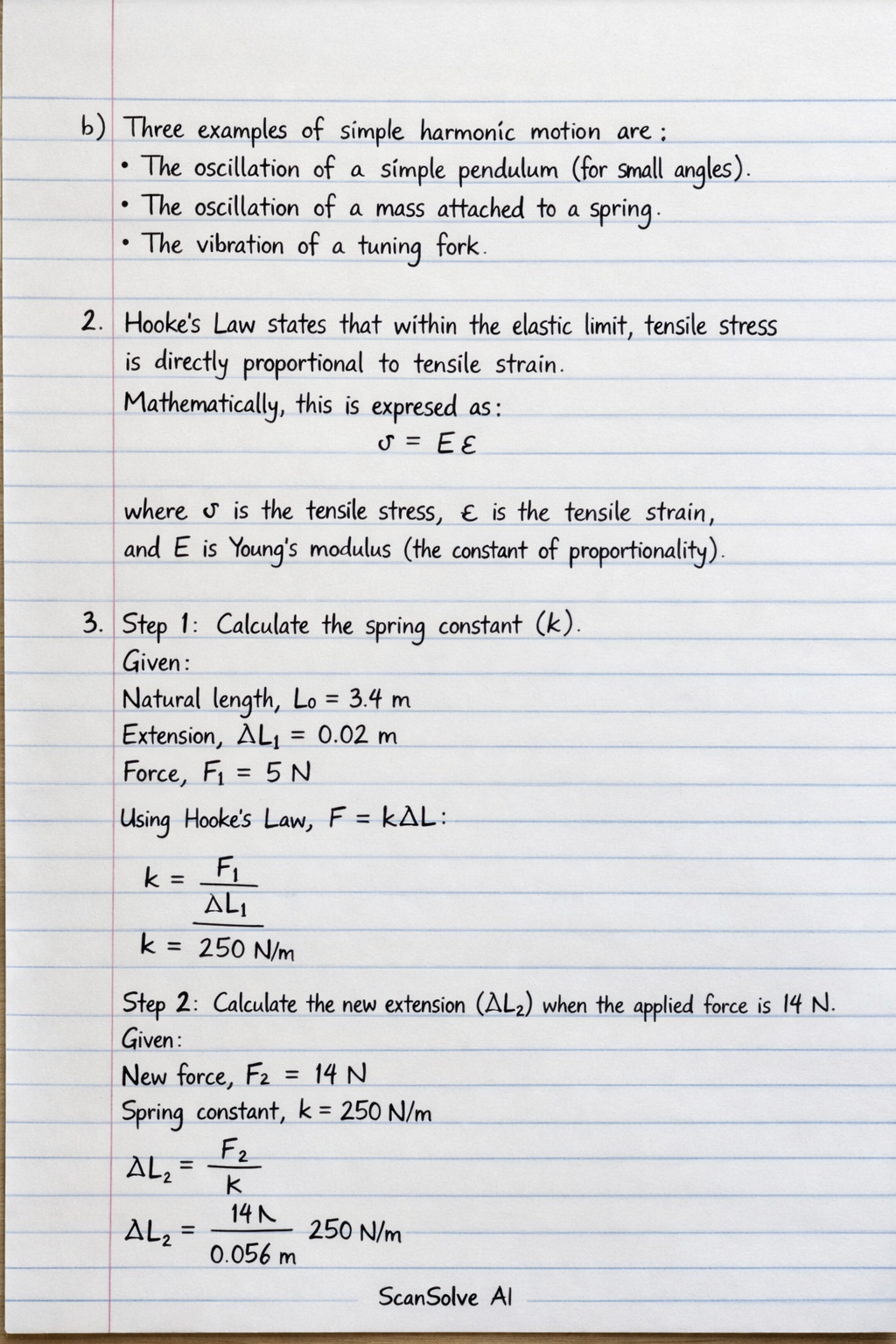
5 stepsb) Three examples of simple harmonic motion are:
- The oscillation of a simple pendulum (for small angles).
- The oscillation of a mass attached to a spring.
- The vibration of a tuning fork.
- Hooke's Law states that within the elastic limit, tensile stress is directly proportional to tensile strain. Mathematically, this is expressed as:
where is the tensile stress, is the tensile strain, and is Young's modulus (the constant of proportionality).
- Step 1: Calculate the spring constant (). Given: Natural length, Extension, Force,
Using Hooke's Law, :
Calculate the new extension () when the applied force is .
Given:
New force,
Spring constant,Using Hooke's Law:
Calculate the new total length ().
The length of the spring when the applied force is will be .
- Step 1: Identify the given values. Tensile stress, Length increases by 7% of its original length. This means the tensile strain () is 7%.
Convert the percentage increase in length to tensile strain.
Tensile strain,
If the length increases by 7%, then .
So, .Calculate Young's modulus ().
Young's modulus is defined as the ratio of tensile stress to tensile strain:
Round the result to an appropriate number of significant figures.
The Young's modulus of the wire is .
Try one yourself
A new problem that tests the same skill.
Still stuck on this one?
Ask a follow-up, and the answer starts from this question.
More Physics Questions
Handwritten Step-by-Step Solution
Get this as a handwritten image on WhatsApp — like a tutor wrote it for you.
Try on WhatsApp