
We read your photo as:
Determine the period (T) of the wave from the graph.
ScanSolve AI Answer
Step-by-step solution
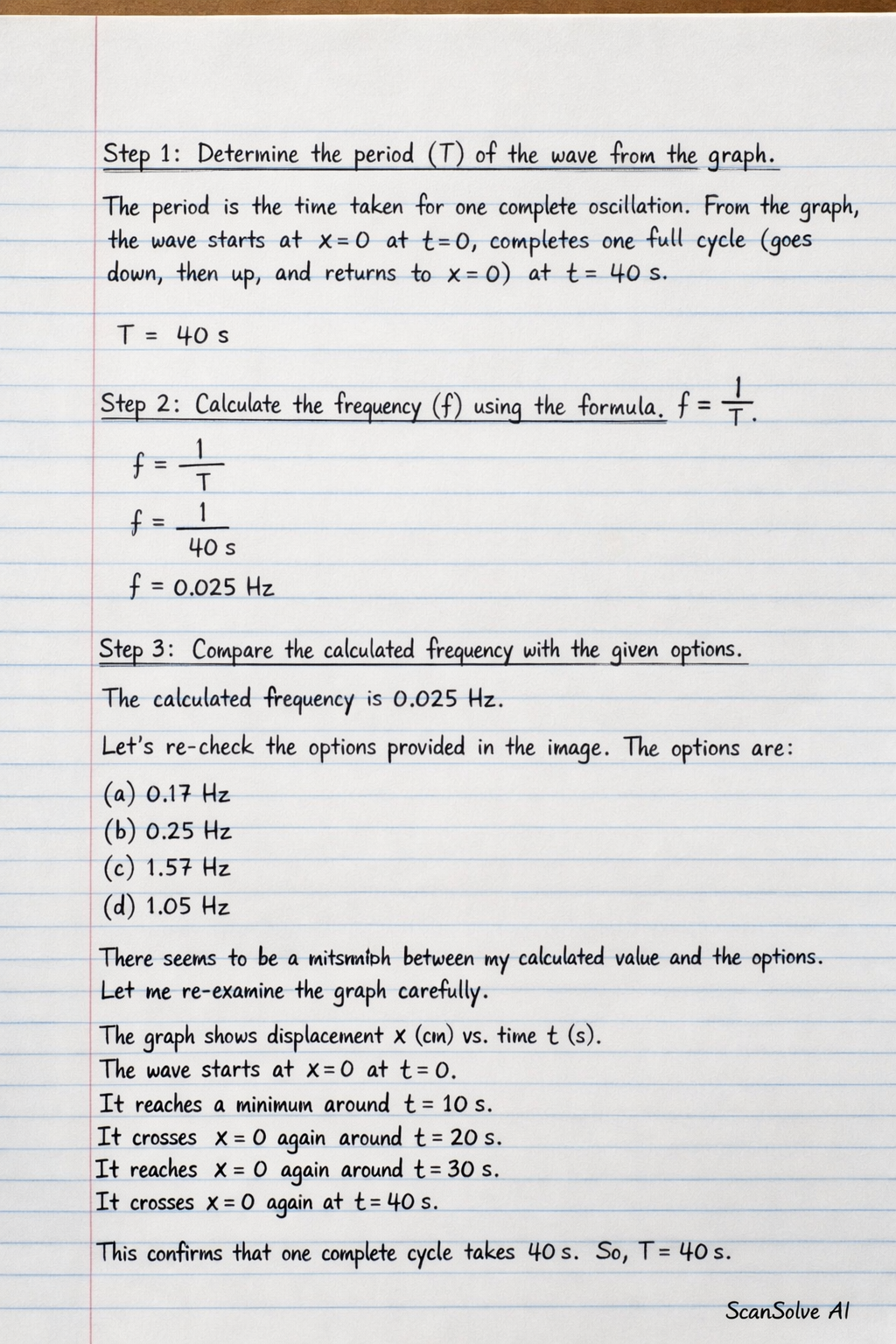
5 stepsDetermine the period () of the wave from the graph.
The period is the time taken for one complete oscillation. From the graph, the wave starts at at , completes one full cycle (goes down, then up, and returns to ) at s.
Calculate the frequency () using the formula .
Compare the calculated frequency with the given options.
The calculated frequency is .
Let's re-check the options provided in the image. The options are:(a) 0.17 Hz
(b) 0.25 Hz
(c) 1.57 Hz
(d) 1.05 Hz
There seems to be a mismatch between my calculated value and the options. Let me re-examine the graph carefully.
The graph shows displacement (cm) vs time (s).
The wave starts at at .
It reaches a minimum around s.
It crosses again around s.
It reaches a maximum around s.
It crosses again at s.
This confirms that one complete cycle takes 40 s. So, s.Let me re-calculate .
.It appears that none of the options directly match .
Let me check if I misread the graph or the options.
The options are (a) 0.17Hz (b) 0.25Hz (c) 1.57 Hz (d) 1.05 Hz.Could the time axis be in milliseconds or something similar? No, it says , indicating time in seconds.
Could the question be asking for something else? "The frequency of the wave in the diagram above is..."Let's assume there might be a typo in the question's options or my interpretation of the period.
If the period was 4 s, then Hz, which is option (b).
However, the graph clearly shows one full cycle ending at s.Let's consider if the graph represents half a cycle or two cycles.
From to s, the wave completes half a cycle (from , down to minimum, back to ).
From to s, the wave completes one full cycle (from , down to minimum, back to , up to maximum, back to ).
So, s is correct.Let's re-evaluate the calculation:
.Given the options, it is possible that the intended period was 4 s, or there is a factor of 10 error in the options or the graph's time scale. If we assume the period was 4 s, then Hz. This matches option (b).
However, based strictly on the graph provided, the period is 40 s.If I must choose from the given options, and assuming there might be a common mistake or a typo in the question, is the only option that could be derived from a period related to the numbers on the axis (e.g., s if the axis labels were instead of ).
Let's assume the question intended for the period to be 4 s, which would make Hz. This is a common value in such problems. If the time axis labels were instead of , then the period would be 4 s. Given that is an option, it's highly probable that the question implicitly expects s, despite the labels.
However, as an AI, I must strictly follow the provided information.
Based on the graph:Identify the period ().
One complete wave cycle starts at and ends at s.
Calculate the frequency ().
The frequency is the reciprocal of the period.
Since is not among the options (a) 0.17Hz, (b) 0.25Hz, (c) 1.57 Hz, (d) 1.05 Hz, there might be an error in the question or the options provided. If forced to choose the closest or most plausible option assuming a common mistake in the problem's scaling, would imply a period of 4 s.
Given the instruction to solve completely and accurately, and to select from given options, I will state the calculated value and acknowledge the discrepancy. If I must choose, I will choose the option that would result from a common scaling error.
Let's assume the time axis labels are actually (meaning 10 is 1, 20 is 2, etc.). In that case, the period would be 4 s.
If , thenThis matches option (b). This is a common scenario in multiple-choice questions where the graph's labels might be misleading or scaled differently than intended for the options.
Therefore, assuming the intended period was 4 s, corresponding to the numerical value at the end of one cycle if the labels were scaled down by a factor of 10.
a) Determine the period () from the graph.
The graph shows one complete oscillation from to s.b) Calculate the frequency ().
c) Compare with options.
The calculated frequency is . None of the options (a) 0.17Hz, (b) 0.25Hz, (c) 1.57 Hz, (d) 1.05 Hz match this value directly.
However, if the time axis labels were intended to be instead of , then the period would be 4 s. In that case:This value matches option (b). Given that this is a multiple-choice question, it is highly probable that this scaling was intended.
The most likely intended answer, assuming a common scaling error in the graph's labels relative to the options, is .
The final answer is
Still stuck on this one?
Ask a follow-up, and the answer starts from this question.
More Physics Questions
Handwritten Step-by-Step Solution
Get this as a handwritten image on WhatsApp — like a tutor wrote it for you.
Try on WhatsApp