
We read your photo as:
Explain the physics concepts behind moving a stone, including force, friction, and energy.
ScanSolve AI Answer
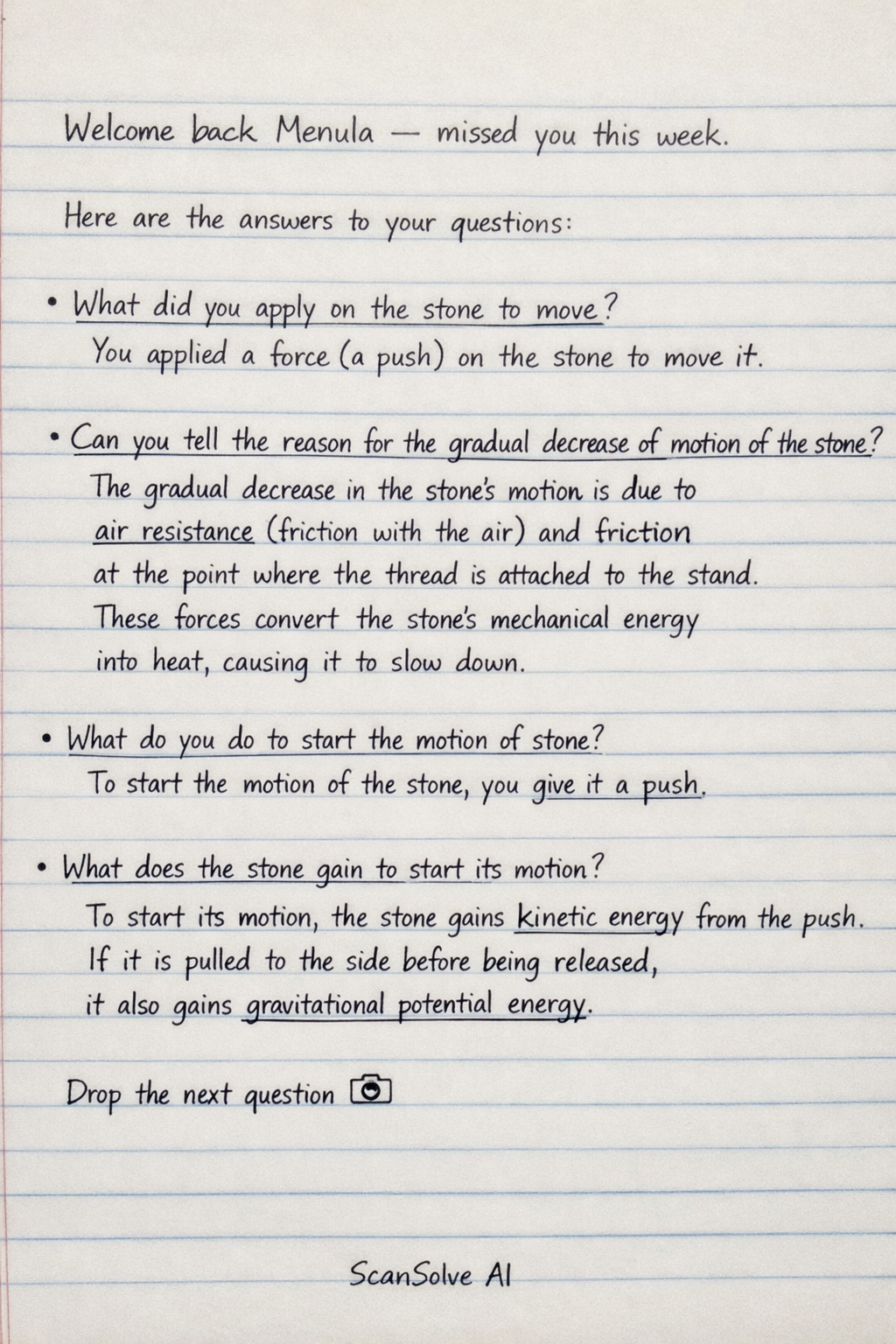
Here are the answers to your questions:
-
What did you apply on the stone to move? You applied a force (a push) on the stone to move it.
-
Can you tell the reason for the gradual decrease of motion of the stone? The gradual decrease in the stone's motion is due to air resistance (friction with the air) and friction at the point where the thread is attached to the stand. These forces convert the stone's mechanical energy into heat, causing it to slow down.
-
What do you do to start the motion of stone? To start the motion of the stone, you give it a push.
-
What does the stone gain to start its motion? To start its motion, the stone gains kinetic energy from the push. If it is pulled to the side before being released, it also gains gravitational potential energy.
Still stuck on this one?
Ask a follow-up, and the answer starts from this question.
More Physics Questions
Handwritten Step-by-Step Solution
Get this as a handwritten image on WhatsApp — like a tutor wrote it for you.
Try on WhatsApp