
We read your photo as:
What is the magnitude and direction of the frictional force when the stone is moving forward in both (1) and (2) above? Give a reason for your answer.
ScanSolve AI Answer
Step-by-step solution
5 stepsHere are the solutions to questions 5.5 and 5.8:
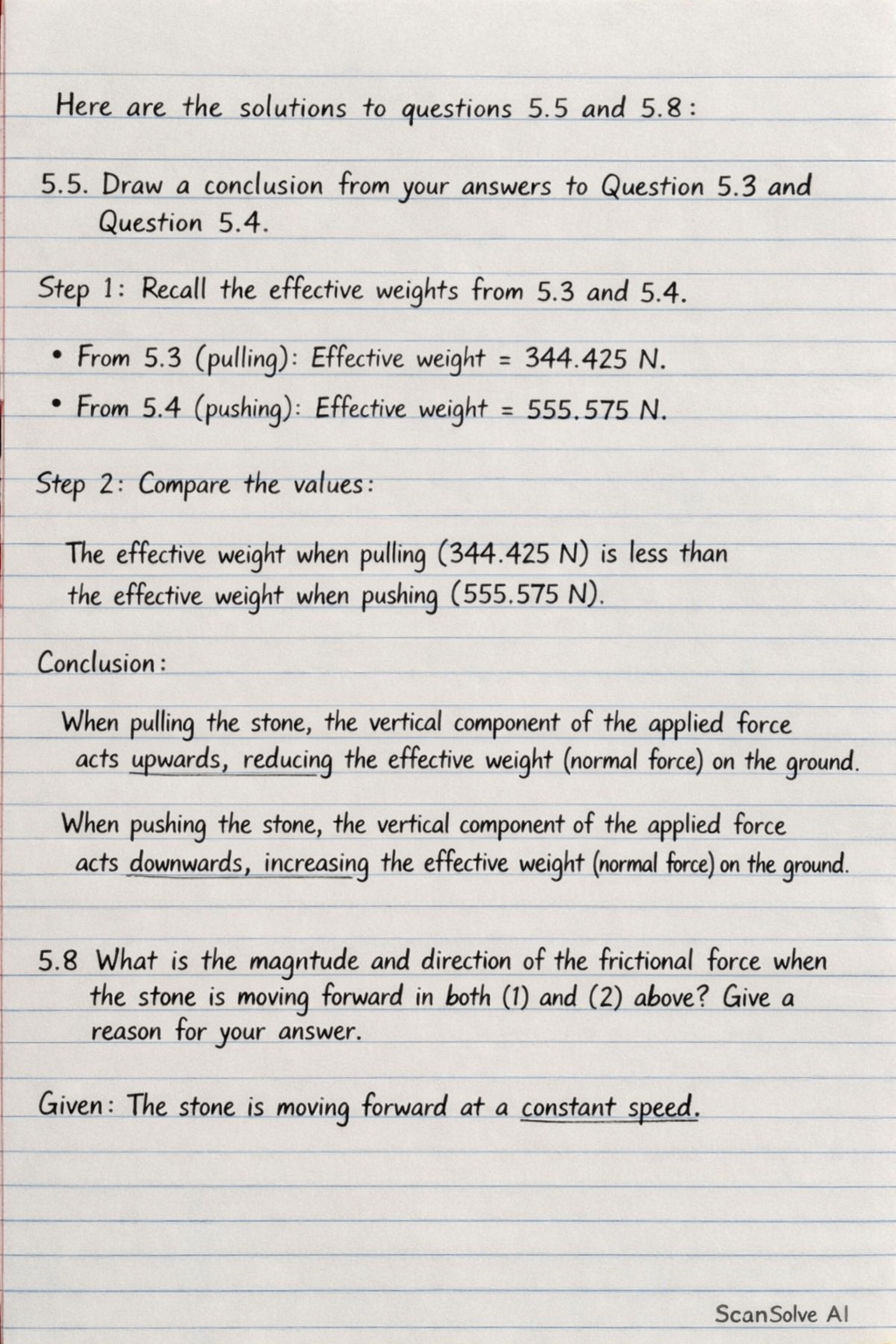
Part 5.5· 2 steps
Draw a conclusion from your answers to Question 5.3 and Question 5.4.
Recall the effective weights from 5.3 and 5.4.
- From 5.3 (pulling): Effective weight = 344.425 N.
- From 5.4 (pushing): Effective weight = 555.575 N.
Compare the values.
The effective weight when pulling (344.425 N) is less than the effective weight when pushing (555.575 N).
Conclusion:
When pulling the stone, the vertical component of the applied force acts upwards, reducing the effective weight (normal force) on the ground. When pushing the stone, the vertical component of the applied force acts downwards, increasing the effective weight (normal force) on the ground.
Part 5.8· 3 steps
What is the magnitude and direction of the frictional force when the stone is moving forward in both (1) and (2) above? Give a reason for your answer.
Given: The stone is moving forward at a constant speed.
Determine the magnitude of the horizontal applied force.
From questions 5.6 and 5.7, the horizontal component of the applied force () is the same for both pulling and pushing:
Determine the magnitude of the frictional force.
Since the stone is moving at a constant speed, the net force acting on it is zero (Newton's First Law). This means the horizontal applied force is balanced by the frictional force.
Therefore, the magnitude of the frictional force () is equal to the horizontal component of the applied force.Determine the direction of the frictional force.
Frictional force always opposes the direction of motion. Since the stone is moving forward, the frictional force acts backward.
Magnitude:
Direction:Reason:
The stone is moving at a constant speed, which means its acceleration is zero. According to Newton's First Law, the net force acting on the stone must be zero. Therefore, the frictional force must be equal in magnitude and opposite in direction to the horizontal component of the applied force.
Still stuck on this one?
Ask a follow-up, and the answer starts from this question.
More Physics Questions
Handwritten Step-by-Step Solution
Get this as a handwritten image on WhatsApp — like a tutor wrote it for you.
Try on WhatsApp