
We read your photo as:
Plot a graph of V on the vertical axis and I on the horizontal axis, starting both axes from the origin (0,0). Determine the slope S of the graph. Determine the intercept C on the vertical axis. Evaluate K = E/C.
ScanSolve AI Answer
Answers
2 partsStep-by-step solution
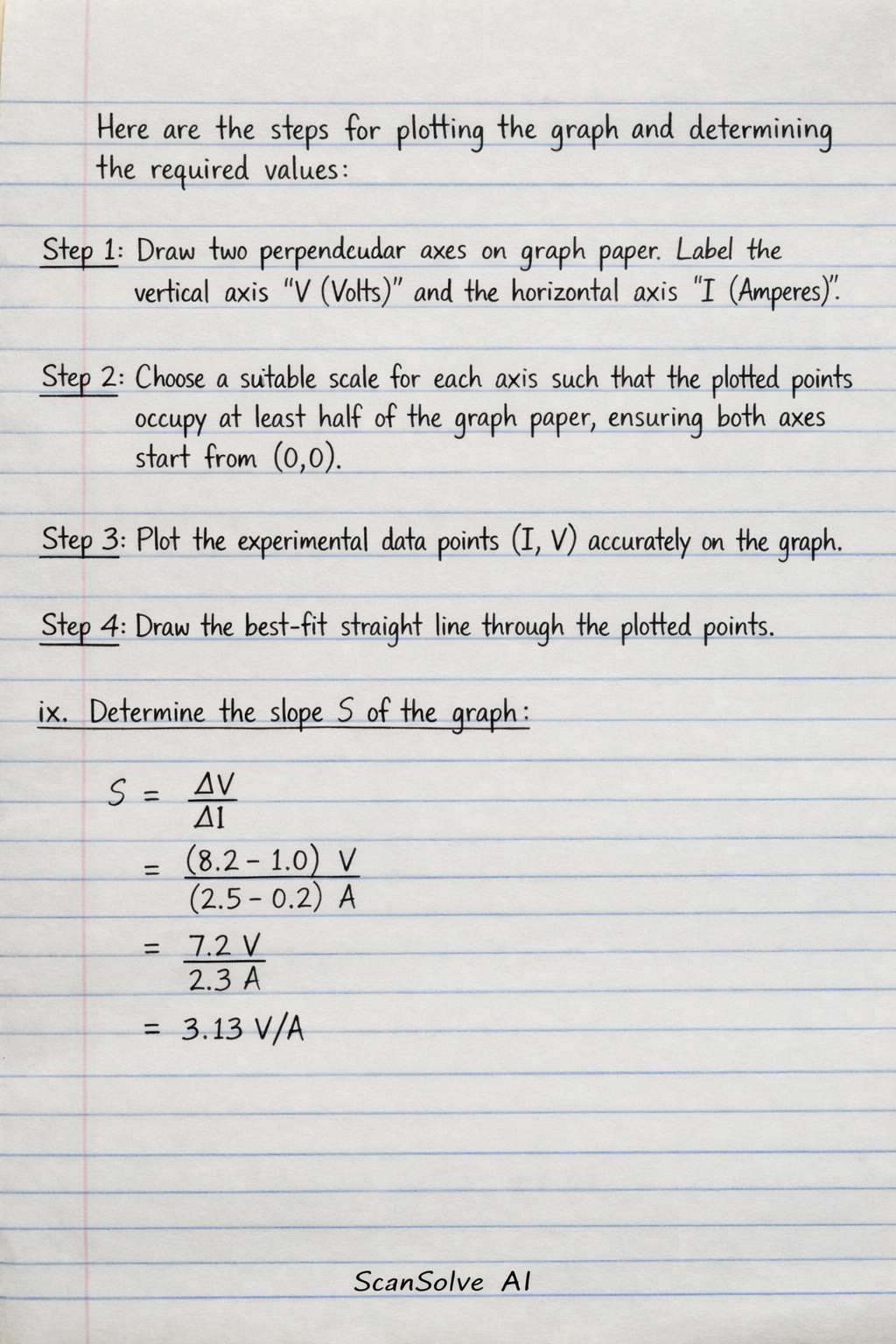
11 stepsHere are the steps for plotting the graph and determining the required values:
Part viii· 4 steps
Plot a graph of V on the vertical axis and I on the horizontal axis, starting both axes from the origin (0,0).
Draw two perpendicular axes on graph paper.
Label the vertical axis "V (Volts)" and the horizontal axis "I (Amperes)".
Choose a suitable scale for each axis such that the plotted points occupy at least half of the graph paper, ensuring both axes start from the origin (0,0).
Plot the experimental data points $(I, V)$ accurately on the graph.
Draw the best-fit straight line through the plotted points.
Part ix
Determine the slope S of the graph.
Select two points and that lie on the best-fit line and are as far apart as possible.
Calculate the slope S using the formula
Substitute the coordinates of the chosen points and calculate the value of S.
For example, if and :
The slope S is
Part x
Determine the intercept C on the vertical axis.
Extend the best-fit line until it intersects the vertical (V) axis.
Read the value of V at the point where the line crosses the vertical axis.
This value is the intercept C.
For example, if the line crosses the V-axis at :
The intercept C isxi. Evaluate .
Obtain the value of E (this value is not provided in the question and is assumed to be from a previous part of the experiment).
Substitute the value of E and the determined value of C into the formula for K.
For example, if and :
The value of K is
Try one yourself
A new problem that tests the same skill.
Still stuck on this one?
Ask a follow-up, and the answer starts from this question.
More Physics Questions
Handwritten Step-by-Step Solution
Get this as a handwritten image on WhatsApp — like a tutor wrote it for you.
Try on WhatsApp